
Plan on 8 hours of structured study per day during COMLEX dedicated, plus an optional 1 to 2 hours of content review in the evening. Run those 8 hours as eight 1-hour blocks with 5-minute breaks and a 30-minute lunch, because that is exactly what test day looks like now. The split is 2 hours of timed questions, 4 hours of question review, and 2 hours of Anki. Stop at a fixed time, keep at least 1 to 2 hours for yourself, and take one full day off every week.
The number most students want to hear is bigger than 8. They want permission to do 12, because 12 feels like insurance. It isn't. Almost every student I meet who is failing practice tests is already putting in 12 to 14 hours a day. Out of the thousands of med students I've worked with or met, I can think of exactly one whose problem was genuinely not enough effort. The rest were burning hours on a schedule that had no shape. The point of this article is to give the day a shape, including the part where it ends.
How many hours a day should I study for COMLEX?
Eight hours of structured work is the target, and it's also close to the ceiling for work that actually raises scores. Those 8 hours are not a suggestion pulled from the air. They match the current COMLEX Level 1 format, which the NBOME revised effective May 7, 2026: eight 1-hour sections of 40 questions each, with scheduled breaks between every section and 60 minutes of total break time across the day. Your study day mirrors that structure so timing and stamina are already in your body when you sit for the real thing.
An optional content-review window of 1 to 2 hours can follow the 8 structured hours. That window is for video on whichever section felt shakiest in the morning, at the end of the day when you're fried and need something lower-effort. It is a bonus. The 8 hours are the plan.
Two blocks of questions per day is the floor for most people, and it's usually the practical maximum as well. Under the current format, that's 80 timed questions. Every question is done timed, no tutor mode. Test day is not in tutor mode, so a study day in tutor mode is rehearsing for an exam that doesn't exist. I've watched too many students run out of time on the real exam because they did every practice block untimed.
What should the 8 hours actually contain?
The 8 hours break into 2 hours of timed questions, 4 hours of question review, and 2 hours of Anki. Review gets the biggest share because a 40-question block takes most students about 2 hours to review thoroughly, and you're reviewing two blocks per day. The question block only diagnoses what you don't know. The review is where the learning happens.
Here is how the day lays out, starting at 8 AM because that's when most students' exams start. Be strict with the start time and the stop time, the same way the exam clock is strict with you.
| Block | Time | Work |
|---|---|---|
| 1 | 8:00 to 9:00 AM | Timed question block 1, 40 questions, focused on a weak topic |
| Break | 9:00 to 9:05 AM | 5 minutes |
| 2 | 9:05 to 10:05 AM | Timed question block 2, back to back with block 1 |
| Break | 10:05 to 10:10 AM | 5 minutes |
| 3 | 10:10 to 11:10 AM | Review block 1, part 1 |
| Break | 11:10 to 11:15 AM | 5 minutes |
| 4 | 11:15 AM to 12:15 PM | Review block 1, part 2 |
| Lunch | 12:15 to 12:45 PM | 30 minutes, mirrors the test-day lunch between sections 4 and 5 |
| 5 | 12:45 to 1:45 PM | Review block 2, part 1 |
| Break | 1:45 to 1:50 PM | 5 minutes |
| 6 | 1:50 to 2:50 PM | Review block 2, part 2 |
| Break | 2:50 to 2:55 PM | 5 minutes |
| 7 | 2:55 to 3:55 PM | Anki, new and learning cards first, then reviews |
| Break | 3:55 to 4:00 PM | 5 minutes |
| 8 | 4:00 to 5:00 PM | Anki, reviews until new, learning, and review cards all hit zero |
| Optional | 5:00 to 6 or 7 PM | Content-review video on the shakiest section, up to 10 unsuspended cards per video |
The two question blocks run back to back on purpose. The opening stretch of test day is brutal, and you want that rhythm to feel familiar rather than new. Focused blocks come first (4 to 6 per weak discipline, 3 to 6 per weak system), then mixed blocks once the focused blocks run out. If you want the full logic behind the block-by-block plan, including how to pick the focus, read how to make a COMLEX study plan that works.
The review hours have their own rules. If you were right for the right reason, move on. If you guessed or missed, lock onto the correct answer and the choice you picked, and let the other three distractors go. Fewer than 3 Anki cards per missed or guessed question, and ideally zero new cards for the ones you got right. Students who write 8 cards per question are the students who can't reach zero by 5 PM. The detailed method is in how to review practice questions efficiently.
Why is 8 hours the right number and not 12?
Because anything beyond the test-day structure doesn't help your timing or your stamina, and it actively costs you the next day. Test day is 8 hours of testing plus 60 minutes of breaks. A study day that mirrors it builds exactly the endurance you'll need. A 12-hour study day builds endurance for a 12-hour exam that you will never sit.
The other half of the answer is burnout, and burnout during dedicated is a different animal than burnout during a busy rotation. You've been accumulating it through all of medical school. Dedicated accelerates it, because you're locked in a room for weeks with no class breaks, no friends, and nothing fun. Burnout doesn't reduce how many hours you can sit at a desk. It reduces what your brain does with those hours. Hour 10 of a 12-hour day is not a real study hour. It's a tired person rereading a stem three times and retaining none of it, then waking up tomorrow too fried to get value out of the 8 AM question block that actually matters.
I say this as someone who did it wrong. Through preclinical I studied 16-hour days, cut out the gym and my friends, and lost 20 pounds because I'd convinced myself I didn't have time to cook. The 99th percentile score on Level 1 still came, and by then the burnout was entrenched enough that I never fully recovered from it. The score didn't fix the burnout. I wrote the longer version of that story in how to manage burnout during board prep. The short version is that 8 focused hours and a real stopping point would have gotten me the same score without the damage.
Here's the reframe that most school administrators get wrong. When a student's practice scores are flat, the default advice is "work harder, add more questions, add more lectures." That advice assumes the student is going home to play video games. They aren't. Med students work from the moment they wake up until they go to sleep, and with class on top, it's two full-time jobs. Without a strategy, you can put in 16 hours a day and still get poor results. More hours on a shapeless day is not a plan. It's a slower way to fail.
How should I structure breaks during a study day?
Take 5 minutes between every 1-hour block and 30 minutes for lunch, for 60 minutes of total break time across the 8 hours. That is the recommended distribution on the real exam, and rehearsing it during dedicated means your body already knows the cadence on test day. On days when you're not deliberately simulating, 10 to 15 minutes between blocks is fine, and a longer lunch is fine too.
Use the breaks the way you'll use them at Prometric. Stand up. Walk. Eat something. Do not spend the 5 minutes scrolling through the questions you just answered. On the real exam, looking things up on breaks might help you get one more question right in a later section, or it might spike your anxiety for the rest of the day. I personally chose not to touch my phone on breaks, partly to protect my fragile ego. Practice whichever version you're going to run on test day.
The breaks are also where burnout management lives at the smallest scale. Scheduled time off is the best burnout tool I've found, because when the break is planned you don't feel guilty taking it. Twelve hours straight with no breaks is the fastest way to hate your life by week 3. Two hours on, a short break, repeat until you're done for the day.
When should I stop studying each day?
Stop structured work at a fixed time, ideally 5 PM if you started at 8 AM, and stop the optional content review no later than 6 or 7 PM. After that, at least 1 to 2 hours belong to you, every day of the week. Go to the gym, walk, cook, watch Netflix, doom-scroll TikTok. Active recovery is better than passive recovery, but an hour of scrolling is still better than an hour of studying you don't have the brain left for.
The stopping point is not a reward for a good day. It's what makes tomorrow's day possible. The hours that actually move your score are the two timed question blocks at 8 AM and the review that follows, and those hours only work if you show up rested. Every hour you steal from the evening comes out of tomorrow morning's question blocks with interest.
There is one hard end condition inside the 8 hours: Anki must hit zero on new, learning, and review cards at least once every day, and Block 8 is where that happens. If you consistently can't reach zero by 5 PM, the fix is not to study later. The fix is upstream, in how many cards you're unsuspending during review. Set the Anki order to show new cards after reviews, so that if you do run short on time you're protecting the facts you already learned instead of adding one more you'll forget. The full setup is in how to use Anki effectively for COMLEX.
The same protection applies at the end of the week. One full day off every week, with Anki reviews still done so the deck doesn't balloon, but no questions and no new content. That is the floor, not a suggestion. Students who skip the day off rarely raise their scores and frequently lower them by week 6. Weekly therapy during dedicated is on the same list. One hour a week talking to an unbiased third party won't hurt your score, and it gives you actual tools for the anxiety and burnout that accumulate anyway. If you run a SIG E CAPS screen on yourself and come up positive, see a psychiatric prescriber. Too many bright minds are lost to depression in med school.
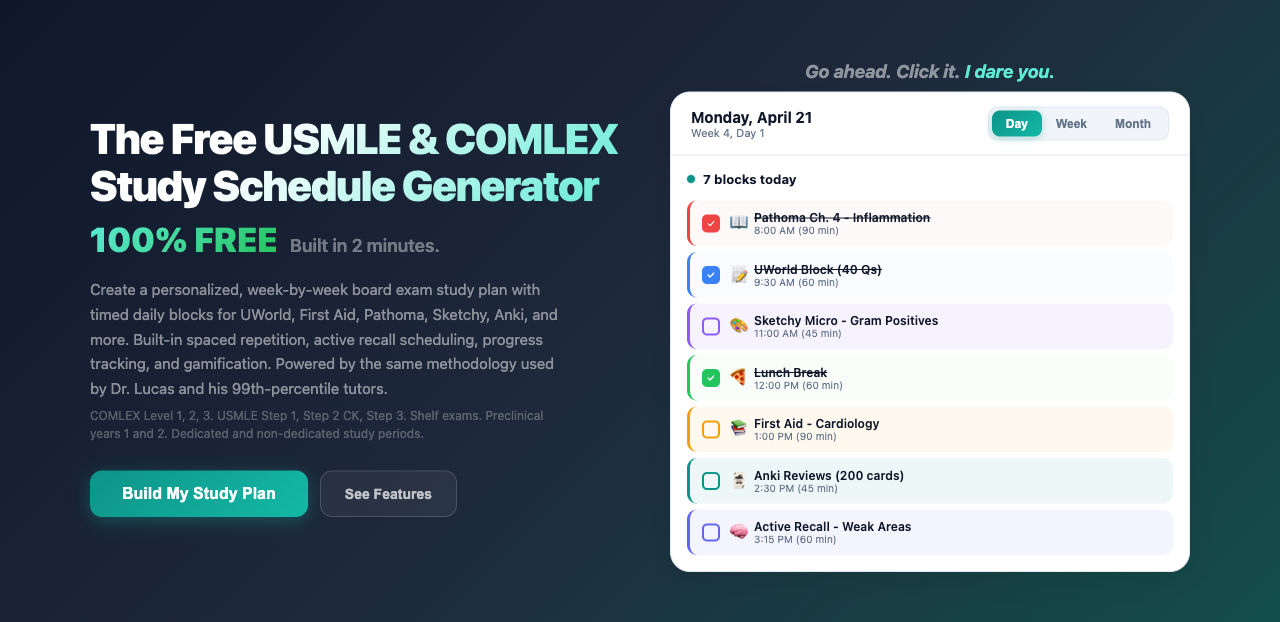
Students who want this whole day mapped onto their real calendar can use the free Study Plan Builder. It builds the block-by-block schedule around your test date, baseline, and weak areas in a few minutes.
Should some days have fewer hours than others?
Yes. Three kinds of days break the 8-hour pattern on purpose: the weekly day off, practice test days, and the day before the exam.
The day off is Anki reviews only. Make plans, do something fun, and spend the vast majority of the day doing whatever you actually want to do. The compounding cost of skipping Anki reviews is the only reason Anki survives the day off.
Practice test days are their own kind of work. Aim for one full-length practice test every 1 to 2 weeks, with two tests in the final 2 weeks before test day. A COMSAE is an 8-hour effort by itself, so it replaces the question blocks that day. The test is where your stamina gets measured. If your endurance is genuinely a problem, one or two full 8-hour simulations close to test day fix it faster than adding hours to regular study days. Most people don't need that. The 1-hour block schedule plus regular practice tests is enough.
The day before the exam is sacred. Would you run a marathon the day before a marathon? Take the whole day off. At most, do your Anki reviews in the morning. No new questions, because a bad block the day before can psych you out. Make plans to stay busy, skip the caffeine after noon, avoid a workout within two hours of bed, and go to bed early. One extra day of studying will not change your outcome. One restful day might. The full checklist is in what to do the day before COMLEX.
What if I can't study 8 hours a day?
Then protect the parts of the day that carry the score and cut from the optional end first. Two timed blocks and a real review of at least one of them beat 8 hours of half-attention every time. If you're still in classes or on a rotation, the schedule bends around the school day, and I wrote a separate guide on how to study for boards while still in classes.
Whether 8 hours across a short dedicated is enough depends on your baseline, not on the calendar. A student walking in with a recent COMSAE in the 400s can finish in 2 to 4 weeks of 8-hour days. A student in the 350 to 450 range usually needs 4 to 8 weeks at the same daily volume. Both need the same day. What changes is how many of those days you string together, and that math is covered in how long should I study for COMLEX Level 1.
If you're hitting 8 hours and the practice scores are still flat after 4 to 6 weeks, the answer is not hour 9. A flat trend is a signal that the shape of the day is off: too much tutor mode, review that re-explains all five answer choices, Anki used as a content-review crutch, or anxiety hiding real knowledge. Fix the input. Adding hours to a broken day just makes the broken day longer.
Frequently asked questions about COMLEX dedicated study hours
Is 6 hours a day enough to study for COMLEX?
Six hours can work if it holds the two timed question blocks and a thorough review of both, with Anki squeezed to the essentials, but it's tight. The 8-hour template gives review 4 full hours because a single 40-question block takes about 2 hours to review properly. At 6 hours, something gets shortchanged, usually the review or the Anki, and those are the two pieces that turn a question block into retained knowledge. If 6 hours is genuinely all you have, protect the two timed blocks and one full block review, then use whatever remains to drive Anki to zero. Plan on a longer dedicated to make up the difference.
Is 12 hours a day too much for COMLEX?
Yes, for almost everyone. Test day is 8 hours of testing plus 60 minutes of breaks, and a study day that goes well beyond that structure does nothing for your timing or stamina. The extra hours are also where burnout compounds. Hour 10 through hour 12 are low-quality hours that cost you the high-quality 8 AM question blocks the next morning. Most students I meet who are failing practice tests are already doing 12 to 14 hours a day. The problem is almost never effort. It's the shape of the day.
Should I study on my day off during dedicated?
Do your Anki reviews on the day off, and nothing else. Skipping reviews has a compounding cost because the cards pile up and the next day's Anki blocks overflow. Everything else stops: no question blocks, no content review, no new material. One full day off per week is the floor for a dedicated period that doesn't end in burnout, and students who skip it rarely see higher scores for the trouble.
How many practice questions should I do a day during COMLEX dedicated?
Two timed blocks of 40 questions, for 80 questions a day. That is the floor for most students and also the practical maximum, because each block takes about 2 hours to review thoroughly and review is where the learning happens. Doing 4 blocks a day and reviewing none of them is collecting data and changing nothing. The exception is the final stretch before test day, when students with real timing or stamina problems can move to 3 or 4 timed blocks a day at the expense of some review.
What time should I start studying during dedicated?
Start at the same time your exam is scheduled to begin, which is 8 AM for most people. Your brain learns to do its hardest work at that hour, and the first two question blocks of the day become a rehearsal for the first two sections of the real exam. Keep the start time strict. A day that starts at 10:30 and runs to 8 PM has the same hours on paper and none of the test-day mirror.
How many hours of Anki should I do a day during dedicated?
Two hours, run as Blocks 7 and 8 in the afternoon, ending when new, learning, and review cards all hit zero. Anki reviews must hit zero every single day, including the day off. If 2 hours isn't enough to get there, you're unsuspending too many cards during question review. Cap it at fewer than 3 cards per missed or guessed question and none for questions you got right for the right reason.
Map the 8-hour day onto your actual test date
The right number of hours is 8, run in 1-hour blocks with real breaks and a hard stop. Fitting that day to your exact test date, baseline, and weak topics is the part that eats a weekend in spreadsheets. Our free Study Plan Builder builds the block-by-block schedule for you in a few minutes, using the same logic I use with 1-on-1 students.