
A COMLEX study plan that works mirrors test day instead of fighting it. Start at 8 AM, run eight 1-hour blocks with 5-minute breaks and one 30-minute lunch, and split the day into roughly 2 hours of timed questions, 4 hours of question review, and 2 hours of Anki. Take one full day off every week and sit a full-length practice test every 1 to 2 weeks. The plan that holds up is the one built around question review and test-day timing, not the one built around stacking more content videos.
Most students who ask me to fix their plan are not lazy and they are not behind on hours. They are running the wrong shape of day. They watch content all morning, do a few untimed questions in the afternoon, and never practice the actual skill the exam tests, which is answering 40 questions in an hour while tired. A plan that works flips that. Below is the exact daily and weekly structure I build with 1-on-1 students, why each piece is there, and how to keep it from collapsing in week 6.
What makes a COMLEX study plan actually work?
A working plan rests on four ingredients and one principle. The four ingredients are timed question blocks, structured question review, daily Anki tied to that review, and one full-length practice test every 1 to 2 weeks. The principle is that the day should look like test day, because timing and stamina are learned skills you can only build by living them.
There is no single plan that fits everyone, and what carried you through preclinical often is not enough for boards. Plenty of students tell me their old "read the lecture three times" method stopped working the moment they hit dedicated. That is normal. Boards reward retrieval under time pressure, so the plan has to be built around retrieval under time pressure.
Here is what trips people up. They treat content review as the main event and questions as a quiz at the end. The exam does not test whether you watched the video. It tests whether you can recognize a buzzword, build a differential, and pick the answer in about 90 seconds. So questions and the review of those questions become the spine of the plan, and content review shrinks down to a short window for the topics that genuinely need it.
How should I structure a COMLEX study day?
Build the day around the post-May-2026 test-day rhythm: eight 1-hour blocks of work, 5-minute breaks between blocks, and a 30-minute lunch in the middle, starting at the same 8 AM hour your real exam begins. That gives you 8 hours of structured study plus 60 minutes of total break time, which is exactly what test day now looks like. By the time you sit the real thing, the cadence is already in your body.
The split for that 8-hour day is 2 hours of timed questions, 4 hours of question review, and 2 hours of Anki. Be strict with your start and stop times, the same way the exam clock is strict with you. Here is how a full day lays out:
- Block 1 (8:00 to 9:00 AM): Timed question block 1. 40 questions, no tutor mode, focused on a weak topic. 5-minute break after.
- Block 2 (9:05 to 10:05 AM): Timed question block 2. A second 40-question block run back to back with the first, so you rehearse the brutal opening stretch of test day. 5-minute break after.
- Block 3 (10:10 to 11:10 AM): Review of block 1, part 1. The question block itself was just diagnosis. Review is where the actual learning happens. 5-minute break after.
- Block 4 (11:15 AM to 12:15 PM): Review of block 1, part 2. Finish reviewing the first block. Most students need about 2 hours to review one 40-question block thoroughly.
- Lunch (30 minutes). Mirrors the test-day lunch between sections 4 and 5. Eat something light, walk, reset.
- Block 5 (12:45 to 1:45 PM): Review of block 2, part 1. Start working through the second morning block. 5-minute break after.
- Block 6 (1:50 to 2:50 PM): Review of block 2, part 2. Wrap up the second block's review. 5-minute break after.
- Block 7 (2:55 to 3:55 PM): Anki, part 1. New cards and learning cards first, then start chipping at reviews. 5-minute break after.
- Block 8 (4:00 to 5:00 PM): Anki, part 2. Keep going until new, learning, and review cards all hit zero.
After Block 8, an optional 1 to 2 hour content-review window is open. Use it at the end of the day when you are fried and want something lower-effort. Pick whichever section felt shakiest in the morning, watch focused video on it, and unsuspend up to 10 Anki cards per video. That window is a bonus, not a requirement.
If you learned the older four-quarter version of this plan, with two 2-hour study quarters before lunch and two after, you are not wrong. That structure was built for the pre-May-2026 COMLEX format of two long 4-hour sessions with pooled break time. The total work is the same. The cadence just changed to eight 1-hour blocks because that is literally what test day became in May 2026, and a plan that mirrors the current format wins.
Why does question review get more time than new content?
Review earns the largest slice (4 of your 8 structured hours) because the question block only tells you what to study, while the review is where you actually study it. Doing questions without reviewing them properly is like taking your temperature and never treating the fever. You collect data and change nothing.
When you review, do not re-explain all five answer choices to yourself. Lock onto the main point: the correct answer and the choice you actually picked. If a distractor matters, it will resurface as the main point of some other question. Sort each missed item onto a spectrum from pure rote memorization to logic and comprehension. Rote facts go straight into Anki. Concept-heavy misses get a few minutes of genuine understanding first, then a card or two to lock in the definition.
Anki is the engine that makes review stick, and it is also the single most misused tool I see. Use a premade deck like AnKing, suspend every card after you download it, then unsuspend cards only when a question you just reviewed calls for them. Cap it at fewer than 3 cards per missed or guessed question, and make zero new cards for questions you got right for the right reason. Every day, drive new, learning, and review cards to zero. If you want the full setup, including the exact settings I use, read how to use Anki effectively for COMLEX. The one rule that matters most: no random cards. Anki is a memory tool, not a content-review crutch.
How do I build the weekly rhythm and the day off?
The weekly layer of the plan is two things: one full day off every week, and one full-length practice test every 1 to 2 weeks. The day off is not a reward you earn, it is a structural part of the plan. Burnout accumulates across the whole dedicated period, and skipping your rest day rarely raises scores while frequently lowering them by week 6.
On your day off, keep doing Anki reviews so the deck does not balloon into an unmanageable backlog, but do no practice questions and start no new content. Spend the rest of the day on whatever actually restores you. The same logic runs through every day at the smaller scale: short breaks between blocks, an hour or two to yourself each evening, and a real plan for managing stress. If you screen positive on a depression check, or you cannot sleep the night before exams, talk to a therapist or a psychiatrist early. Therapy takes time to work, and a 50-plus point drop from your COMSAE to your real exam is a classic testing-anxiety pattern worth evaluating, not powering through.
Practice tests are the other weekly anchor. Aim for one full COMSAE every 1 to 2 weeks, then two tests in the final 2 weeks before test day. COMLEX Level 1 has purchasable COMSAE forms (107, 110, 111) plus school-administered forms some colleges release (113 through 116), with TrueLearn and COMQUEST self-assessments to fill gaps. Save two unused COMSAEs for the end. Two consistent scores above 450 in those final 2 weeks is your green light. For a deeper breakdown of which score actually means you are ready, see what counts as a good COMSAE score.
How do I decide what to study each day?
Pick your daily focus by exam weight, not by what feels comfortable. The COMLEX blueprint is lopsided, so your focused blocks should be too. Musculoskeletal runs about 13 percent of the exam and Community Health about 12 percent, which together account for at least a quarter of test day. OMM sits around 10 to 12 percent. Neuro, the circulatory and heme bucket, respiratory, and GI each land near 10 percent. Almost everything else is roughly 5 percent.
Translate that into focused question blocks. Do 4 to 6 blocks of 44 questions per weak discipline and 3 to 6 blocks per weak system, starting at the low end and adding more only if you are scoring well below average there. Combine similar areas whenever you can, so you do not pick the cardiology answer just because you know it is a cardiology block. If your circulatory, heme, and respiratory scores are all soft, run combined circulatory/heme/respiratory blocks instead of isolated ones. Your most recent score report or COMSAE breakdown tells you which areas to target first.
Once you exhaust your focused blocks, switch to mixed blocks through test day. Mixed blocks force the same untagged, jump-between-systems thinking the real exam demands, so they are the right tool for the home stretch.
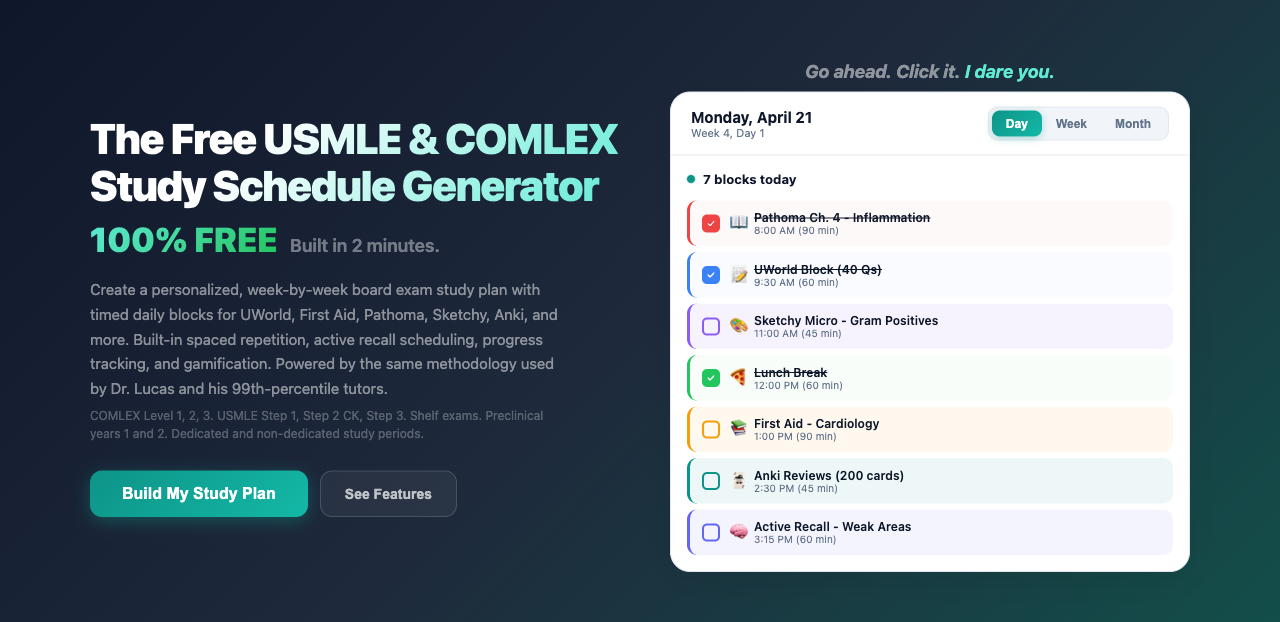
If mapping all of this onto a calendar by hand sounds like one more thing to get wrong, the free Premeducated Study Plan Builder does the count-back math, the practice-test cadence, and the focused-block selection for you. It builds this exact plan around your test date, baseline, and weak areas in a few minutes, using the same logic I use with 1-on-1 students.
What do I do when the plan stops working?
When practice scores stall, the answer is almost never "study harder." A flat or declining COMSAE trend over 4 to 6 weeks is a signal that the shape of the plan is off, not that you need more hours on the same broken routine. The usual culprits are predictable: too many tutor-mode questions, so timing never gets rehearsed; passive content review with no active recall; Anki used as a crutch instead of a memory tool; and unaddressed test anxiety hiding real knowledge. Fix the input, not the volume.
Sometimes the right move is to push the date. Postponing is the correct call when the data says so, and the wrong call when you are simply nervous. Real postponement signals include scores plateaued under 400 despite consistent effort, a previous 50-plus point drop from COMSAE to the actual exam, a recent personal loss, or a school deadline that would genuinely let you reset. When a postponement is warranted, 2 to 4 weeks is usually the sweet spot, because longer windows start trading prep time for fresh burnout.
Readiness comes down to a few honest signals, not one magic number. Look for two recent practice scores above 450, a question-bank percentile above the 5th to 9th percentile floor, a clear upward trend over time, and a gut answer of "yes" to one question: do I feel more confident now than when I started? The NBOME's 2025 poster reported that a COMSAE above 400 corresponds to roughly a 94 percent chance of passing, which is reassuring, though the trend across your last few tests matters as much as any single figure. If your scores are not climbing and you cannot tell why, that is exactly the moment a second set of eyes helps. Here is who actually needs a COMLEX tutor and who does not.
Build your COMLEX study plan in a few minutes
The plan that works is not complicated, but it is specific. Eight 1-hour blocks, the 2-4-2 split, a weekly practice test, one real day off, and focused blocks chosen by exam weight. The hard part is fitting that template to your exact test date, baseline, and weak topics without losing a weekend to spreadsheets.
Let the Study Plan Builder do the math
The free Premeducated Study Plan Builder turns your test date and baseline into the exact daily and weekly schedule above, personalized to your weak disciplines and systems. It uses the same logic Dr. Lucas uses with 1-on-1 students, and it is free with no upgrade required.
Frequently asked questions about COMLEX study plans
What should a daily COMLEX study schedule look like?
Build the day to mirror test day: start at 8 AM, run eight 1-hour blocks with 5-minute breaks and one 30-minute lunch, for 8 hours of structured work. Split it into about 2 hours of timed questions, 4 hours of question review, and 2 hours of Anki. Add an optional 1 to 2 hours of content review at the end of the day if you have the energy. The exact times matter less than the rhythm. Running your study day on the same clock as the real exam bakes in timing and stamina before test day arrives.
How many hours a day should I study for COMLEX?
Plan on about 8 hours of structured work per day during dedicated, plus an optional 1 to 2 hours of content review. More than 10 hours rarely improves scores and usually accelerates burnout, while less than 8 hours on the structured schedule makes it hard to keep up with two question blocks, full review, and daily Anki. Quality and consistency beat raw volume. A focused 8-hour day with timed questions and thorough review will move your score more than a scattered 12-hour day of passive video watching.
How do I split my time between questions and content review?
Most of your structured time should go to questions and the review of those questions, not to new content. A workable split is roughly 2 hours of timed questions, 4 hours of question review, and 2 hours of Anki. Question review earns the biggest share because reviewing one 40-question block thoroughly takes most students about 2 hours, and you are reviewing two blocks per day. Content review shrinks to a short optional window at the end of the day for whichever topic felt shakiest, rather than dominating the morning.
How many practice tests should I include in my COMLEX study plan?
Schedule one full-length practice test every 1 to 2 weeks during dedicated, then two tests in the final 2 weeks before test day. Across a typical 4 to 8 week dedicated period, that works out to roughly 3 to 5 tests. Prioritize COMSAEs because they are the closest thing to the real exam, and save two unused forms for the very end. Two consistent scores above 450 in your last 2 weeks is the standard green light. Use TrueLearn and COMQUEST self-assessments to fill gaps when your COMSAE pool is not deep enough.
Should my COMLEX study plan include a day off?
Yes. One full day off per week is the floor for most students, and it is the standard schedule I run with 1-on-1 students. Keep doing Anki reviews on that day so the deck does not balloon, but skip practice questions and new content entirely, and do something genuinely restorative. Burnout accumulates across the whole dedicated period, so the rest day is structural, not optional. Students who grind seven days a week to "get ahead" usually stall out around week 6 with lower scores, not higher ones.
What if my COMLEX practice scores are not improving?
A flat or declining trend over 4 to 6 weeks means the shape of the plan is off, not that you need more hours. Common diagnoses include over-reliance on tutor mode (so timing never gets practiced), passive content review without active recall, Anki used as a content crutch, and unaddressed test anxiety masking real knowledge. The fix is different hours, not more hours. If scores stay flat and you cannot identify why, that is the right moment to bring in a tutor or run your plan through the Study Plan Builder to find where time is leaking.