
Most osteopathic medical students need 4 to 8 weeks of dedicated study to prepare for COMLEX Level 1. Plan on 8 hours of focused study per day, plus an optional 1 to 2 hours of content review, one full day off every week, and a practice test every 1 to 2 weeks. Students with a strong preclinical foundation and a high baseline practice score can pass in 2 to 4 weeks. Students recovering from a low baseline, a failed attempt, or significant test anxiety usually need 8 to 16 weeks. Total study time matters less than how every hour is spent.
For most first-time test takers, 4 to 8 weeks really is plenty. Eight weeks gives most students enough room to breathe through the practice-test cadence, the focused-block work, and the Anki load without burning out. If you're already scoring in the 400s or even 500s on a recent COMSAE, you're usually good to go with just 2 to 4 weeks of polishing. The longer end of the range, 8 to 16 weeks, is mostly where repeat test takers live. The very high end is reserved for our multi-repeat students who need a full rebuild. Stretching any of these plans to 20 weeks tends to lose momentum, and you'll forget early-block material before test day arrives.
What does a typical COMLEX Level 1 study schedule look like?
A working COMLEX Level 1 schedule has four ingredients: timed question blocks, structured question review, daily Anki, and one weekly practice test. Anki here means a premade deck like AnKing with cards unsuspended after question review, not a random shuffle. Most students spend 8 hours per day on these four ingredients combined, plus an optional extra hour or two of content review at the end of the day. One full day off every week to reset.
The shape of the day matters as much as the total hours, and we build the day on purpose to mirror test day. COMLEX Level 1 is now eight 1-hour blocks of 40 questions each. Short breaks are scheduled between every block, with a longer break for lunch in the middle, totaling 60 minutes of break time across the day. The study day uses the same 8-block, 1-hour rhythm. By the time you sit for the real exam, the cadence is already in your body. You're not learning it for the first time under pressure. Stamina and timing are both learned skills, and you only learn them by living them every day in dedicated.
The split for an 8-hour study day is 2 hours of timed questions, 4 hours of question review, and 2 hours of Anki. The review takes the largest share because reviewing a single 40-question block thoroughly takes most students about 2 hours, and you are reviewing two blocks per day. Here is how it lays out:
- Block 1 (8:00 to 9:00 AM): Timed question block 1, 40 questions, no tutor mode, focused on a weak topic (4 to 6 focused blocks per discipline, 3 to 6 per system). 5-minute break after.
- Block 2 (9:05 to 10:05 AM): Timed question block 2, back to back with the first to mirror the start of test day. 5-minute break after.
- Block 3 (10:10 to 11:10 AM): Start review of question block 1. The block itself just tells you what to study. The review is where you actually study it. 5-minute break after.
- Block 4 (11:15 AM to 12:15 PM): Finish review of question block 1.
- 30-minute lunch break. Mirrors the test-day lunch between sections 4 and 5. Eat, walk, reset.
- Block 5 (12:45 to 1:45 PM): Start review of question block 2. 5-minute break after.
- Block 6 (1:50 to 2:50 PM): Finish review of question block 2. 5-minute break after.
- Block 7 (2:55 to 3:55 PM): Anki, starting with new cards and learning, then moving into reviews. 5-minute break after.
- Block 8 (4:00 to 5:00 PM): Continue Anki reviews until new, learning, and review cards all hit zero.
That covers the 8 hours of structured work, plus the 60 minutes of total break time distributed across the day. After Block 8, an optional 1 to 2 hour content-review window is open. Use it for video content on whichever section felt shakiest in the morning. You can also dig into a weak topic that came up in question review. Unsuspend up to 10 Anki cards per video.
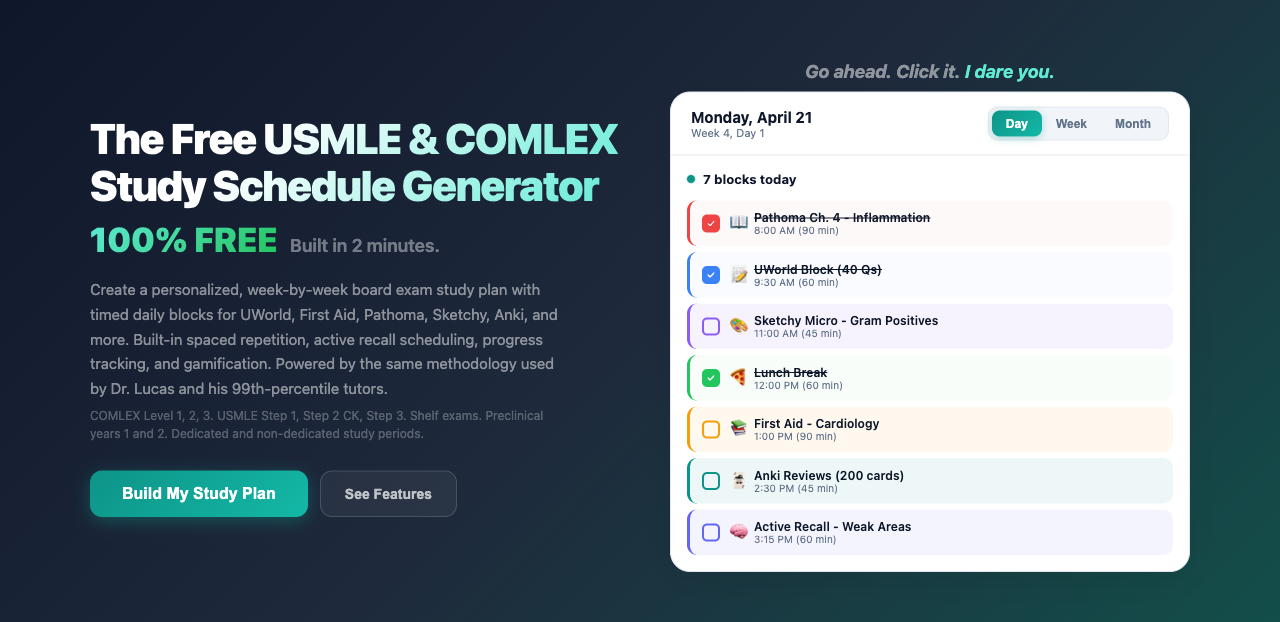
If you don't want to map all of this out by hand, the free Premeducated Study Plan Builder does the thinking for you. It builds this exact schedule personalized to your test date, baseline, and weak areas in a few minutes.
Total structured work lands at 8 hours. Optional content review can add another 1 to 2 hours. One full day off per week is non-negotiable. Anki reviews still happen on the day off so the deck doesn't balloon, but no questions and no new content.
How do I know if I need 4 weeks or 12 weeks of dedicated study?
How long you should study has a lot more to do with where you're starting than with how hard you can grind. Imagine two students both putting in 8 hours a day. One is walking in at a 470 COMSAE. The other is walking in at a 320 with a previous failed attempt. They'll need very different timelines, even at the same daily volume. The single best predictor is the practice test you take 1 to 2 weeks before dedicated begins, combined with whether this is a first attempt or a retake.
The three buckets we use with our 1-on-1 students:
- Strong baseline, polishing only (2 to 4 weeks). Already scoring in the 400s or 500s on a recent COMSAE, intact preclinical foundation, no history of failure. The dedicated period is a consolidation window, not a building window. Adding more weeks to this bucket usually adds noise, not signal.
- First-time test taker, average baseline (4 to 8 weeks). Baseline COMSAE somewhere in the 350 to 450 range, mixed question-bank percentile, no major red flags. This is where most students live. Eight weeks is plenty for the vast majority of first-time test takers.
- Repeat test taker, low baseline, or significant test anxiety (8 to 16 weeks). One previous failed attempt, a baseline well below 350, a documented 50-plus point drop from COMSAE to actual exam on a previous attempt, or a school-mandated retake under a hard gate. Eight weeks is the floor here when the diagnosis is clear and a 1-on-1 plan is in place. Sixteen weeks is reserved for repeat test takers, most often the multi-repeat test takers.
Two notes on baseline. First, an unused COMSAE is more reliable than a TrueLearn self-assessment for predicting your starting point. The TrueLearn statistician is, kindly put, not in line with the actual score scale. Second, baseline isn't a fixed property. Students move within the buckets. A 320 baseline can become a passing score in 5 weeks under the right gate pressure. We've had students walk in with practice scores in the 320s under a 450-or-expulsion gate and walk out with a passing COMLEX score. What gets them there isn't "study harder." It's "study smarter, with feedback."
How many practice tests should I take during COMLEX Level 1 prep?
Plan on one full-length practice test every 1 to 2 weeks during dedicated, plus two practice tests in the final 2 weeks before test day. The goal is two consistent data points above 450 in those final 2 weeks. Above 500 is the ideal, but plenty of students never hit 500 in the time they have to prep, and that's genuinely fine. Above 450 is the real green light. A 460 and a 470 on your last two COMSAEs is a perfectly safe set of data points to walk into test day on.
The cadence matters because COMSAEs are limited. There are three purchasable Level 1 COMSAE forms (107, 110, 111) and four school-administered forms that some colleges of osteopathic medicine make available (113, 114, 115, 116). The retail TrueLearn self-assessment and two COMQUEST self-assessments are also available. If you have enough COMSAEs to cover your whole dedicated period at the every-1-to-2-weeks cadence, just use COMSAEs throughout. They're the closest thing you have to the real exam. There's no reason to swap them out for TrueLearn or COMQUEST self-assessments if you don't need to. Use the TrueLearn and COMQUEST self-assessments only when the COMSAE pool isn't deep enough to fill the schedule.
For a typical 6 to 8 week dedicated period where you're stretching your COMSAE pool, the order most of our students follow is:
- Start with whatever you have available. If you have plenty of COMSAEs, use a used COMSAE as the baseline. If you're tight on COMSAEs, start with the TrueLearn self-assessment 6 to 8 weeks out and save your unused COMSAEs.
- If you need to supplement, slot in a COMQUEST self-assessment 4 to 6 weeks out (repeats are fine for early data points).
- Continue with one practice test every 2 weeks, prioritizing COMSAEs whenever possible.
- Save 2 unused COMSAEs for the final 2 weeks. These are your last and most important data points.
How do I know I'm ready to take COMLEX Level 1?
Readiness isn't a single number. It's a small checklist of consistent signals.
The four signals that matter most:
- Two recent practice scores above 450, taken within the final 2 weeks. Above 500 is the ideal, but a lot of students never hit 500 in the time they have to prep, and that's fine. Above 450 is the real green light. The NBOME's 2021 poster reported that a COMSAE above 450 corresponds to a 99 percent or higher chance of passing. Their 2025 poster put the figure at 94 percent for COMSAE scores above 400. The trend matters as much as the absolute number.
- Question-bank percentile at or above 5 to 9 percent on the bank you've used most recently. That's the floor for passing test day. Anything above 40th percentile is in great shape.
- A clear upward trend in COMSAE and qbank scores over time. A flat or downward trend is a postponement signal regardless of the absolute number.
- Honest self-assessment of confidence. The question to sit with is, "Do I feel more confident now than when I started studying?" If the answer is no, the problem is rarely fixed by adding 1 more week of the same plan.
A good readiness summary looks like: "I scored 470 and 485 on my last two COMSAEs, my TrueLearn percentile has moved from 20th to 55th over 8 weeks, I'm sleeping reasonably well, and I feel more comfortable on the bank than I did a month ago." That student is ready.
What if I'm not on track?
Postponing is the right call when the data says it is, and the wrong call when the data says it isn't. A few signals should trigger a postponement conversation:
- Practice scores have plateaued under 400 despite consistent effort.
- You're a previous test taker who dropped 50-plus points from COMSAE to actual exam (a strong testing-anxiety pattern).
- Recent personal loss or significant life stressor in the run-up to test day.
- A school deadline with an LOA consequence that would actually let you reset rather than push.
Most postponements that work are 2 to 4 weeks. Longer than that and burnout starts to outweigh extra prep time. If you're not sure whether to push the date, our free Postpone Calculator walks you through the standard inputs (recent two scores, qbank trend, anxiety self-assessment, rotation or LOA constraints).
Build a COMLEX Level 1 study plan that fits your timeline
The cleanest way to translate a target test date into a real schedule is to use a tool that handles the count-back math, the practice-test cadence, and the focused-block selection for you. Our free Study Plan Builder builds a personalized COMLEX Level 1 plan in a few minutes. It uses the same logic Dr. Lucas uses with 1-on-1 tutoring students. It accounts for baseline, weeks remaining, weak disciplines and systems, weekly study load, and Anki settings.
Frequently asked questions about COMLEX Level 1 study length
How many weeks of dedicated study should I plan for COMLEX Level 1?
Most first-time DO test takers need 4 to 8 weeks of dedicated study for COMLEX Level 1. Students already scoring in the 400s or 500s on a recent COMSAE often only need 2 to 4 weeks of polishing. Students with a low baseline, a previous failed attempt, or significant testing anxiety usually need 8 to 16 weeks, with 16 weeks reserved for multi-repeat test takers specifically. The most important predictor is the baseline practice score 1 to 2 weeks before dedicated begins.
Can I study for COMLEX Level 1 in 4 weeks?
Yes, for many first-time test takers, 4 weeks is enough. If you're already scoring in the 400s on a recent COMSAE with a solid preclinical foundation, you can usually pass in 2 to 4 weeks of focused polishing. Students with a baseline in the 350 to 400 range usually need 6 to 8 weeks instead. Four weeks isn't enough for a retake or a baseline below 350. Those situations call for 8 to 16 weeks. The right cue is the baseline COMSAE score, not the calendar.
How many hours a day should I study for COMLEX Level 1?
Plan on about 8 hours of structured work per day during dedicated, plus an optional 1 to 2 hours of content review at the end of the day. That breaks down as 2 hours of timed questions, 4 hours of question review, and 2 hours of Anki, all run in 1-hour blocks with 5-minute breaks to mirror test day. More than 10 hours per day rarely improves scores and usually accelerates burnout. Less than 8 hours per day on the structured schedule is hard to sustain without falling behind on practice tests and Anki.
Should I take a day off during COMLEX Level 1 prep?
Yes. One full day off per week is the floor for most students, and it's the standard schedule we run with 1-on-1 tutoring students. Continue Anki reviews on the day off so the deck doesn't balloon. Skip practice questions, don't start new content, and do something genuinely restorative. Burnout is accumulated over the entire dedicated period. Skipping the weekly day off rarely raises scores and frequently lowers them by week 6.
How many COMSAEs should I take before COMLEX Level 1?
Plan one full-length practice test every 1 to 2 weeks during dedicated, with two tests in the final 2 weeks. Across a 4 to 8 week dedicated period, that's 3 to 5 practice tests. Longer windows for repeat test takers can fit 6 or more. Mix purchasable COMSAEs (107, 110, 111), school-administered COMSAEs if available (113 to 116), the retail TrueLearn self-assessment, and the two COMQUEST self-assessments. Save two unused COMSAEs for the final 2 weeks of prep.
What if my COMSAE scores aren't improving?
A flat or declining COMSAE trend over 4 to 6 weeks is a signal that your study plan isn't working. It's not that you need to study harder. Common diagnoses include over-reliance on tutor-mode questions (timing never gets practiced), passive content review without active recall, Anki used as a content-review crutch instead of a memory tool, and unaddressed testing anxiety masking real content knowledge. The fix is rarely "more hours." It's usually "different hours, with feedback." A free Study Plan Builder run can surface where your plan is leaking time.
Build your COMLEX Level 1 study plan in a few minutes
The right COMLEX Level 1 timeline is the one matched to your baseline, your test date, and your weak topics. The free Premeducated Study Plan Builder uses the same logic Dr. Lucas uses with 1-on-1 students to build a personalized plan in minutes. Free, no upgrade required.
Related guides and video resources
- Who actually needs a COMLEX tutor and who does not
- How to use Anki effectively for COMLEX
- Doctor Lucas DO on YouTube: full library of COMLEX strategy, score interpretation, postponement, and burnout videos