
For most DO students, dedicated COMLEX Level 1 prep should start 5 to 8 weeks before test day, anchored to a baseline COMSAE taken 1 to 2 weeks before that window opens. During preclinical years your job is to do the best you can in your school courses, because that work IS the foundation for boards; you don't have to pile on a heavy second curriculum on top of class. Students with a strong baseline can compress dedicated to 2 to 4 weeks. Repeat test takers, students recovering from a low baseline, or anyone with a documented testing-anxiety gap usually start 8 to 16 weeks out, with the longest windows reserved for multi-repeat cases.
The "when do I start studying" question feels simple, but it's actually three questions wearing a trench coat. There's the preclinical foundation, which is just maximizing what you learn from your school coursework. There's structured pre-dedicated prep, a light board-prep overlay in the months before dedicated. And there's dedicated, the protected full-time block right before the exam. Each timeline has a different right answer, and getting them confused is one of the most common reasons a study schedule misfires.
What does "start studying" actually mean for COMLEX Level 1?
For practical planning purposes, separate these three timelines:
- Your preclinical foundation is your school coursework, MS1 through MS2. The single most important thing you can do for boards in this period is to learn your classes as deeply as possible. No separate "board curriculum" is required on top of class, especially in early preclin.
- Structured pre-dedicated prep runs from roughly 6 to 12 months before test day. Question-bank volume increases, Anki becomes daily, and content from class is being filtered through a board-prep lens. This is still a light overlay on top of your preclin work, not a second job; most of your attention should remain on doing the best you can in your classes.
- Dedicated is the full-time, protected window in the 2 to 16 weeks before test day. The number of weeks depends on your baseline and your history.
Most students asking "when should I start" really mean dedicated. The single most reliable way to set your dedicated start is to count back from your test date based on which timeline bucket you fall into. We'll get to those buckets in a moment, but the short version is that the right answer is rarely a round number. It's the bucket that matches your most recent COMSAE and your prior testing history.
When should I start COMLEX prep during my preclinical years?
COMLEX prep is happening from your first day of medical school whether you label it that way or not, because your MS1 anatomy, physiology, and biochemistry are on the test. The right framing for early preclin is not "when do I start board prep on top of school." It's "how do I make sure what I learn in class actually sticks long enough to come back on boards." For most students, that means doing the absolute best you can in preclin coursework first, with one specific lightweight habit on top: using a premade board-style Anki deck like AnKing to grab the high-yield material as it shows up in class so you learn it well the first time.
A reasonable preclinical timeline:
- MS1: Maximize what you learn from your school courses; that's the work. The lightweight overlay on top is using a premade Anki deck like AnKing to unsuspend cards corresponding to current class topics, which lets you pin down high-yield facts as they show up. You don't need to build a separate second curriculum here. Do note that COMLEX leans heavily on anatomy, so if your MS1 anatomy is weak, that material does come back on Level 1.
- MS2 first half: Class learning is still the priority. As a light overlay, start layering in qbank questions on the system you're currently in class on. One to two TrueLearn focused-block sets per week, roughly 40 to 80 questions, on the active system, is plenty. Pathology, pharmacology, and microbiology dominate this phase and they are the bedrock of Level 1.
- MS2 second half (roughly 3 to 6 months before dedicated): Bump qbank volume to about one block per day of the system you are actively studying in class. Anki reviews stay daily. Take an early COMSAE 6 to 8 weeks before dedicated begins to set expectations and pick up your weak disciplines.
- 1 to 2 weeks before dedicated begins: Take your true baseline COMSAE. This score is the input that determines which dedicated bucket you fall into.
This is not a separate time investment from school. It's a framing for how to make your school work compound. Students who learn their MS2 classes deeply and add light qbank reps and daily Anki on top tend to walk into dedicated already calibrated. Treating MS2 lectures as totally distinct from boards is the single most common preventable timing mistake we see, and it usually means dedicated has to start with a full pathology, pharmacology, and microbiology rebuild rather than a consolidation.
How do I count back from my test date to set my dedicated start?
The cleanest way to set your dedicated start is to anchor on three inputs: your scheduled test date, your most recent COMSAE score, and which timeline bucket you fall into. There are three buckets we use with our 1-on-1 students.
Bucket A: Strong baseline, polishing only
Window: 2 to 4 weeks of dedicated study.
Who fits: a recent COMSAE of 450 or higher (target 2 weeks of dedicated) or 400 to 450 (target 4 weeks of dedicated), intact preclinical foundation, consistent question-bank performance, no history of failed attempts, no active testing anxiety. The dedicated period is a consolidation window, not a building window. Adding more than 4 weeks for a Bucket A student usually adds noise, not signal, and starts dragging scores down through forgetting and burnout.
Bucket B: First-time test taker, baseline below 400
Window: 5 to 8 weeks of dedicated study.
Who fits: first-time COMLEX Level 1 test takers with a baseline COMSAE below 400, mixed question-bank percentile, some weak preclinical sections, but no major red flags. This is where most students live. Eight weeks is plenty for the vast majority of first-time test takers. Trying to compress below 5 weeks rarely works for someone in this bucket because the practice-test cadence (one full COMSAE every 1 to 2 weeks) does not have room to breathe.
Bucket C: Repeat test takers, low baseline, or testing anxiety
Window: 8 to 16 weeks of dedicated study.
Who fits: one or more previous failed attempts, baseline well below 350, broad weakness across disciplines, a documented 50-plus point drop from COMSAE to actual exam on a prior attempt, a school-mandated retake under a hard score gate, or active testing anxiety affecting practice scores in a documented way. The 8-to-16 range is wide on purpose. Eight weeks is the floor for someone with a recent failed attempt who is otherwise stable and has a clear diagnosis. Sixteen weeks is reserved for multi-repeat test takers specifically. Past 16 weeks, burnout outweighs the marginal gain from extra runway.
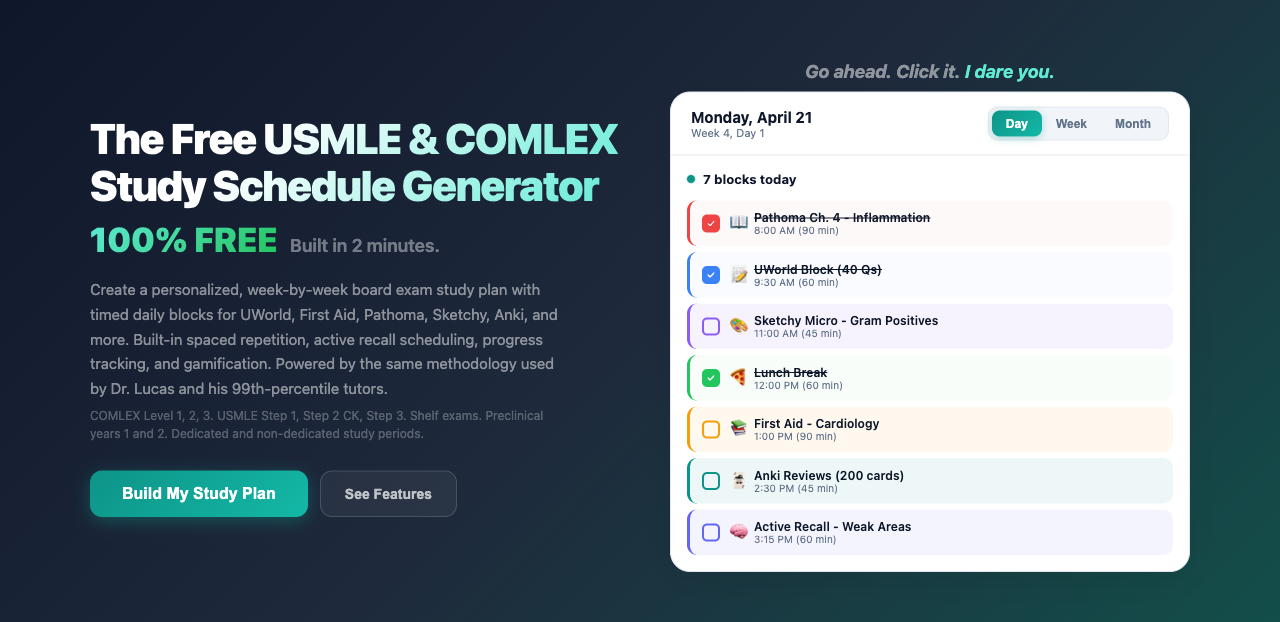
Adding weeks of dedicated is not free. The math has to account for forgetting curves, qbank exhaustion, and the slow grind of motivation under sustained 8-hour days. If you don't want to map all of this by hand, the free Premeducated Study Plan Builder does the count-back math, the practice-test cadence, and the focused-block selection for you in a few minutes.
When does the final 2 weeks of dedicated kick in?
The final 2 weeks have a different shape than the rest of dedicated, so they get treated as their own micro-period regardless of which bucket you started in. Two anchors:
- Two full-length practice tests in the final 2 weeks. One at 2 weeks out, one at 1 week out. The goal is two consistent data points above 450, ideally above 500. Per the NBOME's 2021 poster, a COMSAE above 450 corresponded to a 99 percent or higher chance of passing. Their 2025 poster put the figure at 94 percent for COMSAE scores above 400. Two scores above 450 is a green light. Two scores between 400 and 450 is a yellow light that warrants a postponement conversation.
- Switch from focused blocks to mixed blocks. Once your last focused-block run finishes, all remaining qbank work is mixed blocks through test day. This mirrors the real exam and prevents you from tunnel-visioning on one system the day before sitting.
A few topics earn their keep most when reviewed cold in the final 2 weeks: 1 to 2 biostatistics blocks (sensitivity, specificity, NNT, NNH, relative risk, study design biases), 1 to 2 ethics and jurisprudence blocks (EMTALA, HIPAA, emancipated minors, Medicare versus Medicaid), a First Aid rapid-review skim for the high-yield facts that have been showing up across qbank, and OMM blocks if OMM has been a documented weak spot. These are densely memorizable and decay fast, so they reward late-game review.
The day before exam is studying-free. No questions, no Anki, no review. Plans all day, no nap, no late caffeine, no late workout. The final 2 weeks aim you at that day, not past it.
What are the most common timing mistakes I should avoid?
A few patterns we see repeatedly on free strategy calls:
- Starting dedicated too early "to be safe." A first-time test taker with a 420 baseline who insists on a 16-week dedicated window usually peaks around week 8 and drifts down through weeks 9 to 16. Burnout is the dominant failure mode here. The marginal gain from week 12 versus week 8 is usually negative.
- Setting your start based on a wishful baseline. A TrueLearn self-assessment from three months ago is not your baseline. A used COMSAE you took at the end of MS1 is not your baseline. Your baseline is a fresh, full-length COMSAE taken 1 to 2 weeks before dedicated begins, under timed conditions, in something close to test-day environment.
- Treating MS2 classwork as separate from boards. This is the single most common preventable timing error. The pathology, pharmacology, and microbiology in your MS2 classes is the same content COMLEX is testing. Students who learn that material well in class and layer in some qbank reps walk into dedicated already calibrated. Students who treat MS2 lectures as "just school" usually walk into dedicated needing a full rebuild on those subjects.
- Ignoring the school-mandated cutoff. Many DO programs require a COMSAE score (often 450) before you can sit for COMLEX Level 1. If your school has one, the count-back has to account for both the cutoff date and the actual test date, with a buffer between them. Hitting the cutoff at the last possible attempt usually means you are not ready for the real exam yet either.
- Compressing dedicated to fit a vacation, a wedding, or a rotation block. Calendar pressure is real, and sometimes unavoidable, but the timeline buckets exist because they reflect what actually moves scores. Two weeks of dedicated for a 350 baseline does not work no matter how many hours per day you grind.
A working plan starts from the bucket and the test date, then asks "what does my life have to bend around to make this real," not the other way around.
How do I know if I should push my dedicated start earlier?
Push your start date earlier (more dedicated runway) if any of these are true:
- Your most recent baseline COMSAE is below 350.
- You have a previous failed attempt at COMLEX Level 1 or Level 2.
- You have a documented 50-plus point drop from COMSAE to actual exam on a prior attempt.
- A school-mandated cutoff is between you and your test date, and your current trajectory won't reach it on the existing timeline.
- You'll be on rotation during part of the window. Pre-dedicated layered work is fine on rotation; true dedicated is not, because you can't put in 8 hours per day with rotation hours stacked on top.
Pull the dedicated start later (compress dedicated) only if all of these are true:
- Your two most recent COMSAE scores are above 450 and trending up.
- Your TrueLearn percentile is above the 30th in the bank you've used most recently.
- You have a track record of standardized-test performance (MCAT, shelves) with no real-versus-practice gap on the actual administration.
- You've been treating MS2 classwork as board prep for at least 6 months, with daily Anki and qbank questions tied to active class topics.
If you fall in between, that's the conversation our free strategy call exists to handle. Setting the start date correctly upfront is much cleaner than postponing later. Postponement is a real and useful tool, but it works best as a course correction when new information appears, not as a default response to a start date that was wrong from the beginning.
Frequently asked questions about when to start studying for COMLEX Level 1
How far in advance should I start studying for COMLEX Level 1?
Your preclinical years are the foundation, and the priority there is doing the best you can in your school courses. A lightweight habit of using AnKing-style Anki for active class topics is the right overlay in MS1. Structured pre-dedicated prep ramps up 6 to 12 months before test day, layering in qbank questions on the system you're currently in class on. Dedicated full-time prep starts 2 to 4 weeks out for strong baselines (2 weeks for COMSAE 450 or higher, 4 weeks for 400 to 450), 5 to 8 weeks out for first-time test takers with a baseline below 400, and 8 to 16 weeks out for repeat test takers, low baselines, or significant testing anxiety. Anchor your dedicated start to a fresh COMSAE taken 1 to 2 weeks before that window opens.
Is it too early to start studying for COMLEX Level 1 in MS1?
No, but the type of studying matters. In MS1, the priority is doing the best you can in your school courses. As a lightweight habit on top, use a premade Anki deck like AnKing and unsuspend cards as topics come up in class so you can pin down high-yield material the first time you see it. Heavy qbank work in MS1 is usually low yield because most COMLEX content is pathology, pharmacology, and microbiology, all of which arrive in MS2. Save the qbank ramp for MS2.
When should I start using TrueLearn or COMQUEST?
Start light qbank work in the first half of MS2, focused-block style on whichever system you're currently in class on. One to two blocks per week of about 40 questions each is a reasonable starting volume. Bump up to one block per day in the second half of MS2 on the active system. By the time dedicated begins, you should already be comfortable with timed-mode questions and the question-review process so that dedicated is not also "learn how to use a qbank" week.
How early should I take my first COMSAE?
Take an early diagnostic COMSAE 6 to 8 weeks before dedicated begins to set expectations and surface weak disciplines. Take your real baseline COMSAE 1 to 2 weeks before dedicated begins. The baseline COMSAE is the score that determines your dedicated bucket. An older COMSAE or a TrueLearn self-assessment is not a substitute for a fresh, full-length COMSAE under test-like conditions.
What if I'm on rotation when I'd want to start dedicated?
Pre-dedicated layered work is fine on rotation. True 8-hour-per-day dedicated is usually not, because rotation hours stacked on top mean you can't actually hit the daily volume. The two practical options are to schedule dedicated immediately after the rotation block ends, or to take advantage of the rotation as a chance to integrate clinical reasoning into your studying while you wait for protected time. Trying to do both at full intensity at the same time tends to fail at both.
What if my school has a COMSAE cutoff before I can sit for COMLEX?
Build your timeline around the cutoff date plus a buffer, not just around the COMLEX test date. If your school requires a 450 COMSAE before sitting and your baseline is in the 300s, the math says you need a Bucket C dedicated window with the gate scheduled at least 2 weeks before COMLEX so you have buffer to actually be ready (rather than just barely cleared). Hitting the cutoff at the last possible attempt usually means you aren't ready for the real exam either, and forcing the test under that pressure is one of the patterns we most often see end in postponement or failure.
Build your COMLEX Level 1 study plan in a few minutes
The right COMLEX Level 1 start date is the one matched to your test date, your baseline, and your bucket. The free Premeducated Study Plan Builder uses the same logic Dr. Lucas uses with 1-on-1 tutoring students to build a personalized count-back plan in minutes. Free, no upgrade required.