
Most med students don't need a private COMLEX tutor. If your COMSAE scores are consistently above 450 and trending up, you're usually fine on your own with a free community and a structured plan. The students who genuinely benefit from tutoring fall into four specific patterns: the student working hard but going nowhere, the retaker who changed everything except the strategy, the student whose scores drop on the real exam, and the student who runs out of time on every block. If you fall into one of these four, a tutor pays for itself fast. If you don't, save your money. This article is the honest version of that conversation.
I've written this from the inside of the industry. Most COMLEX and USMLE tutoring companies want every DO student to believe they need a tutor, because that's how the business model works. I run a tutoring company, and I'm going to tell you the opposite. About half the students who come to my free strategy calls don't need to hire us, and we tell them so. The other half need help, and the help they need is specific and diagnosable. The whole point of writing this is to help you figure out which group you're in before you spend a dollar.
Who probably does not need a COMLEX tutor
If your most recent two COMSAE scores are above 450 and your trend over the last 4 to 6 weeks is moving up, you're in good shape. The students at this stage usually don't need a 1-on-1 tutor. They need a structured plan they can stick to, a community of physicians and other DO students to ask questions in, and the discipline to keep showing up.
This is also true for students with a strong track record on standardized exams in general. A solid MCAT, consistent shelf scores, a history of performing under pressure: these are predictors that you've already built the test-taking muscle that COMLEX rewards. If your foundation is there and your scores are climbing, you can almost always close the gap to test day with the free Premeducated Study Plan Builder and the free Skool community.
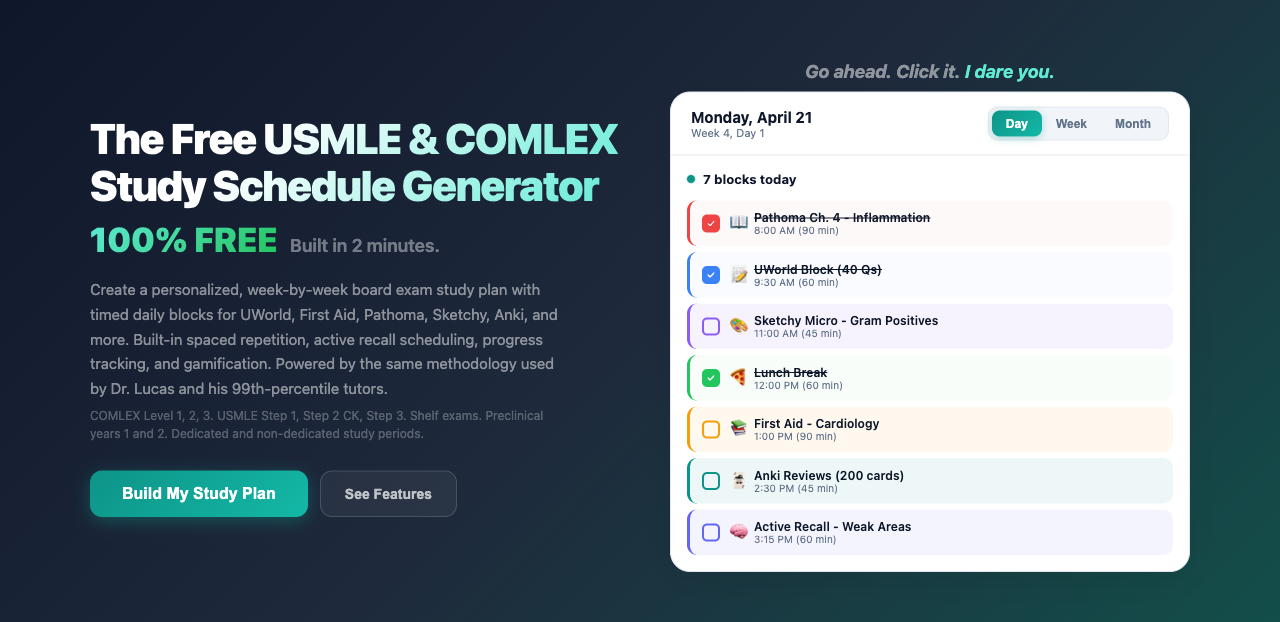
The reason these two free resources can usually carry you across the finish line is simple. Together they replicate most of what 1-on-1 tutoring delivers, just at a slower pace. The Study Plan Builder gives you the same daily structure I use with my 1-on-1 students, personalized to your test date, baseline, and weak areas. The free Skool community gives you weekly office hours with physician tutors, a 100-plus video library of question breakdowns, cloze-deletion Anki cards transcribed from my video library, and DM access to me if you get stuck. The combination provides the structure, accountability, and physician-level feedback that 1-on-1 tutoring would, without the price tag. Use them, stay on the plan, and trust the process.
There's also a category of students who shouldn't hire a tutor regardless of their scores. If you aren't going to follow the plan, tutoring won't save you. Our 1-on-1 students put in 8 to 10 hours of focused work per day during dedicated. That's realistic, but it isn't a shortcut. If you're looking for a way to put in less work and pass anyway, no tutoring company is going to deliver that. A tutor amplifies good effort. We can't replace it.
So who genuinely does benefit from a COMLEX tutor?
There are four patterns we see repeatedly. Each one is a real, diagnosable problem with a structured fix. If you recognize yourself in one of these, that's when a tutor pays for itself fast.
1. The student working hard but going nowhere
This is the most common pattern, and the most frustrating one for the student who's in it. You're studying 8, 10, 12 hours a day. Questions every day. Content videos every day. Anki every day. And your scores are flat or moving slowly in the wrong direction.
The diagnosis is almost never effort or intelligence. It's the system you're studying with.
Justin was a real student of mine. His testimonial video is on the Doctor Lucas DO YouTube channel, and his contact info is in the description if you want to reach out and verify any of this yourself. He had failed COMLEX Level 2 with a score in the low 320s. He'd studied 1 to 2 months full time, done practice questions every day, and watched plenty of content review. The effort was real. The system was broken. He was doing questions randomly, reviewing them passively, and had no method for retaining the information long term. When his school gave him 6 weeks to retake, his first practice test with us came in at 280. That's first percentile.
We didn't add more volume. We changed the system. Focused question blocks targeting his weakest areas. Every question timed, no tutor mode. A daily plan that pivoted based on what he missed yesterday. Spaced repetition tied directly to question review. Multiple specialists on his team for the topics he couldn't crack on his own. Six weeks later his second attempt came in at 440. That was a 120-point jump on the post-fail baseline, and a passing score that helped him match into residency.
The honest test for whether you're in this category: pull up your practice score history. Are your scores actually moving in the right direction, even slowly? If yes, you probably just need a strategy tweak and a community around you. If they've been flat for 4 to 6 weeks, or you've taken multiple practice tests and you genuinely can't figure out why you're stuck, that's when a tutor pays for itself.
2. The retaker who changed everything except the strategy
The most common reaction to a failed COMLEX is to pile on more stuff. New books, new videos, more hours, more resources. As if volume is the missing ingredient.
It almost never is.
Shannon was another student of mine. Her testimonial video is on the channel, and her contact info is in the video description for anyone who wants to reach out. She had failed COMLEX Level 1 on her first attempt. When she came to us, she was already running multiple resources at the same time and trying to juggle all of them. Sketchy Pharm, Sketchy Micro, Pathoma, multiple question banks, and Anki being used incorrectly (she was looking at each card once and never coming back to it). The volume wasn't her problem. Her problem was she had no idea what to cut.
The first thing we did was strip her plan back down. One focused question bank. A structured daily schedule. Clear priorities based on her actual weak areas, not a buffet of "everything that might help." Anki used the way it's supposed to be used, with cards unsuspended in response to question review and driven to zero every day. And one hour with a tutor on Monday, Wednesday, and Friday for accountability and pivots when something stopped working.
Not a firehose of resources. A focused tool with a structured plan around it.
If you've already failed once and you're heading into a retake, sit with this question. Did you actually change the system, or just study harder with the same broken plan? Studying harder with a broken plan is exactly how students end up on their third and final attempt.
3. The student whose scores drop on test day
This is the sneakiest pattern, and the one most underdiagnosed by both students and the bigger test prep companies. You're scoring well on practice tests. You know the material. You feel prepared. And then you walk into the real exam and your score is 50, 100, sometimes 200 points lower than what you've been doing in practice.
That's not bad luck. That's testing anxiety, and it's a real psychiatric diagnosis with structured treatment.
Priyanka was a third student of mine. Her testimonial video is on the channel, and her contact info is in the description if you want to reach out. She matched into a family medicine residency without ever passing Level 2. The program took a chance on her and waited for her score, which is rare and a story worth its own article. She had attempted Level 2 twice before coming to us. Her practice scores included a 900 on a COMSAE. Yes, that's real. I didn't know they went that high either. Her real exam scores came in around the low 300s on both attempts. She wasn't undertrained. She wasn't lazy. She was one of the brightest students I've ever worked with. The pattern was anxiety, not knowledge.
The fix is exposure therapy with structure. We built her a desensitization plan: timed proctored mock exams, away from home, in unfamiliar environments, twice a week for three months. The first mock exam she called me the morning of, asking if she really had to take it. I said yes. That's the entire point. Over time the morning calls stopped. The proctor told me she started looking calm during the exams. By the time she sat for her third and final attempt, the practice-versus-real gap had closed. She passed with a 455. She's a resident physician now.
The signal that you're in this category: practice tests consistently above passing, real exam scores below it. Especially if it's happened on multiple standardized exams in your history (MCAT, shelves, prior COMLEX attempts). That pattern is solvable, but it takes intentional structured exposure work, not more Anki.
4. The student who consistently runs out of time on question blocks
This one comes up more often than it should. Especially in students who only do questions in tutor mode and assume the speed will come if they just understand the material better.
It won't. Speed is a learned skill. You learn it by practicing the way you'll execute it on test day, which means timed mode, every block, every day. There's no magical fairy land where untimed practice teaches you to finish on time.
I had a student who couldn't finish 20 to 40 questions on every shelf and every COMLEX exam he'd ever taken. No formal accommodations, no diagnosed disability, just genuinely slow at processing question stems. He was on his final allowable attempt at COMLEX Level 2 with two prior failures. We made finishing blocks on time his single most important goal. We restructured his question approach to start with the vitals and move backward into the stem (the advanced strategy from our study methodology). We did everything timed, no exceptions. We worked on it for 2 months. The first time he finished a COMSAE on time was about a week before his final attempt. He went in, finished COMLEX on time, and passed.
If you're this student, you don't need a tutor to tell you to "go faster." You need someone to figure out exactly why you're slow and build a plan to fix it. Most of the time the why isn't what students assume it is.
How to honestly figure out which group you are in
The decision isn't as fuzzy as it feels. Here's the rubric we use on free strategy calls before we tell a student whether they should hire us.
You probably don't need 1-on-1 tutoring if all of these are true:
- Your two most recent COMSAEs are at or above 450
- Your trend over the last 4 to 6 weeks is moving up, even slowly
- You have a track record of performing on standardized exams (MCAT, shelves)
- You're willing to follow a structured plan without daily check-ins
You probably do benefit from 1-on-1 tutoring if any of these are true:
- Your scores have been flat or declining for 4 weeks or more, despite consistent effort
- You have a previous failed attempt and are heading into a retake
- Your real exam scores are 50-plus points below your COMSAE scores (testing anxiety pattern)
- You consistently run out of time on practice tests, including the most recent ones
- A school deadline is forcing a faster turnaround than your current trajectory will hit
The middle case (some signals but not others) is what the free strategy call exists to sort out. We don't pitch you upfront. We walk through your scores, your timeline, and your study history with you, and we tell you what we honestly think you need.
What does a free strategy call with Premeducated actually look like?
The call is a conversation, not a sales pitch. Here's what actually happens.
A consultant on our team gets on a video call with you for about 45 minutes. They walk you through the free Premeducated Study Plan Builder live, building you a personalized plan based on your test date, your baseline, and your weak areas. You leave the call with that free plan, regardless of whether you ever pay us a dollar.
Once the plan is built, the consultant has an honest conversation about whether 1-on-1 tutoring is the right fit. If your situation matches one of the four patterns above and the timeline is tight, they tell you why and walk you through what tutoring would look like. If you're in the "free community is enough" group, they tell you that and point you to the free Skool community. If your situation is somewhere in between, they help you decide what tier of support actually matches the gap.
The reason we run it this way is simple. I'd rather help a student figure out they don't need to pay for tutoring than take their money and not actually move the needle. That's the whole point.
What separates Premeducated from other COMLEX tutoring options
Three things make our model different from the bigger USMLE-first programs that retrofit COMLEX content from Step prep:
DO-founded, COMLEX-first. I'm a DO who scored 99th percentile on COMLEX. I built Premeducated specifically for DO students who are tired of being treated like an afterthought by USMLE-first programs. OMM is a meaningful share of the test, and our tutors actually know it. Some of our OMM faculty have written COMLEX OMM questions. That's a different level of fluency than a USMLE-trained tutor pretending OMM is just an extra topic.
Full physician team, switch by topic. Our students don't get one tutor. They get a team. When a student needs OMM, they work with our OMM specialist. When they need pediatrics, they switch to a pediatrician. When they need OB or surgery or EM, they switch to the specialist for that area. The student gets specialist-level explanations on every topic, not generalist guesses.
Pass guarantee on some packages. Some of our tiers include a written pass guarantee: if you complete the program and don't pass, we keep working with you at no additional cost. On final-attempt cases the guarantee includes a refund. We haven't had to issue one. The economics work because the system works.
We've helped hundreds of DO students pass COMLEX, including students who came to us after failing with bigger-name USMLE-focused programs. The 94 to 98 percent pass rate range is what we run across our cohorts year over year. The reason for that pass rate is the combination: the strategy call filters for fit, and the multi-physician team delivers real specialist-level support.
Frequently asked questions about COMLEX tutoring
Is COMLEX tutoring worth the money?
For students in one of the four patterns covered above (working hard but going nowhere, retaker who hasn't changed the system, scores drop on test day, runs out of time on every block), tutoring usually moves scores within 4 to 8 weeks and costs less than a delayed graduation, a residency cycle missed, or a final-attempt failure. For students with rising scores above 450 and a track record of standardized-test performance, the answer is usually no. The free strategy call is built to sort this out before you spend money.
Should I get a COMLEX tutor for my first attempt or wait until after I fail?
Wait until you have data. Take a baseline COMSAE 1 to 2 weeks before dedicated begins. If your baseline is at or above 450 and your preclinical foundation is solid, start with the free Study Plan Builder and the free Skool community. If your baseline is well below 350, or if you have a school-mandated cutoff to clear, hire earlier. There's more rebuild work to do, and 1-on-1 support compresses the timeline. Don't wait until you fail to get help if the warning signs are visible 4 weeks before test day.
How do I know if I have testing anxiety on COMLEX?
The signal is a consistent gap between practice scores and real exam scores. Not a single bad day, not a one-time COMSAE dip. A pattern across multiple standardized exams (MCAT, shelves, prior COMLEX attempts) where the real score is 50 or more points below the practice. The fix is structured exposure work plus, when appropriate, mental health support from a therapist or psychiatrist. More content review won't fix it.
Can a COMLEX tutor help if I have already failed twice?
Yes, and this is one of the most common situations we see. The honest caveat is that a third attempt is your final allowable attempt under NBOME policy. The cost of getting it wrong is high, and the structure of the prep matters more than the volume. We've passed many third-attempt students. The pattern that works is identifying the actual diagnosis (anxiety, strategy, timing, content gap) and building the plan around the diagnosis, not the symptom. If you're heading into a third attempt, the strategy call exists specifically to figure out whether we can credibly help you in the time you have.
How long does a COMLEX tutoring program take?
Most of our students work with us for 4 to 12 weeks during dedicated, depending on baseline, history, and timeline. A polishing engagement (already at 450 and need to hit 500-plus or want extra insurance) can be 2 to 4 weeks. A failure-recovery engagement is usually 6 to 12 weeks. Multi-repeat test takers may need 12 to 16 weeks. The strategy call gives you a realistic timeline before you commit.
Does Premeducated tutoring work for COMLEX Level 2 and Level 3?
Yes. Most of our work is Level 1 and Level 2-CE. Level 3 is a smaller share but well-supported, including the CDM case work that throws students off. The same multi-physician model applies, with specialists matched to the rotations and clinical topics that come up on Level 3.
What if I cannot afford 1-on-1 tutoring?
Use the free Study Plan Builder and the free Skool community first. Both are free. The Skool community includes weekly office hours with physician tutors, a 100-plus video library of question breakdowns, cloze-deletion Anki cards transcribed from my video library, and direct DM access to me. Many students have closed the gap entirely on the free resources. If you genuinely need more, our paid Skool tier and group tutoring options exist as mid-rung alternatives to 1-on-1.
Find out for free whether you actually need a tutor
The Premeducated free strategy call is a 45-minute video conversation. We walk through your scores, your timeline, and your history. We build you a free personalized study plan using the same builder our 1-on-1 students use. Then we tell you honestly what we think you need: tutoring, the free community, or just the plan we just built you. No pressure, no hard pitch. We've never regretted telling a student they didn't need to pay for tutoring.
Related guides and video resources
- How long should I study for COMLEX Level 1?
- How to use Anki effectively for COMLEX
- Doctor Lucas DO on YouTube: full library of COMLEX strategy videos, real student testimonial interviews, and question breakdowns