
Reviewing a practice question block well takes most students about 1 to 2 hours per 40-question block, and that review is where almost all of the actual learning happens. The block itself is just diagnosis. When you review, focus on two answer choices only: the correct answer and the one you picked. Then sort each question you missed or guessed onto a rote-memorization-versus-comprehension scale, send the rote facts to Anki (fewer than 3 cards per question), and spend real time understanding the comprehension ones. Done this way, two blocks plus review fits inside a normal study day and your scores actually move.
Most students get this backwards. They blow through a block, glance at the explanations for the ones they missed, mark it "reviewed," and start a new block. That's not studying. That's collecting data you never use. The questions are the easy part. The review is the part that turns a wrong answer into a fact you own on test day.
Why is question review more important than doing more questions?
Question review is more important than question volume because the block only tells you what you don't know, while the review is what fixes it. A 40-question block takes about an hour. A thorough review of that same block takes most students roughly 2 hours. If you skip the longer half, you're paying for the qbank and throwing away the part that raises your score.
Here's the mental model I give every 1-on-1 student. The block is the X-ray. The review is the treatment. Nobody orders a CT, looks at the obstruction, and then walks out of the hospital without doing anything about it. Yet students do exactly that with practice questions every single day. They generate a beautiful list of knowledge gaps and then never close them.
This is also why grinding more questions rarely fixes a stuck score. If your problem is that you don't review, doing twice the volume just doubles the size of the pile you're ignoring. I cover this trap in more depth in why effort alone does not raise board scores, but the short version is simple. Output goes up when comprehension goes up, and comprehension comes from review, not reps.
How long should reviewing a question block take?
Plan for about 1 to 2 hours of review per 40-question block, which means two morning blocks generate roughly 4 hours of review in the afternoon. That ratio is not an accident. In the daily schedule I build for students, timed questions take about 2 hours, review takes about 4 hours, and Anki takes about 2 hours. Review gets the largest single share of the day on purpose.
A realistic day looks like this:
- Morning: two timed 40-question blocks back to back, no tutor mode, mirroring how test day actually starts.
- Midday and early afternoon: review of block one, then review of block two, roughly 2 hours each.
- Late afternoon: Anki, driving new, learning, and review cards to zero.
- Optional evening: 1 to 2 hours of content-review video on whatever section felt shakiest.
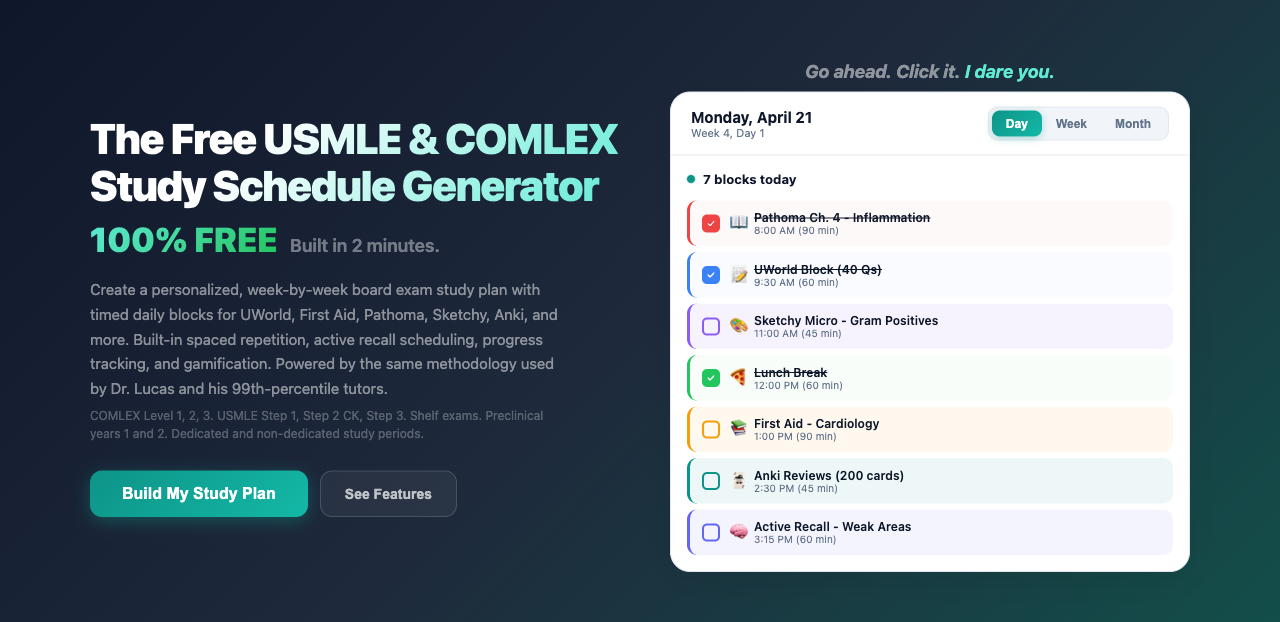
If your review is taking 20 minutes per block, you're not reviewing. You're spot-checking the explanations for the questions you missed and skipping everything else. If it's taking 4 hours per block, you've drifted into rabbit-hole territory and you're reading every answer choice as if all five matter equally. The 1-to-2-hour window is the sweet spot for most students, and it's the cadence the free Premeducated Study Plan Builder bakes into your daily plan automatically.
What should you actually look at when you review a question?
When you review a question, the first decision is whether you even need to review it at all. The rule is fast: if you got it right for the right reasoning, move on. Do not re-read the explanation, do not make a card, do not admire your own correct answer. You already own that fact. Spending review time there is the single most common way students feel busy while learning nothing.
You stop and review when one of two things happened:
- You got it wrong.
- You guessed and happened to be correct.
A lucky guess is a wrong answer wearing a disguise. Treat it exactly like a miss.
Focus on the correct answer and the one you picked
Once a question earns review, narrow your attention to two answer choices: the correct answer and the choice you actually selected. That gap, between what you thought was right and what was right, is the entire lesson. Understand why the correct answer is correct, and understand why your pick was wrong or was a worse fit.
The other three distractors are mostly noise for your purposes today. You do not need to write a dissertation on why every wrong choice is wrong. If one of those other distractors is genuinely high-yield, relax, it will show up as the correct answer or the main point in a future question, and you'll learn it properly then. Trying to master all five choices on every question is how a 2-hour review balloons into a 4-hour slog and you only get through one block.
Find the main point, not the trivia
Every question has a learning summary, the one fact or concept the question is actually testing. Anchor your review to that main point. The explanation will often bury it under three paragraphs of background. Your job is to extract the single takeaway and make sure it sticks, not to memorize the whole explanation verbatim.
How do you classify rote versus comprehension questions?
Sort every question you review onto a continuum that runs from pure rote memorization on one end to logic and comprehension on the other. How you study it depends entirely on where it lands, and getting this wrong is why so many students Anki facts that should have been understood and try to "understand" facts that simply have to be memorized.
A rote question tests a fact with no underlying logic to reason your way to. The brand name of a drug, an enzyme deficiency in a pathway, a buzzword association, the bug that grows on a specific agar. There is nothing to comprehend. The fact either lives in your head or it doesn't.
A comprehension question tests a concept you can reason through. Why a patient's potassium is high given their acid-base status, how a murmur changes with a Valsalva maneuver, which step of a pathway explains a downstream lab. If you understand the mechanism, you can rebuild the answer from scratch even if you've never seen that exact stem.
Here's how the classification changes what you do:
- Rote question: make Anki cards and let spaced repetition carry it. There's nothing to understand, so memorization is the only way to consolidate it.
- Comprehension question: stop and actually understand the topic before you move on. Read around the concept until the mechanism clicks. Then add a small number of Anki cards on the definitions and on the thing you just understood, so the comprehension gets reinforced rather than re-derived from zero every time.
The trap is using Anki as a substitute for understanding. Anki is an incredible memorization tool, and it quietly becomes a crutch the moment you start memorizing your way around concepts you never actually grasped. If something makes sense, you don't need to brute-force it, it just makes sense. If there's nothing to make sense of, memorization is the whole job. Sorting each question onto the continuum forces you to be honest about which situation you're in.
How does Anki fit into question review without taking over your day?
Anki fits in as the consolidation step that runs immediately off your review, with strict limits so it stays a tool and not a second full-time job. The rule I give every student is a hard ceiling: fewer than 3 Anki cards per question you missed or guessed on. For questions you answered correctly with the right reasoning, ideally make no new cards at all.
When a reviewed question does earn cards, build them like this:
- One card on the correct answer choice.
- One card on the answer choice you picked.
- Optionally a third card on whatever else locks in the main point.
Not every question needs all three. Many need only one. The cap exists because a single thorough day of two blocks can generate hundreds of potential cards, and if you make a card for every fact you'll drown in a review queue you can never clear. The non-negotiable part of Anki is that every blue, red, and green card hits zero at least once every single day. A bloated deck makes that impossible, and a deck you can't finish is a deck that stops working.
If your Anki workflow itself feels broken, that's a separate skill worth fixing directly. I walk through deck setup, the suspend-everything-then-unsuspend-from-questions method, and the exact settings I use in how to use Anki for COMLEX.
What does reviewing one question look like, start to finish?
Here is the full loop on a single question, the way I want a student to run it. Walking one all the way through makes the abstract rules concrete.
- Check your reasoning first. You answered a question on a patient with new-onset atrial fibrillation. You picked the right rate-control agent for the right reason. Move on immediately. No card, no re-read.
- Catch the disguised miss. Next question, you guessed between two antibiotics and got lucky. Stop. A lucky guess is a miss. This one gets reviewed.
- Narrow to two choices. Read why the correct antibiotic is correct, and why the one you picked was wrong. Ignore the other three choices unless one is obviously the next thing you'd confuse it with.
- Place it on the continuum. "Which drug covers this bug" is mostly rote. There's no mechanism to reason out, so this goes to Anki, not to a 20-minute deep dive.
- Make minimal cards. One card on the correct drug-bug pairing, one card on the trap you fell for. Two cards, under the cap. Done.
- Contrast with a comprehension miss. Later you miss a question on why a patient's anion gap is elevated. That's comprehension. Now you do spend real time, until the mechanism makes sense, and then you add one or two cards on the definitions so it sticks.
Run that loop on every reviewed question and a 2-hour block review feels efficient instead of endless. You're spending your time where the score is, and skipping the work that only feels productive.
What are the most common question-review mistakes?
A few patterns waste more student hours than anything else I see. Naming them is usually enough to fix them.
The first is doing questions in tutor mode to make review "easier." Tutor mode lets you peek as you go, which feels great and teaches you nothing about timing. Test day is not in tutor mode, so train the way you'll perform: timed blocks, every time. Timing is a learned skill, and I've watched strong students run out of time on the real exam purely because they only ever practiced untimed. There's more on building speed and stamina in how long to study for COMLEX Level 1.
The second is reviewing flagged or "interesting" questions you already got right. If you nailed it for the right reason, it does not need a second look, no matter how cool the pathology was. The third is treating all five answer choices as equally worthy of study, which turns a focused 2-hour review into an unfocused 4-hour one and means you only ever finish one block a day. Stick to the correct answer and the one you picked, and let the rest come up naturally in future questions.
Frequently asked questions about reviewing practice questions
How long should it take to review a 40-question block?
Plan for about 1 to 2 hours per 40-question block. In a normal study day, two morning blocks generate roughly 4 hours of afternoon review, which is the largest single time block of the day on purpose. If your review is taking 20 minutes, you're spot-checking, not reviewing. If it's stretching past 3 hours, you're probably trying to master all five answer choices on every question instead of focusing on the correct answer and the one you picked. The 1-to-2-hour window is the target for most students.
Should I review questions I got right?
Only if you guessed. If you got a question right for the right reasoning, move on and do not make a card or re-read the explanation, because you already own that fact and review time spent there is wasted. The exception is the lucky guess. If you got it right but were genuinely unsure between two choices, treat it exactly like a miss and review it fully. A guess that happened to land is still a knowledge gap.
How many Anki cards should I make per question?
Fewer than 3 per question you missed or guessed on, and ideally zero for questions you answered correctly for the right reason. When a question does earn cards, make one on the correct answer, one on the choice you picked, and optionally a third on whatever else nails the main point. Not every question needs three. The cap matters because a thorough two-block day can spawn hundreds of potential cards, and a deck you can't drive to zero every day is a deck that quietly stops working.
What does it mean to classify a question as rote versus comprehension?
It means deciding whether the question tests a pure fact or a concept you can reason through, because that decides how you study it. Rote questions (a drug name, an enzyme deficiency, a buzzword association) have no underlying logic, so you send them straight to Anki. Comprehension questions (a mechanism, an acid-base shift, why a lab is abnormal) reward actual understanding, so you take time to grasp the concept first and then add a couple of cards to reinforce it. The mistake is memorizing concepts you should understand and trying to "understand" facts that just have to be memorized.
Should I do practice questions in timed mode or tutor mode?
Timed mode, essentially always. Test day is not in tutor mode, so practicing untimed trains the wrong skill and leaves your timing untested until it's too late to fix. Timing is a learned skill, and students who only ever use tutor mode are the ones who run out of time on the real exam even when they know the material. Do the block timed, then do your reviewing at whatever pace you need afterward. The block is for diagnosis under realistic conditions, and the unhurried part is the review that follows.
Why is review more important than doing more questions?
Because the question block only tells you what you don't know, and the review is the part that actually fixes it. A block takes about an hour to do and about 2 hours to review properly. Skipping the longer half means you generate a list of knowledge gaps and never close them, which is why piling on more volume rarely moves a stuck score. If your real problem is shallow review, doubling your question count just doubles the pile you're ignoring. Output rises when comprehension rises, and comprehension comes from review.
Build a study day where review actually fits
Most students never review thoroughly because their schedule has no room for it. The free Premeducated Study Plan Builder fixes that. It maps your timed blocks, your 1-to-2-hour reviews, and your daily Anki into a day-by-day plan built around your test date, your baseline, and your weak areas, so the review half of the work stops getting squeezed out. It's free, and you can build your plan in a few minutes.
Want a community of physicians and DO students to ask questions in while you study? The free Premeducated Skool community runs weekly office hours and a full library of question breakdowns.
Related guides
- How to use Anki effectively for COMLEX
- Why effort alone does not raise board scores
- How long should I study for COMLEX Level 1?
- What is the dedicated study period for COMLEX?
- Doctor Lucas DO on YouTube: question breakdowns, study strategy, and real student testimonials