
Effort alone does not raise board scores because COMLEX and USMLE reward adaptation, not volume. A student doing 12 hours a day of passive review, untimed questions, and unfiltered Anki can grind for months and watch the scores stay flat. The fix is almost never more hours. The fix is changing the system: timed questions in focused blocks, ruthless question review tied to spaced repetition, and a feedback loop that pivots when something is not working. This article walks through why effort plateaus, what the actual lever is, and how to know which change matters for your specific score pattern.
I'm Dr. Jean-Marc Lucas, a DO who scored 99th percentile on COMLEX. I tutor full time and run Premeducated, a multi-physician tutoring company that works with DO and MD students through COMLEX and USMLE. The single most common pattern I see on free strategy calls is a student who is doing everything they were told to do, putting in 10 to 12 hour days, and has watched their COMSAE score sit in the same 40-point band for six weeks. That student is not lazy. The system they're studying inside of is broken, and adding hours to a broken system does not fix it.
Why does studying harder stop raising board scores?
Studying harder stops working once the bottleneck stops being information and starts being interpretation. Early in dedicated, when you genuinely do not know the content, more hours move the score. Once you've seen the high-yield material once or twice, the next 200 hours of passive review barely move the needle, because what's holding the score back is not the content. It's how you process a question stem, how you decide between two close answer choices, and how fast you finish a block under timed conditions. None of that improves from another pass through a content video.
A typical plateau looks like this. The student finishes UWorld or TrueLearn at 50 to 60 percent correct. They restart the same bank, doing it in tutor mode and reading every explanation. Scores creep up a few points. Then they take a COMSAE and land in the same range as last month. The interpretation is usually "I just need more time." The reality is usually that the next gain is locked behind a different skill: timed-mode question execution, ruthless main-point review, and an Anki workflow that punishes the specific facts that beat them yesterday.
This is the moment most students burn out. They double the hours on the same broken system, cancel their day off, cut the gym, and watch the scores still not move. That is not a discipline failure. That is the system asking for adaptation, not volume.
Effort is not the variable. Adaptation is the variable.
The students whose scores actually move are not the ones logging the most hours. They're the ones changing what they're doing when something stops working. The honest test is whether your week three of dedicated looks meaningfully different from your week one. If the answer is "more of the same, just harder," the plateau is already baked in.
Laura is a real student of mine. Her testimonial video is on the Doctor Lucas DO YouTube channel, and her LinkedIn is in the description if you want to verify any of this. She came to us after working with a big-name online prep course. Their plan was three hours of lecture per day plus 80 questions per day. She did the work. Her COMSAE was sitting at 327, and her school had a 450 cutoff that, if she missed it, could expel her before she ever sat for COMLEX. The hours were not the problem. In her own words: "I just needed to change my thought pattern in order to understand what the test writers were wanting." Once we changed the system around her, her scores moved through 440, stalled at 440, 440, 439 for a few weeks, then jumped to 510. She passed COMLEX Level 1 first attempt, passed all her shelves, passed Level 2 first attempt, and got 18 residency interviews.
Notice what changed. It wasn't the hours. It wasn't the number of questions. It was the way she reviewed them and the thought process she was building around the stems. That is the variable. Effort is the cost of admission. Adaptation is the lever.
What does an "adaptation problem" look like on a real student's score history?
There are four patterns I see repeatedly when a student is grinding hard with no score movement. If one of these is yours, the fix is structural, not motivational.
1. Passive review with no active recall
If your week looks like watching content videos, reading qbank explanations, and "going through Anki" without paying attention to whether you actually got the cards right, you are not building recall. You are building familiarity. Familiarity feels like learning. It does not transfer to the exam. The fix is to convert every study block into active recall: timed questions, then a ruthless review where you write the main point in your own words, then targeted Anki cards on the specific facts you missed. Less than three cards per missed question, ideally zero on questions you got right for the right reason. That ratio is from how I structure 1-on-1 tutoring and is laid out in detail in the Premeducated free Skool community curriculum.
2. Anki used as a crutch instead of a tool
Clayton is another real student of mine. He's a DO/PhD candidate applying neurosurgery, and his testimonial video is on the channel with his contact info in the description. When he came to us, he was doing about 2,000 Anki cards a day, sitting in front of the TV and smashing the space bar while he ate. His words: "I always felt so stupid when I did a practice question. So I'm like, I'm just going to Anki my way to it." His score was stuck. He had a 425 with a 450 school cutoff two weeks before COMLEX and three months of grind already behind him.
His diagnosis was the polar opposite of the typical Anki problem. The typical mistake is not using Anki at all. Clayton's mistake was treating Anki as a substitute for comprehension. "Number one pitfall is not using Anki," I told him. "Number two pitfall is not using it correctly. You were a deep number two." We slowly phased out the bulk Anki habit and built question analysis in its place. He cleared the 450 gate and passed COMLEX Level 1 first attempt. His takeaway, in his words: "When I went into studying for boards, I thought it was content. It really isn't content. It was learning how to answer the questions and getting into the mind of the test maker."
3. Untimed questions, then surprise at the timed-mode score
Speed on COMLEX and USMLE is a learned skill, and you only learn it by practicing the way you'll execute on test day. That means timed mode, every block, every day. I've had students who could not finish 20 to 40 questions on every shelf and every COMLEX they'd ever taken, with no formal accommodations and no diagnosed disability. They were genuinely slow at processing stems, and no amount of additional content review fixed it. The single fix was building finishing-on-time into the daily structure: timed mode, restructured question approach starting from the vitals and moving backward through the stem, and a steady ramp from two blocks per day toward three or four as test day got closer. If your tutor-mode percentage is fine but your timed-mode percentage drops sharply, that gap is the entire problem. More hours of untimed practice will not close it.
4. Burnout masquerading as a content problem
There is a point at which more hours actively lowers the score. I burned out before residency. I know what it looks like from the inside, and I see it on free strategy calls weekly. The pattern: scores were trending up, then flattened, then dipped. Sleep is poor. The student has cut their day off because they "do not deserve it" until their scores move. They feel foggy during questions. They've started missing facts they knew cold a month ago. None of that is a content problem. It is a recovery problem. Scheduled time off, real sleep, and an honest look at whether the depression or anxiety screens are positive, that is the intervention. A 50-point gap between COMSAE and the real exam, when it shows up after a long grind, is also a flag for the testing-anxiety pattern, which is treatable with structured exposure work and, when appropriate, a therapist or psychiatrist.
How do I know if I am stuck on effort instead of adaptation?
Pull up your last three to five practice tests and look at three things. First, the trend: are scores moving up at all over the last four to six weeks, even slowly? If yes, the system is probably working and patience is the play. If they're flat or moving down, the system is the issue. Second, the timed-versus-untimed gap: if your tutor-mode percentage is solid but your timed-block percentage drops by ten or more points, the problem is speed and execution, not content. Third, your day-off pattern: if you've cut your scheduled day off and your scores have not moved as a result, that is direct evidence that more hours are not the variable.
Three more diagnostic signals show up frequently. The first is the question-review gap: if you do questions but spend less than an hour reviewing each 40-question block, you are not extracting the value the questions contain. The second is Anki-as-noise: hundreds or thousands of cards a day with no tie to question review is volume without signal. The third is the same-mistake pattern: missing the same type of question (mechanism stems, two-step pharm, OMM interpretation) week after week with no targeted plan to fix it. Any of those three is a system signal, not an effort signal.
What actually changes a flat score?
The reliable lever is a focused, repeatable loop: timed question block, structured review of the main point and the one you picked, targeted Anki on what beat you, and a daily plan that pivots tomorrow based on what you missed today. Around that loop, the supporting pieces are scheduled time off, a practice test every one to two weeks, and a community or coach you trust to call out when your plan needs to change.
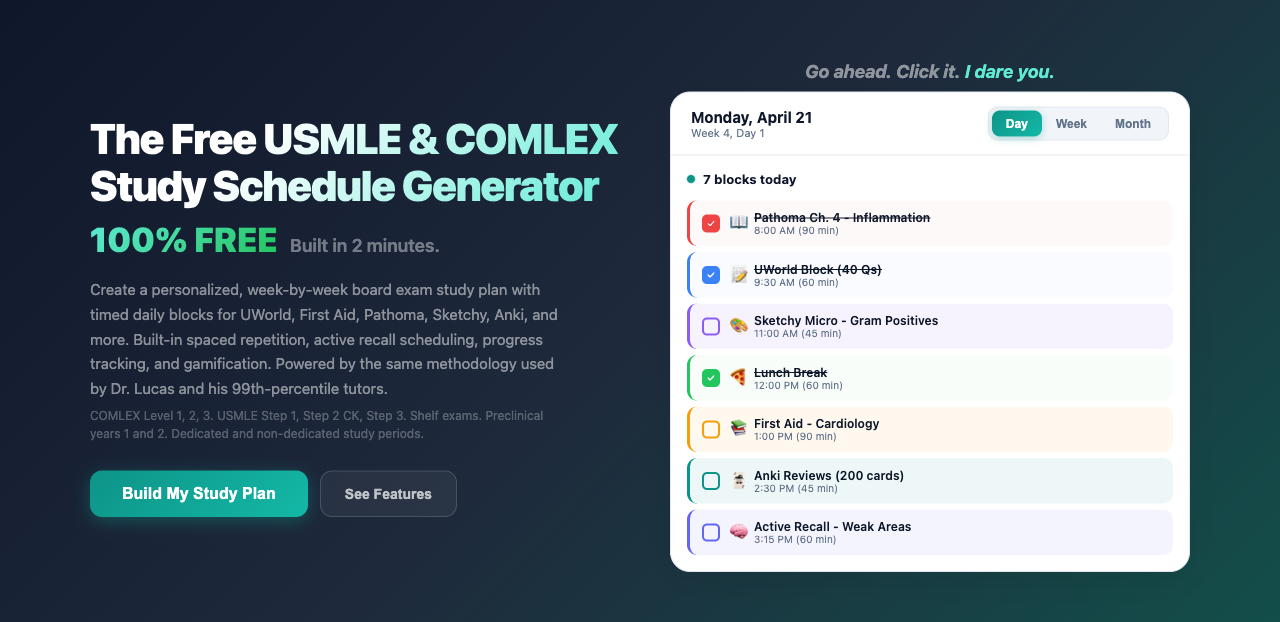
For students who want the structure without paying for tutoring, the free Premeducated Study Plan Builder gives you the same daily template I use with 1-on-1 students, personalized to your test date, baseline, and weak areas. The free Skool community layers in weekly office hours with physician tutors, a video library of question breakdowns, and direct DM access to me if you get stuck. Together those two resources cover most of what a struggling student actually needs. Use them, stay on the plan, and trust the loop.
If your scores have been flat for four weeks or more, if you've already failed once, or if there is a school deadline forcing a faster turnaround than your current trajectory will hit, that's the situation where 1-on-1 tutoring usually pays for itself. The free strategy call is the way to figure out whether you're actually in that group. About half the students who come to us on a call don't need to hire us, and we tell them so.
Frequently asked questions about effort, plateaus, and board scores
Why are my COMSAE scores not improving even though I study 10 to 12 hours a day?
The most common cause is a system mismatch, not an effort gap. If your daily plan is dominated by passive review, content videos, untimed questions, or unfiltered Anki, adding hours to that mix does not move the score. The interventions that actually work are timed-mode question blocks every day, one to two hours of structured review per block focused on the main point and the answer you picked, fewer than three new Anki cards per missed question, and a practice test every one to two weeks. If your trend has been flat for four to six weeks despite consistent effort, that is a structural signal. The fix is changing what you do, not doing more of the same.
How many hours per day should I actually study during dedicated?
Most students do best with seven to ten hours of focused work per day during dedicated, broken into roughly two-hour blocks with short breaks, plus one scheduled day off per week. Twelve-plus hour days sound disciplined and usually are not sustainable. They tend to bring diminishing returns by week three or four because the marginal hour is spent fatigued, foggy, and burning recall instead of building it. If you are stuck on a plateau, do not solve it by adding hours. Solve it by changing what is inside the hours you already have.
Is it normal for board scores to plateau before going up?
Yes, and the canonical example is Laura, the student described in this article. Her COMSAE sat at 440, 440, 439 for several weeks before jumping to 510. Plateaus before breakthroughs are common because the underlying skills (timed execution, question analysis, the thought pattern test writers reward) build invisibly until they cross a threshold. The thing to watch is whether you are doing genuinely different work during the plateau or just grinding harder. The first leads to a breakthrough. The second does not.
Should I cut my day off if my scores are not moving?
No. Cutting your scheduled day off is one of the most reliable ways to make a plateau worse. Sleep, recovery, and real distance from the material are how the brain consolidates what you reviewed during the week. The students who improve fastest are usually the ones who hold the line on the day off even when their scores feel scary. If the day off is the variable you're tempted to cut, that is itself a signal that you are pattern-matching to effort instead of adaptation.
How do I know if my plateau is from a content gap, a strategy gap, or burnout?
Triangulate from three signals. Pull up a missed question, read the explanation, and ask yourself whether the concept is genuinely new to you. New information points to a content gap. A response of "I knew that, I just didn't pick it under pressure" points to a strategy or interpretation gap. Burnout is the diagnosis when you're missing facts you used to know cold, feeling foggy during questions, and sleeping poorly. Most stuck students have a mix, with strategy and burnout dominating. Pure content gaps almost never explain a four-week plateau in a student who is studying eight-plus hours a day.
When should I ask for outside help on my study plan?
Ask earlier than you think. The right time is roughly four weeks of flat or declining scores despite a consistent eight to ten hour daily plan, especially if you have a school deadline, a previous failed attempt, or a real-exam-versus-COMSAE gap of fifty or more points. The free strategy call is built to figure out whether the gap is something you can close on the free resources or whether 1-on-1 tutoring genuinely fits. Either way you leave with a personalized study plan and an honest read on what is actually broken.
Related guides
- Why do smart med students fail board exams?
- Who actually needs a COMLEX tutor and who does not
- How to use Anki effectively for COMLEX
- What is a good COMSAE score for COMLEX Level 1?
- How long should I study for COMLEX Level 1?
## Get the structure without paying for tutoring The Premeducated [free Skool community](https://skool.com/premeducated?utm\_source=blog&utm\_medium=article&utm\_campaign=why-effort-alone-does-not-raise-board-scores) is built for students who are putting in the hours and not seeing the scores. You'll get weekly office hours with physician tutors, a 100-plus video library of question breakdowns, cloze-deletion Anki cards transcribed from my YouTube library, and DM access to me when you're stuck. It's free. Most of the students who close the gap on their own do it here. [**Join the free Premeducated Skool community**](https://skool.com/premeducated?utm\_source=blog&utm\_medium=article&utm\_campaign=why-effort-alone-does-not-raise-board-scores)