
Smart med students fail board exams because the system they're studying with is broken, not because they're lazy or unintelligent. Most are studying 12 or more hours a day, doing thousands of Anki cards, and watching every video they can find. The three failures that show up over and over are a curriculum mismatch between med school content and what boards actually test, a study strategy built on passive review instead of active recall, and untreated test anxiety or burnout. Effort almost never solves any of these. A different system does.
I'm Dr. Jean-Marc Lucas, a DO who scored 99th percentile on COMLEX, and I've tutored hundreds of DO and MD students through COMLEX and USMLE. The pass rate across our cohorts is 98%. The students who reach out after a fail come from a wider range than most people assume. Most had been quietly struggling through preclinical and on shelf exams already. A smaller group felt like preclinical was fine right up until the score came back. Almost all of them did well in undergrad. They walked out of test day with a number that didn't match the work they put in. This article is the honest version of why that happens.
What does a "smart med student who failed boards" actually look like?
Most studied 10 to 14 hours a day for 8 to 12 weeks of dedicated. They finished UWorld or TrueLearn, often twice. They did 200 to 1,000 Anki cards a day. They watched Sketchy, Pathoma, Boards and Beyond, OnlineMedEd, and Dirty Medicine. Most had been quietly fighting through preclinical, with shelf exams sliding by a few points each rotation. A smaller group felt fine up until dedicated and got blindsided by the real-exam score. Almost all of them did well in undergrad. They felt prepared the week before the exam. Then they walked in, finished the day exhausted, and got a score back somewhere between 280 and 380 on COMLEX, or a fail on Step 1.
Almost none of these students failed because of effort. The work was real. The hours were real. Those hours just weren't building anything that the test was going to ask them to use.
Here is the part most students aren't told. About 1 in 10 osteopathic medical students fail COMLEX Level 1 on a first attempt. At some DO schools the first-time pass rate is closer to 85%, which means about 1 in 7 of those students don't pass on attempt one. USMLE Step 1 used to run at a 98% pass rate before the pass/fail change in 2022. By 2024, the published Step 1 pass rate had fallen to 91%. The Level 2 numbers have followed the same trend. None of those failures land randomly. They cluster around the same three system breakdowns.
Why do smart students fail despite studying harder than everyone else?
Three failures show up again and again. Most students who fail are caught in at least one of them, and many are caught in all three at the same time.
1. The curriculum mismatch nobody warned you about
Medical schools mostly aren't optimized to help you pass boards. That's not an insult to the faculty. It's a description of how the curriculum was built. Most preclinical courses are taught by PhDs who've never sat for COMLEX or USMLE, and by clinical faculty who are excellent doctors but who optimize for clinical-year medicine, not for boards. Both groups teach you to think like a researcher or a junior attending. Boards don't test that.
Boards test broad, superficial recognition of common presentations of common diseases. The exam doesn't reward depth. It rewards pattern matching at speed. My second-year microbiology lectures covered dozens of bacteria that never showed up on a single board question or practice question. The hours I spent on those bacteria weren't wasted as a future physician, but they were wasted as a future test taker.
A DO faculty member who scored 99th percentile on a recent COMLEX, who specializes in board prep, and who is in charge of your school's board prep curriculum is exceedingly rare. There may not be a single one at any DO school in the country. The result is that every osteopathic student is, by default, studying a curriculum that wasn't built for the test they're about to sit for. A smart student who trusts the curriculum and grinds through it isn't lazy. They're following the syllabus. The syllabus is just pointed at a different target than the exam.
If you want a fast diagnostic on whether your school's content matches what you're studying for, take an unused COMSAE during the first week of dedicated. Compare the score to the time you've spent on each section of class material. The mismatch usually shows up immediately.
2. The study strategy that quietly burns the score
The second failure is bigger than the first one. Smart students are usually fluent in passive review because passive review worked in undergrad. Reading, rereading, highlighting First Aid, rewatching lectures, copying notes into a beautiful color-coded document. All of this feels productive. None of it builds the retrieval skill that boards reward.
The Ebbinghaus forgetting curve is real. After watching a content video or reading a textbook chapter, you'll forget around 70% of it within 24 hours unless you actively retrieve the information again. Spaced repetition exists specifically to fight that decay. The catch is that spaced repetition only works when the cards are tied to what you're actively studying. Random Anki cards from a 25,000-card deck reviewed in a vacuum won't save you. A premade deck with cards unsuspended after question review will.
The other half of the failure is what students do with practice questions. The tutor mode trap is the biggest one. A student opens a UWorld block, reads each stem, looks at the answer choices, peeks at the explanation when they get stuck, and tells themselves they're "learning the material." That isn't what boards test. Boards test timed, no-help, all-eight-blocks-in-a-row execution. Speed and stamina are learned skills. They're only learned by practicing the way you'll execute on test day, which means timed mode, no tutor mode, every block, every day.
The 1-on-1 students we work with at Premeducated study around 8 hours a day. That sounds like less than the 12-to-14-hour grinder, and it is. The structure of those 8 hours is what carries the score. Two hours of timed questions, four hours of structured question review, two hours of Anki tied to what they reviewed, one practice test every 1 to 2 weeks, one full day off per week. When students finally switch from a high-volume passive-review plan to a structured active-recall plan, it isn't unusual to see a 70-point COMSAE jump in a month. Some students jump 100-plus points in a few weeks. Nobody got smarter. The system changed.
3. The mental health failures everyone tries to push through
The third failure is the one nobody wants to talk about. Burnout and test anxiety aren't personal weaknesses. They're medical conditions with structured treatment, and they're extraordinarily common in dedicated. They're also the single biggest reason high-achieving students underperform on the real exam.
Burnout looks like 12 to 14 hour study days, exhaustion, irritability, falling motivation, sliding question accuracy on topics you used to know, and a loss of the spark that drove you into medicine. Once burnout is entrenched, your retention drops, your speed drops, and you start studying the same content twice without realizing it. Scheduled rest isn't optional. One full day off per week, real sleep, time outside the apartment, and a couple of social hours a week are part of the study plan, not a reward for finishing the study plan.
Test anxiety is the silent killer of board scores. The classic pattern is a 50 to 200 point gap between practice scores and the real exam, often repeating across multiple standardized tests in the student's history. I've seen students post 500s, 600s, and even a 700 on a COMSAE and then fail the actual COMLEX. The diagnosis is rarely a knowledge gap. It's a headspace gap that no amount of additional Anki will fix. Therapy, psychiatry, structured exposure work through proctored mock exams, and a buffer-room rule on practice scores all exist for a reason. Start that work early. Therapy and psychiatry both have wait lists, and acute test-anxiety prophylaxis takes time to titrate.
There is one more rule worth printing on the wall. If you've had bad news recently, the kind that consumes your mental energy, don't test. Bereavement, a family medical crisis, the end of a serious relationship. I've heard from too many students who pushed through a fresh grief and failed. The grief itself is enough to fail you. A 2 to 4 week postponement is far cheaper than a 6 to 12 month recovery from a fail.
How can you tell if you're heading toward a board failure?
There are warning signs that show up weeks before test day. Catching them early is the difference between a passing score and a failure that costs you a year. None of these are predictions. They're flags that tell you to change the plan now, not after the score arrives.
The academic flags:
- A history of struggling on standardized exams (MCAT, prior board attempts, repeated shelf failures). Standardized test performance is more consistent across a career than most students think.
- A preclinical track record of repeated remediation or barely passing.
- Anki used as a random shuffle disconnected from active learning.
- A study plan built on memorization without understanding the underlying pathophysiology.
- COMSAE or NBME practice scores that have been flat or declining for 4 weeks despite consistent effort. The same study strategy has a ceiling, and time is finite.
The mental health flags:
- Severe pre-exam symptoms (palpitations, sweating, brain fog, insomnia, GI distress on test day).
- Studying 12 to 14 hours a day with falling retention and rising irritability.
- A recent major life event that's occupying real mental bandwidth.
The score flags Lucas uses with 1-on-1 students:
- Two most recent COMSAEs below 400. NBOME data from 2025 shows that a COMSAE above 400 maps to roughly a 94% chance of passing COMLEX Level 1. Above 450 maps to roughly a 99% chance. Below 400 the math gets meaningfully worse.
- A 50-plus point gap between recent COMSAEs and a previous real-exam score. The buffer-room rule is real. If you dropped 50 points last attempt, target 50-plus above the prior COMSAE this attempt.
- Question bank percentile in the last 100 questions sitting under the 5th to 9th percentile threshold (3rd percentile for Level 3) in the final two weeks before the exam.
If any combination of these flags is firing, the right move isn't to add more hours. The right move is to change the plan, often with help, and possibly to postpone by 2 to 4 weeks at a time. Meaningful change shows up on a two-week granularity, which is why postponements are most useful in two-week increments.
Justin's story: the failure that was never about content
Justin Babitz is a real student of mine. His testimonial video is on the Doctor Lucas DO YouTube channel, and his contact info is in the description if you want to reach out and verify any of this yourself. Justin failed COMLEX Level 2 on his first attempt with a score in the low 320s. His school gave him 6 weeks to retake. He'd been studying with another tutoring company before he found us. The plan there was, in his own words, doing a crap ton of UWorld questions and not much else.
When he came to us, we put him in front of a baseline practice test on day one. He scored 280. That's first percentile. I was, honestly, regretting some of my life choices that morning.
We didn't pile on volume. We did the opposite. He was assigned a multi-physician team (an OMM specialist, a neurologist, an EM doctor, and me), a daily-pivot study plan that retargeted to the topics he missed yesterday, and a strict accountability cadence. He referred to his side of the deal as "yes drill sergeant" mode. He stopped trying to optimize. He executed. Six weeks later he sat for his retake and scored a 440-plus. That's over 100 points above his original failure and over 160 points above the post-fail 280 baseline.
What changed wasn't Justin's intelligence or his work ethic. Both were already maxed out. What changed was his system. He went from "shooting in the dark" to a structured plan that pivoted around his actual weak spots and gave him people to call when something stopped working.
What actually fixes the smart-student-fails-boards pattern?
The interventions aren't exotic. They're the boring ones, executed consistently.
- Rip out passive review and rebuild on active recall. Stop rereading notes. Stop rewatching lectures you've already watched. Spend the day doing timed question blocks, structured question review, and Anki tied to that review.
- Pin Anki to your real learning, not to a shuffled deck. Use a premade deck like AnKing, suspend everything by default, and unsuspend cards in response to question review and to videos you're watching for a specific weak topic.
- Run high-yield content first. Use the score report and the question bank percentile to find the bottom 3 to 5 disciplines or systems. Build focused blocks of 4 to 6 question sets per discipline against those weak spots. Diversify after the high-yield gaps are closed, not before.
- Treat your mental health like any other clinical problem. Therapy, psychiatry, structured rest. The standard of care for a student in dedicated should be the same standard of care we'd deliver to a patient with the same symptoms.
- Practice the way you'll perform. Timed mode only. All blocks. Real-day cadence on the practice tests. Use the same start time, the same break structure, the same lunch window. Stamina can't be cheated into existence in week 12.
- Run a postpone check at the 4-weeks-out mark. Pull your last two COMSAEs, your last 100-question percentile, your trend over 4 weeks, and your honest self-confidence read. If the math says push, push 2 to 4 weeks. The push is cheaper than the fail.
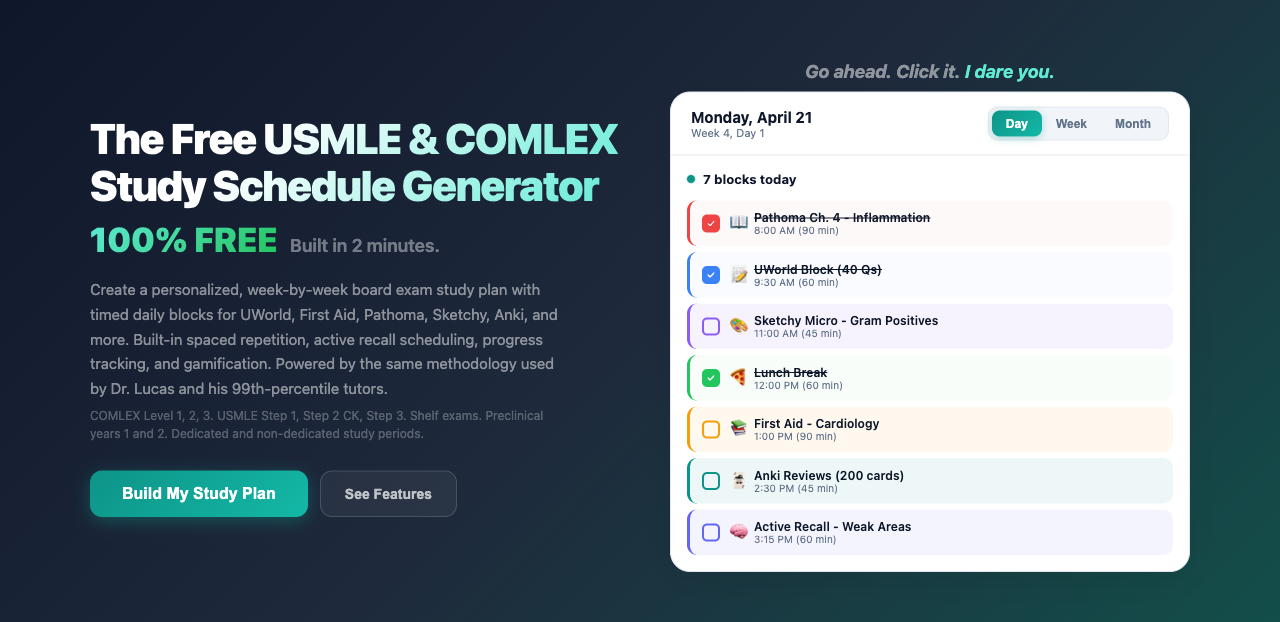
If any of this resonates and you want a structured template you can use right now, the free Premeducated Study Plan Builder builds the schedule above personalized to your test date, baseline, and weak areas in a few minutes. The free Skool community is where the weekly office hours, the question-breakdown video library, and the daily question-and-answer thread with physician tutors live.
Frequently asked questions about why smart med students fail board exams
Is failing boards a sign that I'm not smart enough to be a doctor?
No, and the data doesn't support that interpretation. Around 10 to 15% of practicing physicians failed COMLEX or USMLE on a first attempt. A board failure is most often a sign that a specific system in the prep was broken. Untreated test anxiety, a passive-review-heavy plan, a curriculum mismatch with what the test asks, or a major life event during dedicated. None of those describe an intelligence ceiling. They describe a fixable plan. Many of our students who came to us after a failure ended up matching into the residency they wanted, including in competitive specialties.
How can practice scores be high and the real exam score still be low?
The most common cause is testing anxiety, which is a real medical condition with structured treatment, not a personality flaw. The classic pattern is a 50 to 200 point drop from practice to the real exam, often repeating across multiple standardized tests in the student's history (MCAT, shelves, prior board attempts). The fix is structured exposure through proctored mock exams in unfamiliar environments, mental health support from a therapist or psychiatrist, and a buffer-room rule on the next round of practice tests. More content review won't close the gap.
How many hours a day should I actually be studying for COMLEX or USMLE?
About 8 hours of structured work per day, plus an optional 1 to 2 hours of content review. Smart students often try to grind 12 to 14 hours a day, which sounds like more but produces less because the back end of the day is high-volume passive review. The 8-hour day is two hours of timed questions, four hours of structured question review, and two hours of Anki tied to that review. One full day off per week is non-negotiable. The day off is part of the plan, not a reward for finishing it.
Should I postpone my exam if my COMSAE is below 450?
Maybe. The 450 COMSAE threshold maps to roughly a 99% pass probability per NBOME data, and a COMSAE above 400 maps to around 94% per the 2025 NBOME poster. Below 400 the math gets meaningfully worse. Score isn't the only input though. The full postpone read pulls in your trend over the last 4 to 6 weeks, your recent question bank percentile, rotation or leave-of-absence pressure, your test-anxiety self-assessment, and your honest confidence read. If you've had recent bad news (a death in the family, a major life event), don't test. Postpone in 2-to-4-week intervals. Meaningful change shows up on a two-week granularity.
What's the difference between burnout and test anxiety?
Burnout is the result of sustained over-effort without recovery. The signal is exhaustion, irritability, falling retention, and a slow loss of motivation that creeps in over weeks. The fix is structured rest, a real day off, sleep, and often a therapist. Test anxiety is acute and exam-specific. The signal is palpitations, sweating, brain fog, GI symptoms, insomnia the night before, and a consistent practice-to-real-exam score gap. The fix is structured exposure through proctored mock exams, plus mental health support that may include medication. Both can show up in the same student, and both are treated.
How do I know if I should hire a tutor versus stick with free resources?
Most students don't need 1-on-1 tutoring. If your two most recent COMSAE scores are above 450, your trend is moving up, and you have a track record of standardized-test performance, you can usually close the gap with the free Skool community and the free Study Plan Builder. The students who genuinely benefit from a tutor fall into four patterns: working hard but stuck on a flat trend, retaking after a failure with the same broken plan, real-exam scores that drop from practice (anxiety pattern), or consistent timing failures on practice blocks. The full breakdown is in the who actually needs a COMLEX tutor guide.
## Join the free Premeducated Skool community If anything in this article landed, the place to go next is the free Premeducated Skool community. Weekly live office hours with physician tutors, a 100-plus video library of question breakdowns, cloze-deletion Anki cards transcribed from my video library, daily question-and-answer threads with DO and MD physicians, and direct DM access to me. Many students close the entire gap on free resources alone. [**Join the free Skool community**](https://skool.com/premeducated?utm\_source=blog&utm\_medium=article&utm\_campaign=why-do-smart-med-students-fail-board-exams)
Related guides and video resources
- Who actually needs a COMLEX tutor and who does not
- How long should I study for COMLEX Level 1?
- What is a good COMSAE score for COMLEX Level 1?
- How to use Anki effectively for COMLEX
- Doctor Lucas DO on YouTube: full library of COMLEX strategy, score interpretation, postponement, and burnout videos