
The dedicated study period, usually shortened to "dedicated," is the block of full-time, exam-only study a DO student sets aside right before COMLEX, with classes and clinical duties cleared off the calendar. For most first-time test takers it runs 4 to 8 weeks, built around timed question blocks, structured question review, daily Anki, and a practice COMSAE every 1 to 2 weeks. Many osteopathic medical schools block a dedicated window into the calendar, and some require a passing COMSAE score before they'll clear you to sit. Likewise, some allopathic medical schools block out a similar amount of time and require students to achieve a passing score on an NBME (CBSSA or CBSE) before being allowed to sit for USMLE. How long yours should be depends far more on your baseline practice score than on how many hours you can grind.
What does "dedicated" actually mean for COMLEX?
Dedicated is the period when board prep becomes your full-time job. There are no lectures to attend, no rotations to show up for, and no other coursework competing for your attention. The single goal is passing COMLEX Level 1 (or Level 2-CE), and your whole day is structured around that one outcome.
The word does a lot of quiet work. Before dedicated, you're studying for boards while juggling classes or clinical responsibilities, which means a few hours squeezed in around everything else. During dedicated, the ratio flips. You're putting in roughly 8 hours of focused board prep per day, and the rest of your obligations have been deliberately cleared so they don't pull you off the plan.
That distinction matters because the two phases call for different strategies. Studying around classes is about building a foundation and staying current. Dedicated is about consolidating that foundation, fixing weak areas under timed conditions, and rehearsing the exact rhythm of test day until it feels routine. If you're still in coursework and trying to figure out how to balance both, that's a separate question covered in studying for boards while still in classes.
How long is the dedicated study period for COMLEX?
Most first-time DO test takers need 4 to 8 weeks of dedicated study for COMLEX Level 1. Students already scoring in the 400s or 500s on a recent COMSAE often need only 2 to 4 weeks of polishing. Students recovering from a low baseline, a previous failed attempt, or significant testing anxiety usually need 8 to 16 weeks. The best predictor of which bucket you fall into is the practice test you take 1 to 2 weeks before dedicated begins.
The three buckets I use with our 1-on-1 students:
- Strong baseline, polishing only (2 to 4 weeks). You're already scoring in the 400s or 500s on a recent COMSAE, your preclinical foundation is intact, and you have no history of failure. The dedicated period is a consolidation window, not a building window. Adding weeks here usually adds noise, not signal.
- First-time test taker, average baseline (4 to 8 weeks). Your baseline COMSAE sits somewhere in the 350 to 450 range with a mixed question-bank percentile and no major red flags. This is where most students live, and 8 weeks is plenty for the vast majority of them.
- Repeat test taker, low baseline, or significant test anxiety (8 to 16 weeks). One previous failed attempt, a baseline well below 350, a documented 50-plus point drop from COMSAE to actual exam, or a school-mandated retake under a hard gate. Eight weeks is the floor when the diagnosis is clear and a plan is in place. The 16-week end is reserved for repeat test takers, most often the multi-repeat ones.
Two things matter more than the calendar. First, baseline isn't a fixed property: students move between buckets, and a low starting score can climb fast under the right plan and feedback. Second, longer is not automatically safer. Stretching a polishing plan to 12 or 16 weeks tends to bleed momentum, and you'll forget early-block material before test day arrives. For a deeper breakdown of the timeline math, see how long to study for COMLEX Level 1.
What do schools require for the dedicated period?
School requirements vary, so the honest answer is to check your own college of osteopathic medicine's policy first. That said, most COMs build a dedicated block into the academic calendar, commonly between the end of preclinical coursework and the start of core rotations. The length the school carves out ranges widely, often from a few weeks to a couple of months, and that block is the maximum window you have rather than a recommendation tuned to your baseline.
A growing number of schools also attach a COMSAE gate. The school administers a COMSAE during dedicated and requires a minimum score, frequently a 450, before they will authorize you to sit for the real exam. Miss the gate and the consequences differ by school: some push your test date, some require a remediation plan, and a few tie it to a leave of absence or a hard deadline. None of this is universal, which is exactly why you confirm the specifics with your own administration rather than assume.
Two practical implications follow from how your school structures dedicated. If your school blocks off 10 weeks but your baseline says you only need 4, you don't have to fill the whole window with grinding; you can use the extra runway for a slower ramp or for shoring up a known weak discipline. If your school's window is shorter than your baseline calls for, that's a signal to talk with your administration early about timing and options, not to cram twice the work into half the time.
What should you actually do during dedicated?
Spend your dedicated days on four ingredients: timed question blocks, structured question review, daily Anki, and one full-length practice test every 1 to 2 weeks. A working 8-hour day splits into roughly 2 hours of timed questions, 4 hours of question review, and 2 hours of Anki. Review takes the largest share because reviewing a single 40-question block thoroughly takes most students about 2 hours, and you're reviewing two blocks a day.
The shape of the day is built on purpose to mirror test day. Under the post-May-2026 format, COMLEX Level 1 is eight 1-hour blocks of 40 questions each, with short breaks between blocks and a longer lunch in the middle, totaling 60 minutes of break time. The study day uses that same 8-block, 1-hour rhythm so timing and stamina are already in your body by the time you sit for the real thing. Here is the structure most of our 1-on-1 students run:
- Blocks 1 and 2 (8:00 to 10:05 AM): two timed 40-question blocks back to back, no tutor mode, to mirror the start of test day. Use focused blocks on weak topics until you run out, then switch to mixed blocks.
- Blocks 3 and 4 (10:10 AM to 12:15 PM): structured review of the first question block. The block itself only tells you what to study. The review is where you actually learn it.
- 30-minute lunch: mirrors the test-day lunch between sections 4 and 5. Eat, walk, reset.
- Blocks 5 and 6 (12:45 to 2:50 PM): structured review of the second morning question block, same depth as the first.
- Blocks 7 and 8 (2:55 to 5:00 PM): Anki, starting with new and learning cards, then grinding reviews until new, learning, and review counts all hit zero.
- Optional content review (5:00 to 7:00 PM): 1 to 2 hours of video on whichever section felt shakiest in the morning. Unsuspend up to 10 cards per video.
A few rules hold across every dedicated plan, regardless of which bucket you're in. Do all questions timed, because test day is not in tutor mode and timing is a skill you only build by living it. Take one full day off every week, keeping Anki reviews going so the deck doesn't balloon but skipping new questions and new content. Tie your Anki to what you just reviewed instead of shuffling random cards, which is the difference between Anki as a memory tool and Anki as a crutch, covered in how to use Anki for COMLEX.
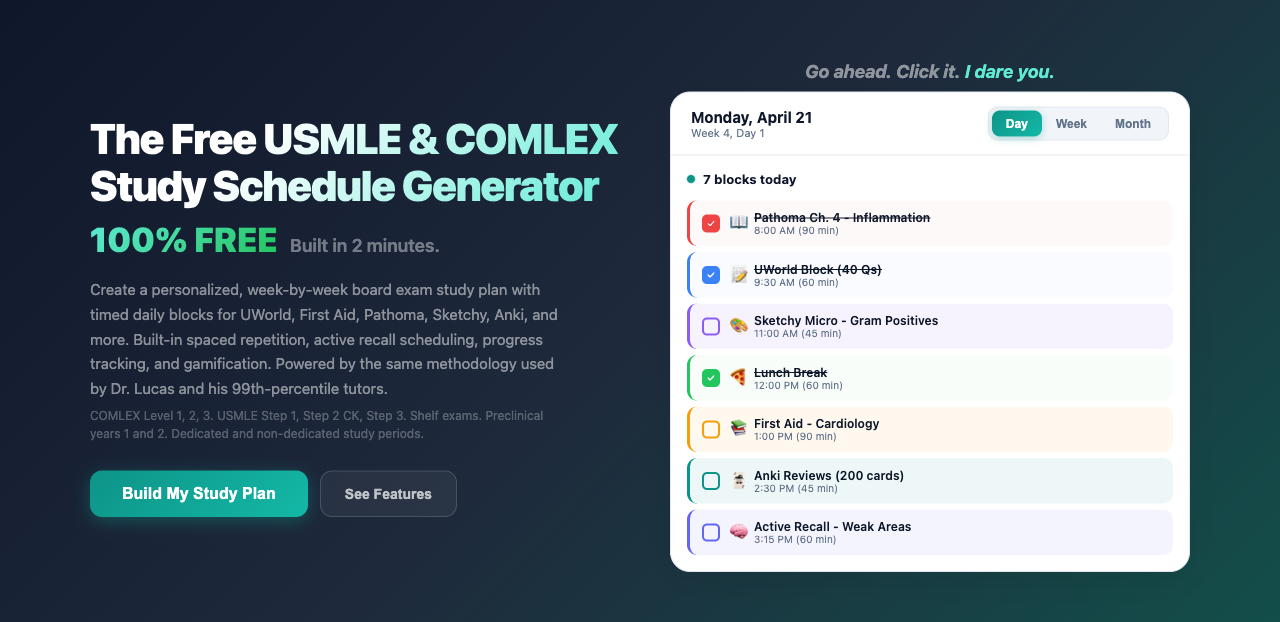
If mapping all of this against your test date sounds like a chore, the free Premeducated Study Plan Builder builds this exact schedule for you, personalized to your baseline, your weak areas, and the number of weeks you have left.
What does the final 2 weeks of dedicated look like?
The last 2 weeks shift from building to consolidating and rehearsing. Take one practice test two weeks out and another one week out, aiming for two consistent scores above 450 (above 500 is ideal, but plenty of students pass without ever hitting it). Once your focused blocks are done, switch to mixed question blocks through test day so nothing feels out of context. This is also the window for the high-yield memorization topics you've been putting off.
Two block types earn dedicated time in this stretch. Run 1 to 2 biostatistics blocks and make sure you're solid on sensitivity and specificity, relative versus absolute risk reduction, number needed to treat, odds ratios, and study-design biases. Add 1 to 2 ethics and jurisprudence blocks covering emancipated minors, EMTALA, HIPAA, and the difference between Medicare and Medicaid. These are points that students leave on the table not because the content is hard but because they never carved out time for it.
The day before the exam is sacred, and it is not a study day. At most do your morning Anki reviews, then make plans that keep you busy and away from question banks. One extra day of cramming rarely moves your score, and going in poorly rested or psyched out by a bad practice block can quietly cost you points you already earned.
How do you know if your dedicated period is working?
Readiness during dedicated is not a single number. It's a small set of consistent signals: two recent practice scores above 450, a question-bank percentile at or above the 5th to 9th range, a clear upward trend over time, and the honest sense that you feel more confident now than when you started. The NBOME's 2025 poster found that a COMSAE above 400 corresponds to roughly a 94 percent chance of passing, which is why I look for consistency above that line and treat 450-plus as the real green light.
The trend matters as much as the absolute number. A student climbing from 380 to 430 to 470 over three COMSAEs is in a very different position than a student stuck at 440, 435, 445 for a month, even though the second set looks higher on paper. A flat or declining trend over 4 to 6 weeks is a sign the plan itself is leaking time, not a sign you need to add hours. Common culprits are tutor-mode questions that never train timing, passive content review masquerading as studying, and unaddressed test anxiety. If any of that sounds familiar, a free Study Plan Builder run can surface where the leak is, and some students reach a point where working with a tutor is the faster fix.
One more honest note. If your scores have plateaued under 400 despite consistent effort, or you've had a serious life event in the run-up to test day, postponing 2 to 4 weeks is often the right call rather than a failure. Headspace on test day carries real weight, and walking in feeling like you're going to fail is its own risk factor.
## Turn your test date into a real dedicated plan The right dedicated period is the one matched to your baseline, your test date, and your weak topics, not a generic number of weeks. The free Premeducated Study Plan Builder uses the same logic Dr. Lucas uses with 1-on-1 students to lay out your daily blocks, practice-test cadence, and Anki load in a few minutes. Free, no upgrade required. [**Build my Study Plan**](https://studyplan.premeducated.com/?utm\_source=blog&utm\_medium=article&utm\_campaign=what-is-dedicated-study-period-for-comlex)
Frequently asked questions about the COMLEX dedicated study period
What does "dedicated" mean in medical school?
Dedicated refers to the stretch of full-time, exam-only study a medical student takes right before a board exam, with classes and rotations cleared from the schedule. The single goal is passing COMLEX (or USMLE), and the entire day is structured around question blocks, review, and spaced repetition. It contrasts with studying for boards while still in coursework, where prep happens in the gaps around everything else. For COMLEX Level 1, dedicated most often runs 4 to 8 weeks for first-time test takers.
How long should dedicated be for COMLEX Level 1?
Most first-time DO test takers need 4 to 8 weeks. If you're already scoring in the 400s or 500s on a recent COMSAE, 2 to 4 weeks of polishing is often enough. Students with a low baseline, a previous failed attempt, or significant testing anxiety usually need 8 to 16 weeks, with the 16-week end reserved for multi-repeat test takers. The single best predictor is the baseline practice score you post 1 to 2 weeks before dedicated begins, not how many hours a day you think you can sustain.
Does my school decide how long my dedicated period is?
Your school sets the window, but not the ideal length for you. Most colleges of osteopathic medicine block a dedicated period into the calendar, often between the end of preclinical coursework and the start of rotations, and that block is the maximum runway you have. Whether you need all of it depends on your baseline. Some schools also require a minimum COMSAE score before clearing you to sit, so confirm both the window and any score gate with your own administration early rather than assuming.
How many hours a day should I study during dedicated?
Plan on about 8 hours of structured work per day, plus an optional 1 to 2 hours of content review at the end. That breaks down as 2 hours of timed questions, 4 hours of question review, and 2 hours of Anki, run in 1-hour blocks with short breaks to mirror test day. More than 10 hours a day rarely raises scores and usually accelerates burnout. Take one full day off per week, keeping Anki reviews going while skipping new questions and content.
What should I do in the last 2 weeks of dedicated?
Take a practice test two weeks out and another one week out, aiming for two scores above 450. Move from focused blocks to mixed blocks through test day, and finally tackle the memorization topics you've been postponing. Run 1 to 2 biostatistics blocks and 1 to 2 ethics and jurisprudence blocks, since those are easy points students often skip. Keep the day before the exam completely off, doing at most your morning Anki and nothing else.
Can I pass COMLEX with a short dedicated period?
Yes, if your baseline supports it. A student walking into dedicated already scoring in the 400s on a recent COMSAE, with a solid preclinical foundation and no history of failure, can often pass after 2 to 4 weeks of focused polishing. A short window is the wrong move for a retake, a sub-350 baseline, or active testing anxiety, where 8 to 16 weeks is more realistic. The cue is always the baseline score and the trend, never the calendar alone.