
If class is already 35-plus credit hours, you cannot bolt a full second curriculum on top of it and survive. The right move is to learn your school courses as deeply as possible (because that material is on COMLEX and Step 1) and add a light board-prep overlay on top: a premade Anki deck like AnKing unsuspended as topics come up in class, plus 1 to 2 focused practice-question sets per week during MS2. Heavy board-style work belongs in dedicated, not on top of a semester load. The closer you get to test day, the more the overlay grows; until then, your class IS your prep.
Most med students hear "you should be studying for boards while you're in class" and panic, because they're already inside one of the most academically intense years of their life. The good news is the panic is usually misplaced. What you're learning in class is board studying, to a real extent. The piece you have to build on top is small if you build it right, and it's mostly about making sure class material sticks until test day rather than re-learning it from scratch in dedicated.
What does "studying for boards while still in classes" actually mean?
There are three timelines worth separating, because confusing them is the single most common reason a study plan misfires before dedicated even begins:
- Class itself. Anatomy, physiology, biochemistry, pathology, pharmacology, microbiology, and OMM if you're a DO student are all on Level 1 and Step 1. The job in class is to learn that material deeply the first time, not to "treat it as board prep" in a way that adds extra hours on top.
- A light board-prep overlay during the semester. Daily Anki (anchored to a premade board-style deck like AnKing) and a small dose of qbank questions on whatever system you're currently in class on. This is hours per week, not hours per day.
- Dedicated. A protected 2 to 16 week block right before test day, no class on the calendar. Heavy lifting happens here. Most students reading this article are not in dedicated yet, so don't try to act like you are.
The most preventable mistake we see is treating MS2 lectures as totally unrelated to boards, then waking up on day one of dedicated and realizing pathology, pharm, and micro have to be rebuilt from zero. Pay attention in class and let the class do most of the work for you. The overlay on top is small.
How much extra board prep can you realistically add when class is already 35-plus credit hours?
Be honest about your actual capacity. After a full class day plus mandatory small groups plus the OMM lab, most students have 1 to 3 hours of focused brain left before they're cooked. Trying to schedule 6 hours of board prep on top of class is how students burn out by midterms and quit Anki entirely by Thanksgiving. Build for sustainability, not for the screenshot.
Here is a realistic per-week board-prep overlay by stage of medical school:
- MS1. Daily AnKing reviews on cards that match your current class topics, 20 to 45 minutes. Unsuspend the high-yield deck cards that correspond to this week's lectures so spaced repetition is happening on material you're already learning. No qbank required at this stage. Your job is to learn the foundation deeply, not to grind board questions on content you haven't seen yet.
- MS2 first half. Anki reviews stay daily. Add 1 to 2 TrueLearn or UWorld focused-block sets per week, roughly 40 to 80 questions total, on the system you're currently studying in class. Review them slowly. The point at this stage is not score; it's pattern recognition.
- MS2 second half (roughly 3 to 6 months before dedicated). Bump qbank usage to about 10-20 questions per day on the active system. Even still, this is entirely dependent on how much classwork you have and if you can afford to spend the extra time doing this. Doing well in class should still come first. Daily Anki continues. Take an early COMSAE or NBME-style practice exam 6 to 8 weeks before dedicated begins so you have a real baseline going into your protected window.
- The last 2 to 4 weeks before dedicated starts. Treat it as a soft ramp. Wrap your final class block, sleep, and let the baseline COMSAE or CBSE/CBSSA you take 1 to 2 weeks before dedicated tell you which timeline bucket you fall into.
That's the entire overlay. Hold it for 18 months across MS2 and you'll walk into dedicated calibrated rather than panicked.
What's worth keeping during the semester
The short list of things that actually earn their hours on top of class:
- Daily Anki on a premade board-style deck like AnKing. Suspend everything in the deck on download day, then unsuspend cards as the matching lectures come up in class. This builds spaced repetition on board-relevant facts at the moment you're learning them, which is much higher yield than cramming the same material 18 months later in dedicated. Get all blue (new), red (learning), and green (review) cards to zero every day, including the day you don't have class.
- Light qbank exposure on the active system (MS2 only). A 40-question focused block on cardiology while cardio is the current class block teaches you how the test-writer phrases that material. Review slowly, take real notes on missed concepts, and let the qbank sharpen your class learning rather than replace it.
- Two Anki settings that protect your retention. Turn on auto-advance if you tend to dawdle on cards (10 to 15 seconds for "show question," 20 to 30 for "show answer"). Slide easy days down on exam weeks so the review pile doesn't balloon. Keeping spaced repetition sustainable for 18-plus months matters more than any one heroic week.
- Sleep, exercise, and one full day off every week. This isn't filler. Med students who tank their sleep through MS2 walk into dedicated already burned out and are the most likely to plateau by week 4. The full-day-off rule applies in class years too, not just dedicated. Anki reviews still happen on the day off so the deck doesn't pile up, but no qbank and no new content.
What to drop
Most of what students believe is "board prep on top of class" is either redundant or actively counterproductive when class is already 35-plus credit hours. Cut these:
- A second parallel curriculum. Trying to do a full Pathoma watch-through, a full Sketchy run, AND your school's full pathology course at the same time is a recipe for none of it sticking. Pick the resources you're using inside class and stick with them. Save full content-review pass-throughs for dedicated.
- Full-length practice exams during the semester. Save your COMSAEs and NBMEs for the run-up to dedicated. A COMSAE in MS2 first half on material you haven't been taught yet just demoralizes you and burns a finite resource (there are only so many forms). The exception is one diagnostic COMSAE 6 to 8 weeks before dedicated to set a baseline.
- Random Anki decks. Adding three more decks alongside AnKing because someone on Reddit said so doubles your daily review time and halves your retention on any of them. Lock to one comprehensive premade deck and unsuspend strategically.
- Tutor-mode qbank questions. When you do practice questions during the semester, do them timed. Tutor mode lies to you about how the exam actually feels. Building a tutor-mode habit during MS2 guarantees you'll struggle with timing on test day even if your content knowledge is solid.
- Highlighting and re-reading. Passive review feels productive and does almost nothing for board retention. Replace it with active recall: cover the slide, quiz yourself, then check. The painful version is the one that sticks.
When should you shift gears from class-mode to board-mode?
The cleanest rule from the script that seeded this article: inside 3 to 4 months of test day it's worth doing a little additional studying at the end of each day, beyond what class requires. Outside that window, if a dedicated period is coming up, you genuinely do not need to overdo it.
In practice the transition looks like this:
- More than 6 months out from test day. Class is the priority. Anki on class-matched cards happens daily. Light qbank only if you're already in MS2 second half. Sleep wins ties on cram weeks.
- 3 to 6 months out. Push qbank to roughly one focused block per day on the active system. Add 30 to 60 minutes of content review at the end of the day on whichever section felt shakiest that week. Take a diagnostic COMSAE about 6 to 8 weeks before dedicated begins.
- Final 4 to 8 weeks before dedicated. Wrap your last class block, take the true baseline COMSAE 1 to 2 weeks before dedicated starts, and let that score plus your prior history determine whether dedicated is 2, 4, 6, 8, or more weeks. The full bucket math lives in our guide on when to start studying for COMLEX Level 1.
There's no virtue in starting dedicated-mode intensity 9 months before test day. Plenty of students do it, and most of them are toast by week 4 of the real dedicated period because the well has run dry.
What separates students who walk into dedicated calibrated from those who don't
Two habits, really. They sound boring because they are boring, and that's the point.
First, the students who do well had daily Anki for 12-plus months going into dedicated. Not a perfect streak, not 1,000 cards a day, just consistent spaced repetition on material they were actively learning in class. The math here is unforgiving: a board-style fact reviewed 20 times across 18 months of spaced repetition is genuinely memorized; the same fact crammed during dedicated and never reviewed again is gone in a week. Anki used as a content-review crutch is dead weight. Anki anchored to class content as it shows up is what carries preclinical knowledge through to test day. For the full setup, see our Anki for COMLEX guide.
Second, the students who do well treated MS2 lectures as the test. They didn't add a second curriculum on the side. They added depth to the one they were already in. Pathology lectures earned full active recall notes. Sketchy got watched once carefully alongside the relevant micro and pharm blocks, not three times in a panic during dedicated. Pharm cards got unsuspended in AnKing as drugs showed up in lecture, not all at once in week 1 of dedicated. None of this is heroic. It's just compounding.
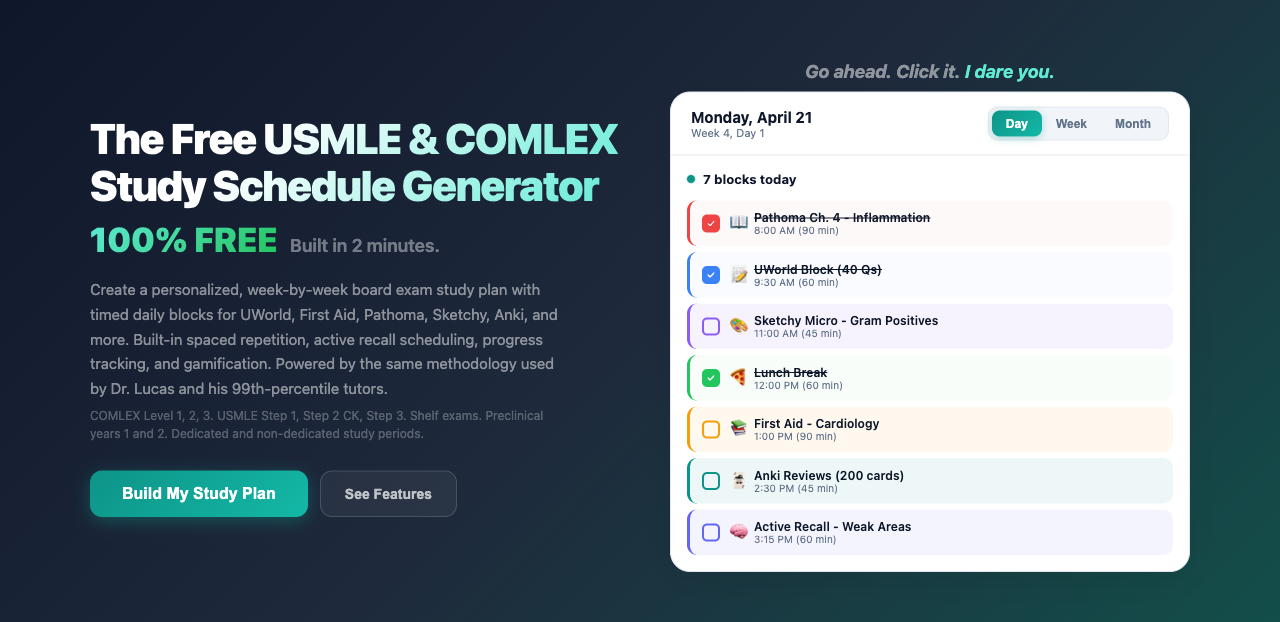
If you want a structured way to translate all of this into a personalized weekly plan, our free Study Plan Builder handles the count-back math, the system-by-system focused-block selection, and the daily Anki load for you. It uses the same logic Dr. Lucas uses with 1-on-1 tutoring students.
Frequently asked questions about studying for boards during classes
Should I start studying for COMLEX or Step 1 in MS1?
Yes, but only in the lightest possible sense. The main job in MS1 is learning your school courses deeply, because anatomy, physiology, and biochemistry are on Level 1 and Step 1. The one habit worth adding on top is daily Anki on a premade board-style deck like AnKing, unsuspending cards as the corresponding topics come up in class. That keeps high-yield material spaced and reviewed for 18-plus months instead of crammed in dedicated. Skip a full parallel board curriculum.
How many qbank questions should I do per week during MS2?
In MS2 first half, plan on 1 to 2 TrueLearn or UWorld focused-block sets per week (roughly 40 to 80 questions total) on the system you're currently studying in class. Move to about one 40-question timed block per day during MS2 second half, in the 3 to 6 month run-up to dedicated. Do them timed, not in tutor mode, because tutor mode trains a timing pattern you can't use on test day. Review slowly. At this stage the goal is pattern recognition, not score.
Is it worth doing UWorld or TrueLearn during preclinical?
A small dose, yes. UWorld and TrueLearn focused blocks during MS2 teach you the test-writer's lens on material you're actively learning in class, and that's the highest-yield use of qbank during the semester. Stick to focused blocks on the active system, do them timed, and review them slowly. Burning through 2,000 questions in MS1 on material you haven't been taught yet doesn't help; it just demoralizes you and burns a finite resource you'll need later.
Should I take a COMSAE before dedicated starts?
One diagnostic COMSAE 6 to 8 weeks before dedicated begins is a smart move. It sets a baseline before your protected study window, surfaces weak disciplines you'll want to target first, and gives you time to adjust the dedicated timeline if the score is much lower than expected. Take your true baseline COMSAE 1 to 2 weeks before dedicated begins; that's the score that determines which timeline bucket you fall into. Don't burn COMSAEs as motivation tools during MS2 first half. Save them.
How do I keep Anki sustainable during a 35-credit-hour semester?
Three settings keep Anki alive through a heavy class load. Turn on auto-advance (10 to 15 seconds on "show question," 20 to 30 on "show answer") if you tend to dwell on cards. Slide easy days down on weeks where class load spikes so the review count doesn't balloon. Unsuspend cards in small batches tied to current lectures rather than all at once. The non-negotiable habit is hitting zero on new, learning, and review cards every day so the deck doesn't pile up. For the full setup, see our Anki for COMLEX guide.
What's the biggest mistake students make trying to study for boards while in class?
Adding a full parallel curriculum on top of class. Pathoma, Sketchy, Boards & Beyond, Dirty Medicine, plus the school pathology course, plus daily qbank, all running in parallel at 35-plus credit hours. The result is everything getting half-done and nothing sticking. Pick the resources you're using inside class, layer one premade Anki deck and modest qbank exposure on top, and save full content-review pass-throughs for dedicated. Class is the foundation. Don't sabotage it trying to build a second one beside it.
## Build a study plan that fits class and boards together Translating a heavy semester load into a sustainable board-prep overlay is a planning problem before it's a willpower problem. The free Premeducated Study Plan Builder maps your test date, baseline, weak topics, and weekly class load into a personalized schedule in a few minutes. Same logic Dr. Lucas uses with 1-on-1 tutoring students. Free, no upgrade required. [**Build my Study Plan**](https://studyplan.premeducated.com/?utm\_source=blog&utm\_medium=article&utm\_campaign=how-to-study-for-boards-while-still-in-classes)