
Do 80 practice questions a day during COMLEX dedicated: two timed 40-question blocks, back to back, first thing in the morning. That number is the floor for most students and also the ceiling, because each block takes about 2 hours to review and review is where the learning happens. Go to 3 or 4 blocks a day only in the final stretch before test day, and only if you have a real timing or stamina problem.
Most students ask this question hoping the answer is 120 or 160. A bigger number feels safer, and the classmate posting 200-question days makes 80 look lazy. It isn't. The daily question count is set by how many questions you can review properly, and for almost everyone that number is 80.
How many practice questions should I do a day during COMLEX dedicated?
Two timed blocks of 40 questions, for 80 questions a day, 6 days a week. COMLEX Level 1 now runs as eight 1-hour sections of 40 questions each, so every practice block is a rehearsal of one real section at the real pace of about 1.5 minutes per question. Two blocks take 2 hours. Reviewing them takes about 4 more.
Here is how those 80 questions sit inside the day we give most of our 1-on-1 students:
- 8:00 to 9:00 AM. Timed block 1, 40 questions, no tutor mode.
- 9:05 to 10:05 AM. Timed block 2, back to back with the first to mirror the start of test day.
- 10:10 AM to 12:15 PM. Review of block 1.
- 12:45 to 2:50 PM. Review of block 2, after a 30-minute lunch.
- 2:55 to 5:00 PM. Anki until new, learning, and review cards all hit zero.
That's 2 hours of questions, 4 hours of review, and 2 hours of Anki. An optional 1 to 2 hours of content review can follow in the evening. The full breakdown lives in our guide on how many hours a day to study during dedicated.
Run the math across a week. Six study days at 80 questions is 480 questions a week, and an 8-week dedicated puts you near 3,800 questions before counting practice tests. Nobody fails COMLEX because 3,800 reviewed questions wasn't enough exposure.
Students who took the exam before May 7, 2026 will remember 44-question sections, which is why older advice says 88 a day. The format is now 320 questions in 8 sections of 40. Set your qbank to 40.
Why is 80 questions the ceiling and not just the floor?
Review capacity sets the ceiling. A thorough review of one 40-question block takes most students about 2 hours, so two blocks cost 6 hours once you count the questions themselves. Add 2 hours of Anki and the 8-hour day is full. A third block has to take its 3 hours from somewhere, and it takes them from review or from Anki.
The block itself is just diagnosis. You answer 40 questions and find out what you don't know. Nothing gets fixed until you sit with the missed and guessed questions, figure out the main point of each one, and turn the gaps into Anki cards. A student who does 160 questions and skims the explanations has diagnosed the same weaknesses four times and treated none of them.
This is the same trap as the 14-hour study day. Almost every student I meet who is failing practice tests is already working hard enough. Piling more questions onto a day with no real review just produces more percent-correct numbers, and a percent-correct number doesn't teach you anything.
Review has its own efficiency rules, and they're what make 2 hours per block possible:
- If you were correct for the right reasoning, move on.
- If you guessed and got it right, or got it wrong, focus on the main point: the learning summary and the correct answer.
- Understand the correct answer and the one you picked. The other choices matter less. If they're important, they'll show up as the main point of another question.
- Make fewer than 3 Anki cards per incorrect or guessed question, and ideally none for questions you got right for the right reason.
The full method is in our guide on how to review practice questions efficiently. If your review runs well past 2 hours per block, fix the review before you touch the question count.
Should every question be timed?
Yes. Do all of them timed, in 40-question blocks, never in tutor mode. I've heard "but tutor mode lets me learn as I go" a million times. Test day isn't in tutor mode. Unless you have 2x timing accommodations, a better percentage in tutor mode tells you nothing about how you'll perform at 1.5 minutes per question.
Timing is a learned skill. I've had many students struggle to finish sections on the real exam because they did their entire qbank in tutor mode. Eighty timed questions a day builds pacing without you having to think about it. Eighty untimed questions builds a habit you can't use on test day.
Timed blocks also protect the schedule. A 40-question timed block ends in 60 minutes. A tutor-mode block drifts to 90 or 120 minutes, and then the afternoon review gets squeezed.
What kind of blocks should those 80 questions be?
Start with focused blocks on your weak areas, then switch to mixed blocks once the focused list runs out. We assign 4 to 6 focused blocks per weak discipline and 3 to 6 per weak system, pulled from your score report or your most recent practice test. Our students do focused blocks in UWorld, except OMM and MSK, which go in COMQUEST.
TrueLearn is still the best thing we have for COMLEX-style mixed blocks, as much as everyone loves to complain about it. If you've been through TrueLearn and you're consistently scoring above average, switch to a different bank for fresh questions.
The daily count stays at 80 either way. What changes across dedicated is the content of the blocks, which we cover in how to pick focused question blocks based on weak areas.
How should my daily question count change as the exam gets closer?
For most students it shouldn't change at all. Two timed blocks a day plus a practice test every 1 to 2 weeks is enough to build the stamina for an 8-hour exam. The exception is a student with a real timing or stamina problem, who moves from 2 blocks to 3 or 4 timed blocks a day as test day approaches.
Here's the progression from preclinical to test day:
- MS2, first half. One or two focused blocks per week (roughly 40 to 80 questions total) on the system you're covering in class. Class comes first.
- MS2, second half, 3 to 6 months before dedicated. About 10 to 20 questions a day on the active system if your class load allows it. Our guide on studying for boards while still in classes covers this stage.
- Dedicated. Two timed 40-question blocks a day, 6 days a week. Focused blocks first, then mixed.
- Final 2 weeks. Still 80 a day for most students. Finish your last focused blocks, then run mixed blocks through test day in TrueLearn or COMQUEST. Swap in 1 to 2 biostatistics blocks and 1 to 2 ethics and jurisprudence blocks, since both are memorization-heavy and pay off late.
- The day before. Zero. No new questions, no practice test. A bad block the day before can't be acted on and only rattles you. See what to do the day before COMLEX.
When does going to 3 or 4 blocks a day make sense?
Two situations. The first is stamina: you hold up for the first half of a practice test and your accuracy falls apart in the back half. The second is speed: you can't finish 40 questions in 60 minutes, even after weeks of timed blocks.
If either one is you, go from 2 blocks a day to 3 or 4 timed blocks a day as you approach test day. Be honest about the cost. Those extra blocks come out of question review or content review, so you're trading learning for conditioning. That trade only makes sense late, when most of the learning is done and finishing the exam is the bigger risk.
One of my students couldn't finish 20 to 40 questions on every exam he took, including shelf exams and COMLEX Level 2. I made finishing blocks on time his number one goal. Over 1 to 2 months of timed work he started finishing, and he finished COMLEX on time, which was a miracle for him. He passed on his third attempt.
Most people don't need this. If you're finishing timed blocks with a few minutes to spare and your practice test scores don't sag in the last sections, stay at 80 and keep the review.
For stamina specifically, practice tests do more than extra blocks. Take one every 1 to 2 weeks, and consider one or two full 8-hour exam days close to test day. The cadence is laid out in how many practice tests to take before COMLEX.
What if I can't get through 80 questions a day?
Figure out which part is breaking: the blocks or the review. The two timed blocks always take 2 hours, so when students say they can't hit 80, it almost always means review is running 3 or 4 hours per block.
Slow review usually has one of three causes. You're reading every explanation for every answer choice, including the questions you got right for the right reason. Or you're making 8 Anki cards per miss, not fewer than 3. Or a missed question sends you into a 45-minute video on the whole topic in the middle of review. Save that for the optional content review window at the end of the day.
If your baseline is low enough that nearly every question is a miss, review will legitimately take longer. On a day when the hours run out, keep both timed blocks and give one of them a full review before you cut anything else. For a small group of students I switch to a content-review-first approach for the first stretch of dedicated, because questions on material you never learned don't teach much. That's the exception. Two timed blocks with real review works for the vast majority.
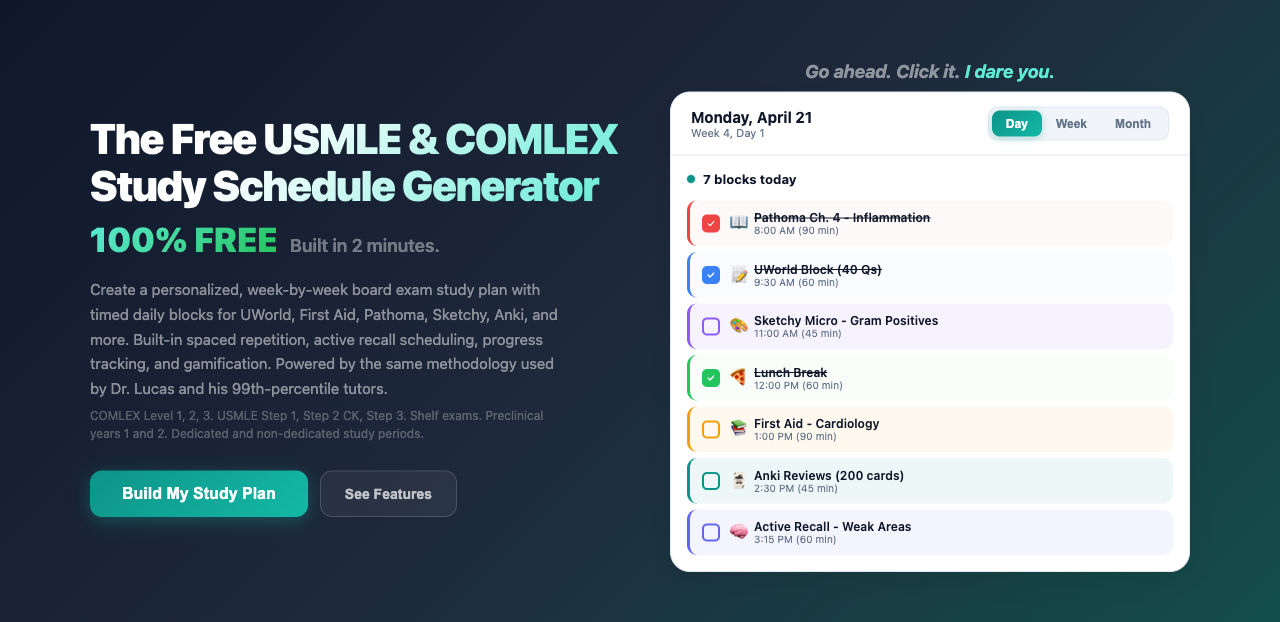
Students who want the daily blocks mapped to their test date and weak areas can use the free Study Plan Builder. It assigns the focused blocks, the mixed blocks, and the practice test days for you.
Frequently asked questions about daily COMLEX practice questions
Is 40 questions a day enough for COMLEX?
During the semester, yes. During dedicated, no. One block a day gives you half the exposure over the same number of weeks, and you never practice sitting two sections back to back the way test day opens. If 40 is all you can get through right now, the bottleneck is almost always review speed. Tighten the review rules (main point only, fewer than 3 Anki cards per miss) and you'll have room for the second block.
Is 120 or 160 questions a day too many?
For most students, yes. A 40-question block takes about 2 hours to review thoroughly, so 160 questions would need 4 hours of testing and 8 hours of review. Nobody does that, so the review is what gets cut, and review is where the learning happens. Three or four blocks a day makes sense only near test day for students with a real timing or stamina problem.
Should I do practice questions on my day off?
No. Take one full day off every week during dedicated. Do your Anki reviews that day so the cards don't pile up, and skip questions entirely. The day off is what lets you do 80 high-quality questions at 8 AM the other 6 days. Students who skip it tend to get a worse version of all 7.
Do practice test questions count toward my daily goal?
A practice test day replaces your normal blocks. A COMSAE or a full-length simulated exam is already far more than 80 questions, and piling a regular block on top adds fatigue without adding learning. Treat practice tests as their own days on the calendar, taken every 1 to 2 weeks, and go back to two blocks a day after.
How many questions should I do in total before COMLEX?
There's no magic total. Two blocks a day, 6 days a week, comes to about 480 questions a week, or roughly 3,800 over an 8-week dedicated, plus practice tests. What predicts readiness is your practice test scores, not your question count. I look for two practice test scores above 450 in the final two weeks before I call a student ready.
Should I redo questions I've already seen?
Fresh questions are better when you have them. A question you've seen before measures your memory of that question more than your grasp of the concept. If you've finished TrueLearn and you're scoring above average consistently, move to a different question bank. If you missed a concept the first time, the Anki cards you made in review are the right tool for holding onto it.
Get your 80 questions a day assigned for you
Two timed blocks a day is the easy part. Choosing which focused blocks to do, when to switch to mixed, and where the practice tests land takes most students a weekend in a spreadsheet. Our free Study Plan Builder lays it out around your test date, baseline, and weak areas in a few minutes, using the same logic I use with 1-on-1 students.