
Take one full-length practice test every 1 to 2 weeks during dedicated, plus two in the final 2 weeks before test day. For a typical 4 to 8 week dedicated period, that works out to roughly 3 to 6 tests total. The exact number depends on how many weeks you have and how many unused COMSAE forms you can get your hands on. The goal isn't a body count of exams. It's two consistent data points above 450 in your last 2 weeks, on the most exam-like forms you have.
The number itself matters less than the cadence and the order you take them in. A student with a 6-week window and four unused COMSAEs is in a very different spot than a student with a 4-week window and one unused form. Both can build a sound plan. Below is how to count the tests back from your test date, which forms to use in what order, where the USMLE crowd fits NBMEs into the rotation, and what your scores need to say before you walk in.
How many practice tests should I take before COMLEX?
Plan on one full-length practice test every 1 to 2 weeks through dedicated, with two tests squeezed into the final 2 weeks. Across most dedicated periods that lands between 3 and 6 exams. Shorter windows for strong baselines sit at the low end. Longer windows for repeat test takers can run 6 to 8 or more. The cadence is the rule. The total is just whatever the cadence produces once you map it onto your calendar.
Here is roughly how the count shakes out by timeline:
- 2 to 4 week polishing window (strong baseline): 2 to 3 tests. You're consolidating, not rebuilding, so you don't need a long data series.
- 4 to 8 week first-time window (average baseline): 3 to 6 tests. This is where most students live, and the every-2-weeks rhythm fills the calendar cleanly.
- 8 to 16 week repeat or recovery window: 6 to 8 or more. Longer windows fit more checkpoints, but the every-1-to-2-week ceiling still holds so you don't burn tests faster than you can act on them.
Those buckets line up with how long you should plan to study in the first place. If you don't know which bucket you're in yet, your baseline COMSAE score 1 to 2 weeks before dedicated is the single best predictor.
One hard limit on the high end: more practice tests is not better past a point. A full-length exam costs you a day you could spend on focused question review, and the diagnostic value of a fifth test in two weeks is close to zero. Space them so you actually have time to fix what each one exposes.
How should I space my practice tests counting back from test day?
Work backward from your test date, not forward from today. Reserve your two best unused forms for the final 2 weeks, then drop one test every 2 weeks moving earlier on the calendar. That way your most exam-like data lands when it counts most, right before you sit.
Here's the count-back method I use with 1-on-1 students:
- Lock your real test date and count the weeks of dedicated you actually have.
- Reserve two unused forms for the last 2 weeks, one about 2 weeks out and one about 1 week out. Do not schedule any practice test inside the final 5 days. Bombing a test 3 days before the real thing psyches people out, and a great score that close changes nothing about your prep.
- Place one test every 2 weeks working backward from that final pair.
- Fill the early slots with used COMSAEs or with the retail TrueLearn and COMQUEST self-assessments, and protect your unused COMSAEs for late.
- Take a baseline 1 to 2 weeks before dedicated even starts, so you walk in already knowing your bucket.
A worked example makes the rhythm obvious. Say you test on a Friday eight weeks out. You'd take an unused COMSAE about one week out and another about two weeks out (your final-2-weeks pair), then space the rest at roughly four, six, and eight weeks out. That's five tests across the window, with the two strongest forms saved for the end. Shift the same pattern onto a 4-week window and you get three tests: two weeks out, one week out, and a baseline at the start.
Which practice tests actually count toward COMLEX?
For COMLEX, COMSAEs are the closest thing you have to the real exam, so they're your priority forms. Around them sit the retail TrueLearn self-assessment and the two COMQUEST self-assessments, which fill gaps when your COMSAE pool runs thin. You do not need to swap COMSAEs out for anything else if you have enough of them to cover the cadence.
The COMSAE pool is small and worth knowing cold:
- COMLEX Level 1 purchasable COMSAEs: forms 107, 110, and 111. These come with correct answers but no explanations.
- COMLEX Level 1 school-administered COMSAEs: forms 113, 114, 115, and 116. Not every college of osteopathic medicine releases all of these, so confirm what your school actually gives you.
- COMLEX Level 2 purchasable COMSAEs: forms 108 and 111.
- COMLEX Level 2 school-administered COMSAEs: forms 107, 109, 110, and 112.
A few honest caveats on the supporting cast. COMSAE scores are genuinely variable compared to real COMLEX results, and the real questions tend to run a little longer and make a little more sense, so treat any single score as a data point and not a verdict. The TrueLearn self-assessment requires owning the TrueLearn question bank to unlock, and its three-digit "score" and "percent chance of passing" readout is not calibrated to the actual scale, so ignore those two outputs and read the underlying performance instead. COMQUEST self-assessments are a reasonable supplement that some students find a touch easy. Use TrueLearn and COMQUEST when the COMSAE pool can't fill the schedule, not as a default replacement.
If you're tight on unused COMSAEs, repeating a used COMSAE early in prep is completely fine. Early tests exist to find weak areas and build stamina, and a form you've seen before still does both jobs. Save the unused ones for the back end where the score actually has to mean something.
What if I run out of COMSAEs before test day?
Stretch the pool by ordering forms from least to most predictive. Start with a used COMSAE or the retail TrueLearn self-assessment early, slot a COMQUEST self-assessment into the middle if you need it, and keep two unused COMSAEs in reserve for the final 2 weeks. The principle is simple: your weakest data goes early when you're still building, and your most exam-like data goes late when you're deciding whether to sit.
A typical stretched sequence for a student short on forms looks like this:
- Begin with the retail TrueLearn self-assessment 6 to 8 weeks out, saving every unused COMSAE.
- Add a COMQUEST self-assessment 4 to 6 weeks out if there's a gap to fill. Repeats are acceptable for these early checkpoints.
- Continue the every-2-weeks rhythm with whatever's left, prioritizing COMSAEs as you get closer.
- Finish with your two reserved unused COMSAEs in the last 2 weeks.
Sometimes you have to get creative and run the retail TrueLearn self-assessment in the second-to-last week, then an unused COMSAE one week out. That's a fine compromise when the pool is genuinely shallow. What you don't want is to burn both unused COMSAEs in week one and walk into the final stretch with nothing but a recycled form to read.
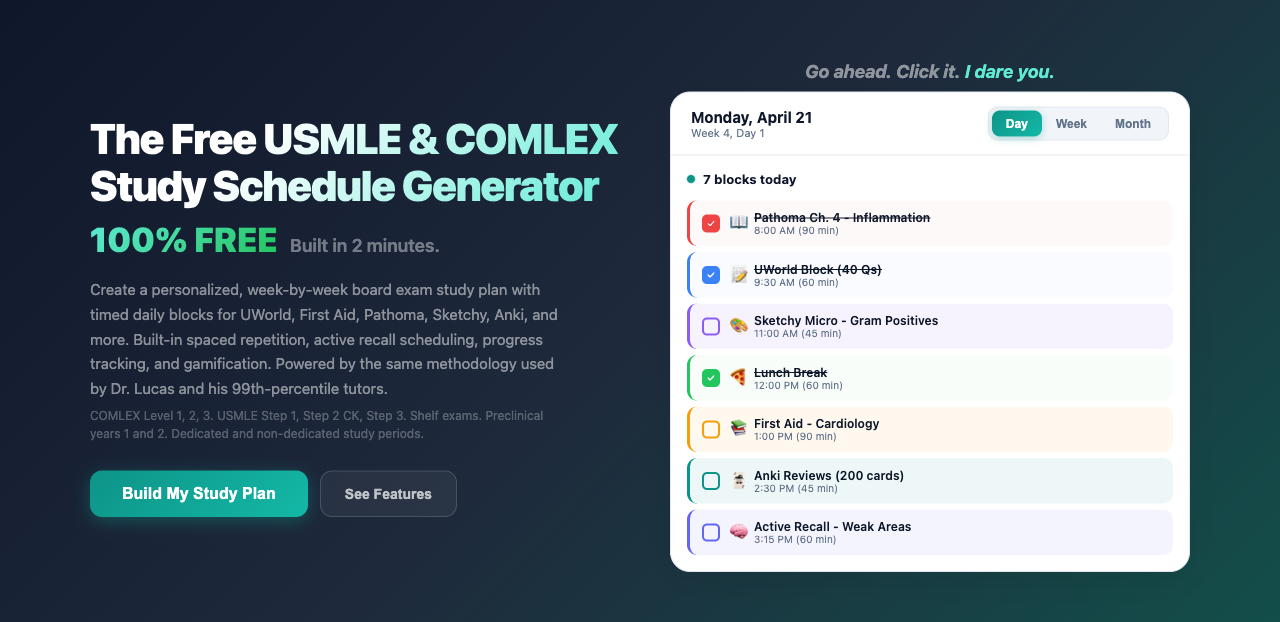
Mapping all of this onto a real calendar by hand is fiddly, which is exactly what the free Premeducated Study Plan Builder handles for you. It counts back from your test date, spaces the practice tests at the right cadence, and slots your available forms into the schedule in a couple of minutes.
How many practice tests should I take if I'm dual-tracking USMLE?
If you're sitting both COMLEX and USMLE, alternate COMSAEs with NBME self-assessment forms rather than doubling your total test load. The content base for both exams overlaps heavily, so one full-length exam every 1 to 2 weeks is still the ceiling. You just rotate which exam each test calibrates. A COMSAE one cycle, an NBME the next, and your final-2-weeks pair weighted toward whichever exam you sit first.
The logic is about recovery, not stinginess. A full-length test plus its review eats a full day, and stacking a COMSAE and an NBME in the same week leaves no time to act on either one. Alternating keeps you inside the same every-1-to-2-week rhythm while still giving you calibration data for both exams. Read each exam's score against its own scale, since the COMSAE pass-probability landmarks below are COMLEX-specific and don't transfer to USMLE.
Whether you should be dual-tracking at all is a separate question with its own tradeoffs. If you're still deciding, start with whether DO students should take the USMLE before you build the practice-test calendar around two exams.
What do my practice scores need to say before I sit?
Look for two recent scores above 450, taken in the final 2 weeks, with a trend that's flat or climbing rather than falling. The NBOME's 2025 poster put a COMSAE above 400 at a 94 percent chance of passing, and aiming for 450 or higher gives you more cushion when you can get it. Above 500 is the ideal, but plenty of students never hit 500 in the time they have, and that's genuinely fine. A 460 and a 470 on your last two forms is a safe set of numbers to walk in on.
Two data points beat one. A single great score can be a fluke, and a single bad score can be a bad night of sleep. The reason I want two tests in the final 2 weeks is to see whether the score is real and stable, not whether it can spike once. Consistency above 400, ideally above 450, with an upward or steady trend, is the green light.
When the scores aren't there, the practice-test data is also your clearest postpone signal. A flat or declining trend under 400 across several tests, despite real effort, usually means the plan needs to change before the date does. Readiness comes down to six inputs we weigh together: your two most recent scores, the overall score trend, your question-bank percentile, your recent question-bank trend, your rotation or leave-of-absence constraints, and your headspace (testing anxiety and confidence). Practice tests feed the first two directly, which is why their cadence matters so much. For where your number sits on that scale, see what counts as a good COMSAE score for COMLEX Level 1.
One last thing the scores can't fix on their own. If your practice tests are strong but you keep dropping 50-plus points on the real exam, that gap is a testing-anxiety pattern, not a content gap, and more practice tests won't close it. That situation calls for structured exposure work, and often a therapist or psychiatrist, rather than another COMSAE.
Frequently asked questions about COMLEX practice tests
How many COMSAEs should I take before COMLEX Level 1?
Plan one full-length practice test every 1 to 2 weeks through dedicated, with two in the final 2 weeks, which works out to roughly 3 to 6 tests across a 4 to 8 week window. Prioritize COMSAEs, since they're the most exam-like forms you have. The three purchasable Level 1 forms are 107, 110, and 111, plus school-administered forms 113 to 116 where your school releases them. Supplement with the retail TrueLearn and two COMQUEST self-assessments only when the COMSAE pool can't fill the cadence. Save two unused COMSAEs for the last 2 weeks.
How many practice tests should I take before COMLEX Level 2?
The same cadence applies: one every 1 to 2 weeks, two in the final 2 weeks. The Level 2 COMSAE pool is even thinner, with forms 108 and 111 purchasable and 107, 109, 110, and 112 school-administered. Because there are so few, lean harder on used-form repeats early and the TrueLearn and COMQUEST self-assessments mid-window, and guard your two unused COMSAEs for the end. The total still usually lands in the 3 to 6 range for a standard dedicated period.
Can I reuse a COMSAE I have already taken?
Yes, especially early in prep. A used COMSAE still builds stamina, still surfaces weak areas, and still gives you a timing rep, which is most of what an early test is for. The catch is that a repeated form inflates your score because you've seen the questions, so don't trust a recycled score as a readiness signal. Use repeats to stretch a shallow pool early, and keep unused forms for the final 2 weeks when the number has to be honest.
How close to test day should my last practice test be?
Keep your final practice test about one week out, and take nothing inside the last 5 days. A test that close can't change your prep, and a bad score that close mostly just shakes your confidence going in. The day before the exam is for rest, not for questions. Use your last 2 weeks for two real data points, then protect the final stretch for review, light Anki, and recovery.
What if my practice scores aren't improving?
A flat or declining trend over 4 to 6 weeks is a signal that the plan isn't working, not that you need to grind harder. Common culprits are untimed tutor-mode questions that never train pace, passive review without active recall, Anki used as a content crutch, and unaddressed testing anxiety masking real knowledge. The fix is usually different hours, not more hours. If the trend is stuck under 400 despite consistent effort, that's a real postponement conversation worth having with the data in front of you.
Do COMLEX practice tests work for USMLE too?
Not directly, because the scales and some content emphasis differ. COMSAEs calibrate COMLEX, and NBME self-assessment forms calibrate USMLE. If you're sitting both, alternate the two exam families so you stay inside one full-length test every 1 to 2 weeks instead of doubling the load. Read each score against its own exam's scale, and don't apply the COMSAE pass-probability landmarks to a USMLE form.
Map your practice tests onto a real calendar in minutes
The right number of practice tests is whatever the every-2-weeks cadence produces once it's mapped onto your test date and your available forms. The free Premeducated Study Plan Builder does that count-back math for you, spaces your COMSAEs and self-assessments at the right intervals, and personalizes the whole schedule to your baseline and weak areas. Free, no upgrade required.
Related guides
- How long should I study for COMLEX Level 1?
- What is a good COMSAE score for COMLEX Level 1?
- Should DO students take the USMLE?
- How to use Anki effectively for COMLEX
- Doctor Lucas DO on YouTube: full library of COMLEX strategy, score interpretation, and readiness videos