
For most DO students, the answer is no. COMLEX-USA alone licenses you to practice medicine in every U.S. state, so the USMLE is optional, not required. Taking it genuinely helps in a narrow set of cases: ultra-competitive specialties, MD-heavy academic programs, and the prestigious urban centers that screen applicants on Step scores. If you are not already scoring well on your COMSAEs, adding the USMLE almost always makes your overall outcome worse, not better.
I took both exams, and I now tutor DO and MD students through both as my full-time job. The USMLE question comes up in nearly every strategy call I run with a DO student, usually framed as "keeping my options open." Below is how to tell when that instinct is right, when it is just noise, and how to make the call based on your real specialty goals instead of vague anxiety about the match.
Do DO students have to take the USMLE?
No. A DO student can graduate, obtain a medical license in any U.S. state, and practice as a physician with COMLEX-USA alone. The USMLE is optional for osteopathic students. The only reason to take it is residency competitiveness, specifically for programs that historically screen applicants on Step scores. If your specialty goals do not involve those programs, you can skip the USMLE entirely and put every hour into COMLEX.
Here is the context that makes this question feel louder than it used to. Since the ACGME single accreditation transition finished in 2020, DO and MD students apply into the same residency system. There is no separate osteopathic match anymore. That change is real, and it is why so many DO students assume they now need to play by MD rules, including the USMLE. The assumption is mostly wrong. The single system did not erase the fact that COMLEX is your licensing exam and the USMLE is, at most, a strategic add-on for a subset of applicants.
Think of COMLEX as the requirement and the USMLE as the optional upgrade. You do not buy the upgrade unless the thing it unlocks is something you actually need. For a lot of DO students, it unlocks nothing they will use.
When does taking the USMLE actually help a DO student?
The USMLE is worth the extra cost and the extra months of prep in four specific situations: you are targeting an ultra-competitive specialty, you are aiming at MD-heavy academic programs, you want to match in a major metropolitan academic center, or you are genuinely undecided on specialty while excelling on your COMSAEs. Outside those four, it is usually noise.
- Ultra-competitive specialties. Any ROAD specialty (radiology, ophthalmology, anesthesiology, dermatology) or surgical subspecialty (orthopedics, neurosurgery, plastics, ENT, urology) draws enough applicants that programs filter on Step scores. A USMLE score can help here. Even so, strong audition performance carries enormous weight for DO applicants, often more than the number itself.
- MD-heavy academic programs. Institutions like Mayo, Hopkins, Stanford, and UCLA are almost entirely MD and lean on Step scores as a screening tool. These programs are hard for DO students to match into even with an excellent USMLE score. Reality-check whether the goal is realistic before you invest the months.
- Major metropolitan academic centers. Big cities concentrate the academic programs in category two. If your goal is to match in NYC, Boston, LA, Chicago, or DC at a prestigious urban center, the USMLE may be a hard prerequisite. Community programs and DO-friendly programs in the surrounding suburbs usually are not.
- Genuinely undecided while excelling on COMSAEs. If you are scoring 500-plus on your COMSAEs, your preclinical foundation is solid, and you legitimately have not narrowed your specialty, the USMLE keeps doors open. The framing matters here. When you suspect you want primary care or another less competitive field, you probably do not need it. If surgery is genuinely on the table, you probably do.
Notice that all four cases assume you are already in good shape on COMLEX. The USMLE is a tool for students who have proven they can handle their licensing exam and want to extend their reach. It is not a safety net, and it is not a way to compensate for a shaky COMLEX trajectory.
When is the USMLE just noise for a DO student?
For most DO students, the USMLE is noise. If you are targeting primary care, most community programs, or DO-friendly programs of any specialty, the USMLE adds cost and prep time without changing your match odds in any meaningful way. And if you are currently struggling with COMLEX, adding the USMLE does not keep your options open. It closes them.
This is the trap I push back on hardest on strategy calls. A student scoring in the 300s or low 400s on COMSAEs tells me they want to also take the USMLE to keep options open. The math does not work that way. Every MD student in the country takes the USMLE, including students from the most selective schools in the country. When you sit for the USMLE as a DO student, you are ranked against that entire pool. Sitting for COMLEX instead means you are ranked against your fellow DO students. A student in the 15th percentile on COMLEX has comfortably passed. The same student on the USMLE could land in the 5th percentile and fail outright.
Here is how the noise scenario usually plays out in practice. The student tries to study for both, defaults to UWorld because "it is the best question bank," and quietly neglects COMLEX-specific prep and OMM. The result is predictable. They either fail COMLEX, barely pass it, or fail the USMLE on top of barely passing COMLEX. Worse outcomes in every direction, all from an attempt to hedge. (For why hardworking students still fall into this pattern, see our breakdown of why smart med students fail board exams.)
If you are not crushing COMLEX, you are almost certainly going to struggle more with the USMLE. The fix is not to add a second exam as insurance. It is to get COMLEX solid first, then decide whether a second exam still makes sense.
How much does the USMLE actually weigh in the match compared to audition rotations?
For DO applicants, especially in competitive and surgical fields, audition rotation performance and letters of recommendation often carry as much weight as a Step score, sometimes more. A program that has watched you work for a month knows far more about you than a three-digit number tells them. This is the part of the match that the USMLE conversation tends to ignore entirely.
DO-friendly programs in particular build their rank lists through relationships. They bring students in for audition rotations, then watch how they handle the floor, how they take feedback, and how they fit the team. A strong audition can move you up a rank list in a way a mid USMLE score never will. I have watched students with unremarkable board numbers match into competitive spots because they were the best sub-intern a program saw all year.
None of this means board scores are irrelevant. A score that is too low can keep you from getting the interview in the first place, and you cannot audition somewhere that never invites you. The real point is one of proportion. If you have limited time and energy, and you almost certainly do, pouring months into a USMLE score while neglecting your audition rotations is often the wrong trade. Solidify COMLEX, show up exceptional on your auditions, and get strong letters. For many DO applicants, that package outperforms a USMLE score chased at the expense of everything else.
What does adding the USMLE actually cost you?
Adding the USMLE costs you roughly a thousand dollars or more in exam fees, several extra weeks of dedicated prep pulled directly out of your COMLEX budget, and a permanent line on your record. The cost is not just money. It is risk and attention, and both of those are finite during a dedicated period.
Start with the all-or-nothing rule, because students miss it constantly. Once you take a USMLE exam, you must submit every USMLE score you have to programs. You can take Step 2 without taking Step 1, but you cannot fail Step 1 and then quietly submit only a passing Step 2. A failed Step follows you forever once it exists. That is a genuine downside risk you take on the moment you register, and it is exactly why a half-hearted "might as well" attempt is the worst version of this decision.
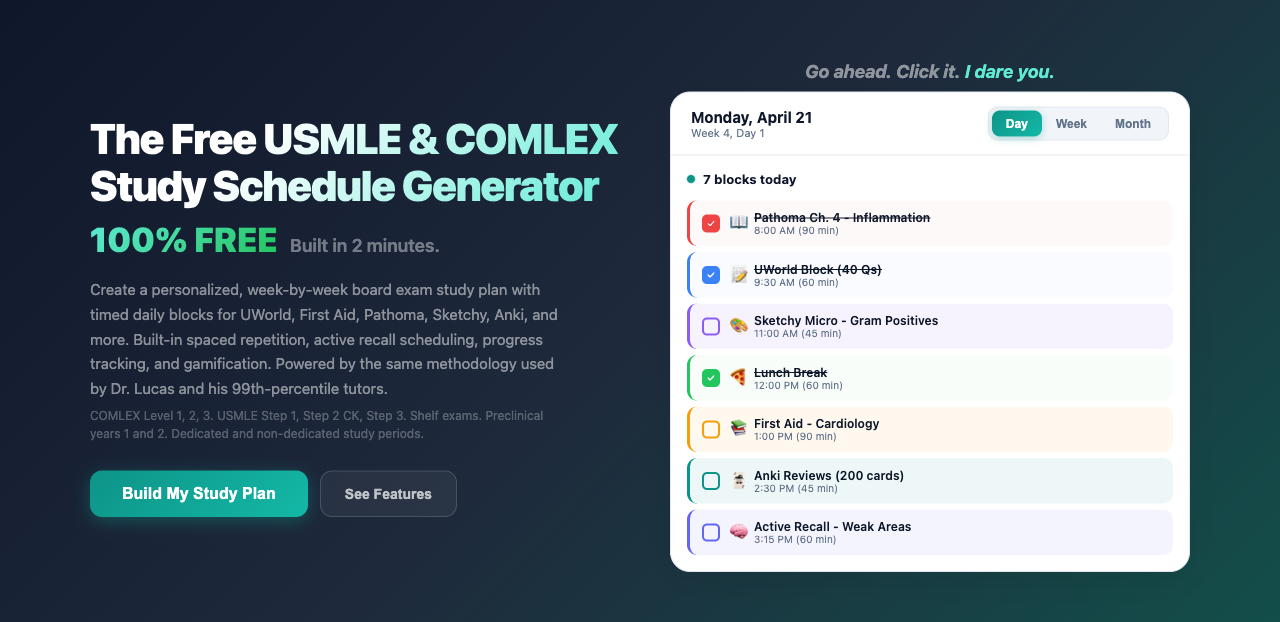
Then there is the prep tax. Time spent on USMLE basic science and longer USMLE-style stems is time not spent on COMLEX-style questions and OMM. OMM is roughly 10 to 12 percent of every COMLEX exam and has no USMLE equivalent, so it is usually the first thing that gets starved when a student splits focus. Students who want a structured plan that protects their COMLEX prep can build one with the free Premeducated Study Plan Builder, which schedules around your real test dates and weak areas.
The honest version: the USMLE is not free even when you can afford the registration fee. It spends the scarcest things you have during dedicated, which are focus and time.
How should a DO student decide whether to take the USMLE?
The decision is less fuzzy than it feels. Run yourself through two short checklists before you register for anything.
Skip the USMLE if all of these are true:
- You are targeting primary care, a less competitive specialty, or DO-friendly and community programs
- Your COMSAE scores are not yet consistently strong
- You do not have a specific program or specialty that requires Step scores
- You would be taking it mainly to "keep options open" rather than to hit a concrete goal
Seriously consider the USMLE if any of these are true:
- You are targeting a ROAD specialty or a surgical subspecialty
- Your goal is an MD-heavy academic program or a prestigious urban academic center
- You are scoring 500-plus on COMSAEs, your foundation is solid, and surgery or another competitive field is genuinely on the table
- A mentor in your target specialty has told you a Step score is expected at the programs you want
The in-between case, where some signals point each way, is exactly the conversation worth having out loud with someone who has seen the match play out. If you want that gut check, the free Premeducated Skool community runs weekly office hours with physician tutors, and you can DM me your specific scenario instead of guessing. For the structural side-by-side of the two exams, our guide on the difference between COMLEX and USMLE covers question style, scoring scales, and the curve in detail.
Talk through your specific match goals in the free community
The Premeducated Skool community is free. It includes weekly live office hours with physician tutors, a growing library of COMLEX and USMLE question breakdowns, and direct DM access to me. "Should I take the USMLE for my specialty" is one of the most common questions we work through, and the honest answer really does depend on your scores, your timeline, and your goals. Bring yours and get a real answer.
Frequently asked questions about DO students and the USMLE
Do DO students need to take USMLE Step 1 now that it is pass-fail?
Probably not. Since Step 1 became pass-fail on January 26, 2022, it no longer produces a three-digit number that programs can screen on, so the strategic value of taking it as a DO student dropped significantly. A passing Step 1 still signals you can handle USMLE-style testing, but it does not differentiate you the way a strong score once did. If you are deciding between Step 1 and Step 2 CK as a DO applicant, Step 2 CK is usually the more useful exam now, because it still produces a scored result that programs can compare.
Is it too late to take the USMLE if I already passed COMLEX Level 1?
No. Many DO students take a USMLE exam after COMLEX, and Step 2 CK is commonly taken during third or fourth year regardless. The bigger question is whether it is worth it for your goals, not whether the timing is allowed. If you passed COMLEX Level 1 comfortably and a competitive specialty is on the table, taking Step 2 CK can still strengthen your application. If you barely passed, your energy is better spent making COMLEX Level 2-CE strong rather than opening a second front.
Should I take USMLE Step 2 CK instead of Step 1 as a DO student?
For most DO students who decide to take a USMLE exam, yes. Step 1 is pass-fail and no longer gives programs a number to rank you on, while Step 2 CK is still scored and is the exam most programs weigh now. Step 2 CK also overlaps more cleanly with COMLEX Level 2-CE content, so the prep is less of a detour from your licensing exam. Talk to a mentor in your target specialty before committing, since the expectation varies by field.
Will not taking the USMLE hurt my residency application?
For most specialties and most programs, no. DO students match into the large majority of specialties every year with COMLEX scores alone. Skipping the USMLE only hurts you when you are specifically targeting programs that screen on Step scores, which are concentrated in ultra-competitive specialties and MD-heavy academic institutions. For everyone else, a strong COMLEX score, excellent audition rotations, and good letters of recommendation carry the application.
Can I study for COMLEX and USMLE at the same time?
You can, but it is harder than students expect, and it is the most common way the "keep options open" plan backfires. Studying for both means splitting focus between two question styles and two content emphases, and OMM almost always gets starved because it has no USMLE equivalent. Most DO students who take both schedule the exams a few weeks apart and bias their dedicated time toward whichever one comes first. If you are not already strong on COMLEX, do not attempt both at once.
What USMLE score do DO students need to be competitive?
There is no single number, because it depends entirely on the specialty and the programs. Competitive specialties expect scores well above the national passing threshold, and the bar shifts year to year. Rather than chase a target number in the abstract, identify the specific specialty and programs you want, then ask mentors and recently matched applicants in that field what scores actually got interviews. A score chased without a target is the definition of the noise this article is warning you about.