
Pass-fail Level 1 removed the residency comparison, not the academic consequence. The foundation you build in preclinical years still drives almost everything that happens on Level 2. Level 2 is scored, and residencies actually read those scores. The material on Level 2 is the clinical application of the same physiology, pharmacology, and pathology that Level 1 tested. Treating Level 1 as "just pass" and skating through preclinical years is the single most predictable way to get blindsided by Level 2. The students I tutor who struggle on Level 2 almost always struggled on Level 1 too, and the diagnosis traces back to a foundation that was never built in the first place.
When COMLEX Level 1 moved to pass-fail on May 10, 2022, and USMLE Step 1 made the same shift on January 26, 2022, students were told the stress was gone. The score didn't matter anymore. The exam was just a checkbox. That message has done real damage to second-year strategy. The Level 1 score doesn't go on your residency application now, but the knowledge it tested is the same knowledge Level 2 leans on, and Level 2 is the one residency programs read most closely. This guide walks through what actually changed, what didn't, and how to set up preclinical and Level 1 prep so that Level 2 isn't a surprise.
What changed when Level 1 went pass-fail and what didn't
What changed: the three-digit score is no longer reported. There's no comparison number that goes on residency applications. Programs that used to filter on Step 1 or Level 1 scores can no longer do that, and they've shifted that filtering pressure onto Step 2 CK and COMLEX Level 2-CE.
What didn't change: the content blueprint, the question style, the passing threshold, the OMM weighting, and the underlying purpose of the exam. COMLEX Level 1 still tests the preclinical sciences (biochemistry, physiology, pharmacology, microbiology, immunology, pathology) integrated with OMM. The passing score is still 400 on the scaled COMLEX system. The structured 8 hours of testing, the 8 blocks, the 40-question blocks (after the May 2026 restructure), all of that is the same exam your seniors took, just with the score hidden from outside eyes.
The cultural shift after the change was bigger than the structural one. Students started treating the Level 1 prep window as an obstacle to minimize rather than a foundation to build. The data that has come back since 2022 isn't reassuring. The NBOME's examination performance data shows first-time failure rates on both Level 1 and Level 2-CE have crept up to roughly 10 percent each most recently, and both have climbed steadily since Level 1 went pass-fail in 2022. Two exams. Same direction. The link isn't a coincidence, and it points at the same root cause: when students stop investing in the foundation, the building falls down later.
Why Level 1 still matters even though it is pass-fail
Three reasons, none of them about your residency application.
The first reason is that Level 1 is the entry exam for the clinical years. Everything in third-year shelf exams, in COMSAEs, in COMAT exams, and on Level 2-CE is built on the basic-science framework you laid down in preclin. When I started shelf exams in third year, I already had a strong base from Level 1 prep, and the clinical reasoning just slotted into a scaffold that was already there. Students who skip building that scaffold show up to third year feeling like every shelf is a brand-new subject they've never seen. It isn't. It's the same physiology and pharmacology dressed up in a clinical vignette.
The second reason is that the pass-fail threshold is still real. Failing COMLEX Level 1 forces a retake, often delays clinical rotations, and can trigger school remediation policies that change your career trajectory. About 90 percent of first-time DO test takers pass Level 1 on their first attempt, which leaves roughly 1 in 10 who don't. A failure is not a clean reset. It costs a rotation block, sometimes a residency cycle, and a meaningful amount of money in re-registration fees and lost study time.
The third reason is the most important for strategy: Level 1 prep is the test run for Level 2 prep. The study habits you build in M2 (question-bank rhythm, Anki discipline, COMSAE cadence, focused-block selection, timed practice) are exactly the habits you need for Level 2. If you cobble together a Level 1 plan, drop everything for clinical rotations, and try to rebuild from scratch in M4, the relearning curve is brutal. Students who build a real system for Level 1 keep that system humming through M3 and walk into Level 2 prep with momentum.
How does pass-fail Level 1 affect Level 2 strategy specifically?
Pass-fail Level 1 shifts almost all of the residency-application pressure onto Level 2-CE. That makes Level 2 prep more important than it has ever been for DO students, not less. Here is how that pressure shows up in practice, and what to do about it in your study plan.
1. Level 2-CE is now the score residency programs read most carefully
Before pass-fail, residency programs could use Level 1 as an early filter and Level 2 as confirmation. Now Level 2-CE carries that filter alone. Competitive specialties (the ROAD specialties, surgical subspecialties, anything that historically required a strong Step 1 to interview) are increasingly using Level 2-CE and Step 2 CK scores as the primary objective filter on applications. A mediocre Level 2 score doesn't have a stronger Level 1 score to compensate anymore. The exam is on its own.
The strategy implication is straightforward. If you're applying to anything more competitive than the bottom quartile of DO-friendly specialties, you should be aiming for a Level 2 score well above pass. The students we work with who are gunning for ortho, neurosurgery, ENT, urology, plastics, derm, ophtho, radiology, anesthesiology, or competitive primary care programs are aiming for 550 plus on Level 2-CE. The students aiming for solid DO-friendly family medicine or internal medicine programs are usually fine with passing scores, but the days of "passing is enough" are getting narrower every cycle.
2. Level 2 content is layered on top of Level 1 content, not separate from it
This is the part students underestimate. Level 2-CE is a clinical exam, but every clinical question is built on a preclinical scaffold. A question about heart failure management requires you to know the underlying cardiac physiology, the receptor pharmacology of the drugs, the pathophysiology of preload and afterload, and the histology of the failing myocardium. If you skipped building the cardiology foundation in M2, the Level 2 question reads like noise. If you built it well, the clinical layer slots cleanly on top.
The students I tutor who struggle on Level 2 almost always struggled on Level 1 too. The Level 2 crisis usually started two years earlier and just stayed hidden until the score came back. When we dig into the diagnosis on a free strategy call, the question isn't "what should we cram for Level 2." It's "what foundational topic is missing entirely, and how do we rebuild that scaffold in the time we have left."
3. The habits that get you through Level 2 efficiently are built during M1 and M2
Question-bank technique, Anki discipline, COMSAE pacing, focused-block selection, score-report interpretation. None of these are skills you can pick up in a 6-week dedicated window for Level 2 if you never used them for Level 1. The Level 2 study window is shorter and denser than the Level 1 window, because you're also rotating, taking shelf exams, and applying for residency. Trying to learn the basic study mechanics for the first time during that period almost always ends with a delayed exam or a panicked retake.
If you've built the muscle during preclin and reinforced it during your Level 1 prep window, Level 2 prep gets faster. You already know your COMSAE-to-test-day pattern. The question-bank choice that fits your style has been settled. Timed mode versus tutor mode is no longer a debate. The number of focused blocks you need per discipline is something you can estimate without guessing. That meta-knowledge is half the battle.
4. The temptation to coast through M2 is the trap, and pass-fail made it worse
I see this conversation play out the same way every year. A student tells me, "Level 1 is just pass-fail, so I'm going to do the minimum needed to pass, save my energy for M3 and Level 2." Six months later they're calling me from week 3 of dedicated, scoring 320 on a COMSAE, panicked because they thought they understood pharmacology and they didn't. The cause is never one bad month of dedicated prep. It's a 24-month foundation that got skipped.
The honest truth about pass-fail Level 1: aiming to barely pass is more dangerous than aiming for a strong score, because the buffer between "barely pass" and "fail" is small, and you usually don't know which side of the line you're on until results come back. The students who pass Level 1 cleanly are studying like Level 1 is scored. They just don't have to brag about the number afterward.
What does a Level-2-aware Level 1 study plan look like?
The plan that sets up Level 2 well is the same plan that produces a strong Level 1 result, with three structural choices you make on purpose.
Choice 1: Treat preclinical coursework as your real foundation
In M1 and M2, the priority is doing the best you can in your school courses. The course material IS the board prep, and the work you put in there compounds for both Level 1 and Level 2. No separate "board curriculum" needs to run in parallel as a second job. A lightweight overlay is fine and useful: a premade Anki deck like AnKing, unsuspended as you cover topics in class, plus question-bank exposure in M2 on the systems you're currently studying. That's the right level of board prep during preclin. Anything heavier in M1 usually trades short-term test performance for long-term burnout.
(For a deeper walkthrough on layering board prep onto class time, see our guide to studying for boards while still in classes.)
Choice 2: Use the Level 1 dedicated window to install the habits you'll reuse for Level 2
Your dedicated period is where you actually learn how you take a board exam. Pick the question-bank methodology you're going to use for both exams (TrueLearn COMBANK for COMLEX, UWorld if you're also doing Step). Lock in your Anki workflow with unsuspending tied to question review, not to passive content consumption. Build your COMSAE cadence with one practice test every 2 weeks during dedicated, two in the final 2 weeks. Use timed mode on every block. None of these decisions need to be redone for Level 2 if you make them right the first time.
The students I tutor who breeze through Level 2 prep are the ones who already know their own study DNA from Level 1. Their average review time per block is dialed in. Anki backlog tolerance has a known ceiling. The gap between real-COMSAE pace and tutor-mode pace is already measured, not guessed. That self-knowledge is one of the best gifts a strong Level 1 prep gives you.
Choice 3: Aim for a real score even though no one will see it
This is the most counterintuitive choice, and it's the one that protects Level 2 the most. Aim for the COMSAE score you'd want if Level 1 were still scored. For most students that means 450 or higher heading into test day. For students aiming at competitive specialties, 500 plus. The exam blueprint hasn't changed, and the level of mastery that produces a 500 on Level 1 is the same level of mastery that gives you a clean clinical-layer build on Level 2. Aim there even though only your transcript will show "pass."
The corollary: if your COMSAE pattern says you'll pass but not by much, you're still at risk. The cohort that passes Level 1 between 400 and 450 has historically been the cohort that struggles most on Level 2, because the foundation is intact but thin. If your most recent two COMSAEs are below 450, treat that as a Level 2 problem starting to form, not a Level 1 problem you can just squeak through.
What if you already minimized Level 1 prep and Level 2 is coming up?
This is the most common situation I see in my Level 2 tutoring practice, and it's recoverable. The diagnostic question is which parts of the foundation got skipped, not whether the foundation needs rebuilding.
Start with a baseline. Take a COMSAE Level 2 about 8 to 16 weeks before your test date and look at the score-report breakdown. The breakdown tells you which systems and disciplines are weakest. If pharmacology and pathology look fine but cardiology and renal physiology are dragging, you have a topical foundation gap that needs targeted relearning, not a global crisis. If everything looks weak, you have a habits-and-strategy problem layered on top of a content problem, and you probably need a structured plan with outside accountability.
The next step is to plan dedicated based on the bucket you actually fit, not the bucket you wish you fit. Strong foundation, clean Level 1 prep, COMSAE 450 plus on baseline: 4 to 6 weeks of dedicated is usually enough. Intact foundation but thin (COMSAE 400 to 450): 6 to 10 weeks. Weak foundation, history of struggling on Level 1: 8 to 16 weeks. The temptation to compress dedicated to "see if I can pull it off in 4 weeks" is exactly the same temptation that produced the foundation gap in the first place. Trust the bucket.
If you're scoring well below 400 on a baseline COMSAE Level 2, that's not a "study harder" problem. It's a structural one. Students in that situation usually benefit from a free strategy call with our team where we can look at your scores, your timeline, and your history together and tell you honestly what you need. (For the honest version of who actually benefits from 1-on-1 help, see our breakdown of who actually needs a COMLEX tutor.)
How USMLE Step 1 going pass-fail changes the same calculus
The Step 1 conversation runs in parallel and mostly arrives at the same conclusion. Step 1 became pass-fail on January 26, 2022, and Step 2 CK has absorbed the residency-filtering pressure the same way Level 2-CE has on the DO side. MD students who treat Step 1 as "just pass" walk into Step 2 CK with the same scaffolding gap I see on Level 2-CE, and the consequences are sometimes harsher because the USMLE curve is built on a national MD pool that includes the most selective schools in the country.
For DO students considering taking both COMLEX and USMLE, pass-fail Step 1 doesn't change my general recommendation. Most DOs are best served by mastering COMLEX first and only adding USMLE when a specific residency target actually requires it. The cohort that should add USMLE has roughly the same shape after pass-fail as it did before: students gunning for ultra-competitive specialties, certain DO-friendly-but-MD-heavy programs, and students whose long-term licensure plans cross state lines into jurisdictions where USMLE simplifies the paperwork. (For the long version, see our COMLEX vs USMLE deep-dive.)
The non-obvious side effect of double pass-fail Step 1 plus pass-fail Level 1: students who are mediocre on both Level 2 and Step 2 have no early test to point at as their stronger number. Both exams are scored. Both get read. There is no longer a Level 1 score to fall back on as evidence of preclinical mastery. The clinical exams are doing all the work.
A free way to figure out where your foundation actually stands
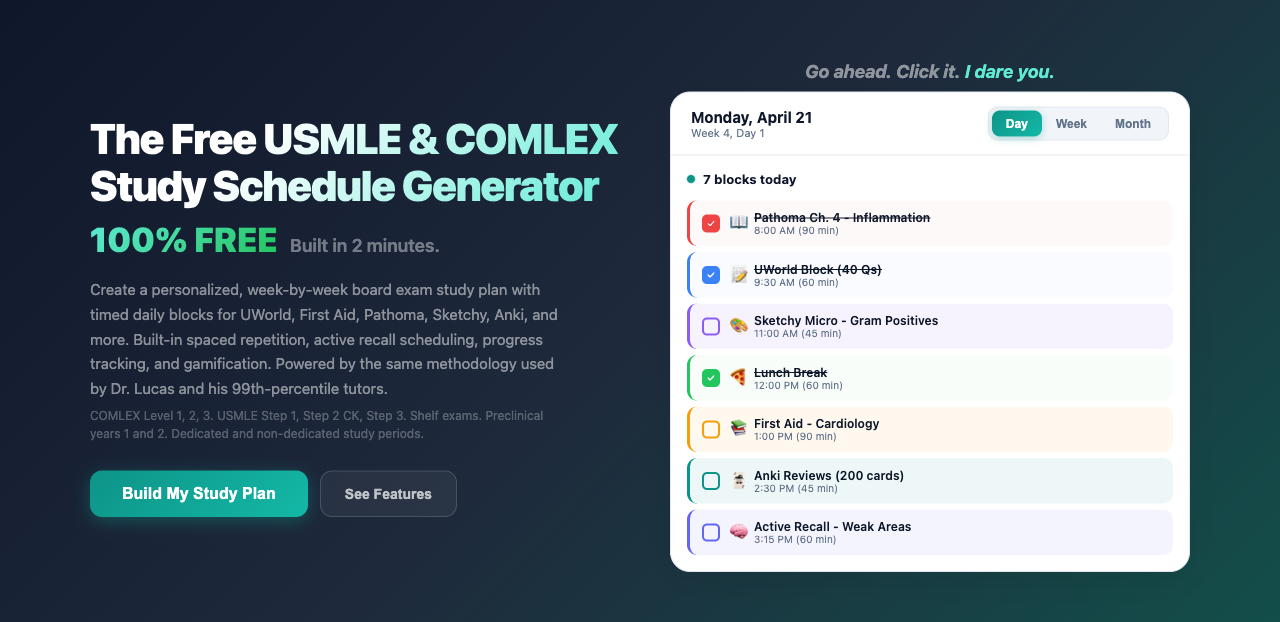
If you're in preclin and trying to plan your Level 1 prep, the free Premeducated Study Plan Builder will build you a personalized dedicated plan based on your test date, baseline, and weak areas. It's the same builder our 1-on-1 students use. If you're in M3 or M4 and worried about Level 2, take a baseline COMSAE Level 2 first, drop the score breakdown into the builder, and use that as your starting point. You'll get a realistic week-by-week plan for the timeline you actually have.
The other free resource that helps in preclin is the free Skool community. Weekly office hours with physician tutors, a 100-plus video library of question breakdowns, cloze-deletion Anki cards transcribed directly from my video library, and a community of DO students at every stage of board prep. It's where students go to ask the questions that don't fit cleanly in a class lecture or in a question-bank explanation.
Frequently asked questions about pass-fail Level 1 and Level 2 strategy
Does Level 1 still matter now that it is pass-fail?
Yes, just not for residency applications directly. Level 1 sets the preclinical foundation that Level 2 is built on, and Level 2-CE is now the score residency programs read most carefully. Students who minimize Level 1 prep almost always struggle on Level 2, because the basic science gaps don't get filled in by clinical rotations alone. Aim for the same level of mastery you would have aimed for under the old scored system. Only your transcript will say "pass," but the underlying knowledge is what carries you into M3, M4, and Level 2 prep.
Did pass-fail Level 1 actually change pass rates?
Yes. According to the NBOME's examination performance data, first-time failure rates on both COMLEX Level 1 and Level 2-CE have risen steadily since Level 1 moved to pass-fail in May 2022, and both now sit at roughly 10 percent. The likely cause is that students reduced the effort they put into preclinical foundation work once the score no longer counted, and that foundation gap surfaced on both exams. The size of the shift is modest at the national level but meaningful at the individual level: if you're the marginal student on either exam, the choice to invest in preclinical work is the choice that moves you from the fail side to the pass side.
Should I aim for a real Level 1 score even though it is pass-fail?
Yes. The score you'd want under the old system is a good proxy for the foundation depth that protects your Level 2 result. For most students that means a COMSAE pattern of 450 plus heading into test day. For students targeting competitive specialties, 500 plus. The actual COMLEX Level 1 score doesn't get reported, but your scaled mastery is what enters M3, shelf exams, and Level 2 prep with you. Aiming for "barely pass" is the most risky version of pass-fail strategy.
How does Level 2-CE actually differ from Level 1 in question style?
Level 2-CE is a clinical knowledge exam built on Level 1 preclinical content. Questions tend to lead with a clinical vignette (chief complaint, demographics, vital signs, physical exam, sometimes labs and imaging) and ask for the most appropriate next step in diagnosis or management. The underlying physiology, pharmacology, microbiology, and pathology are still the substrate. If your Level 1 base is strong, the clinical layer slots on top quickly. If your Level 1 base is shaky, the clinical questions read like a foreign language. OMM is still 10 to 12 percent of the exam on Level 2-CE.
Do residency programs care about Level 1 at all if it is just pass-fail?
A growing minority of programs do still look at whether you passed Level 1 on your first attempt. A first-time failure shows up on your transcript as "fail" plus the retake result, and it can trigger filtering at programs that screen for first-time pass status. The score itself doesn't get reported, but the pass-fail outcome and the attempt count do. Treating Level 1 as "just a checkbox" is fine philosophy. Treating it as "I might fail and it won't matter" is not.
How should preclinical students adjust their study plan if Level 1 is pass-fail?
Don't adjust much. The priority in M1 and M2 is doing the best you can in your school courses, with a lightweight Anki overlay using a premade deck like AnKing, and question-bank work in M2 on the system currently being covered in class. The foundation work is identical to what it would be under a scored Level 1. The thing to resist is the cultural pressure to coast through M2 because the exam is pass-fail. Your M2 self is building the scaffold that your M4 self is going to climb on Level 2.
What if my Level 1 prep was minimal and I am already in dedicated for Level 2?
Take a baseline COMSAE Level 2 right away. Look at the score-report breakdown by system and discipline. If specific systems are dragging, build focused blocks targeted at those systems, do thorough question review, and use Anki to retain what you learn. If everything looks weak, you probably need a structured plan with outside accountability and a realistic timeline based on the dedicated bucket you actually fit, not the one you wish you fit. Compressing dedicated to "see if I can pull it off in 4 weeks" usually fails for students with a thin foundation. Trust the bucket.
Get the free community support that protects your Level 2 score
The Premeducated free Skool community is where DO students at every stage of board prep ask the questions that don't fit in a lecture or a qbank explanation. Weekly office hours with physician tutors, a 100-plus video library of question breakdowns, cloze-deletion Anki cards transcribed from Lucas's video library, and DM access if you get stuck. Free, no upgrade required. It's the best way to keep your preclinical foundation strong without adding cost to your study budget.
Related guides and video resources
- How long should I study for COMLEX Level 1?
- When should I start studying for COMLEX Level 1?
- What is the difference between COMLEX and USMLE?
- Why do smart med students fail board exams?
- Doctor Lucas DO on YouTube: full library of COMLEX strategy videos, Level 1 to Level 2 prep deep-dives, and real student testimonial interviews