
No. For most students, waiting until content review is "done" delays the only feedback loop that tells you what you actually need to review. Start timed practice questions in week one of dedicated and pull the majority of your content review out of the question review itself. A short content-review window, 1 to 2 hours at the end of the day, covers what the questions do not. The exception is a small group of students with a strong standardized-testing history and a genuinely thin foundation, and even they should cap the front-loaded content at a couple of weeks.
Nobody finishes content review and feels ready. That's the part students underestimate. The finish line moves, because every pass through First Aid or Boards and Beyond surfaces three more things you don't know cold, and the feeling of preparedness you're waiting for never arrives on its own schedule. Meanwhile the exam date does not move. What follows is how I actually sequence this with 1-on-1 students, what the exceptions look like, and how to tell which group you're in.
Should I finish content review before starting practice questions?
Start questions early and use them as your content review. There are two schools of thought in board prep: watch content videos first and switch to questions later, or get most of your content review from reviewing questions. I use a mix of both with my students, weighted heavily toward the second. For the vast majority of students, that combination works better than either extreme.
The reason is not that content review is useless. It's that content review by itself has no measurement attached to it. You can watch a pharmacology video, feel like it landed, and have no idea whether you can apply it inside a 90-second stem with four plausible distractors. A question block tells you in one hour. It's a diagnostic test, and until you run it, every hour of review you schedule is a guess about what you need.
There's also a retention problem. Without some form of active recall attached, you'll forget the large majority of what you watch. Rewatching the same video does work, it's just slow, and slow is the one thing a dedicated period cannot absorb. The upperclassmen in my med school class used to read the same textbook chapter as many times as they could before an exam. It worked to a point. Quizzing yourself on it once would have beaten reading it four times.
Why does waiting until you feel ready backfire?
Because "ready" is a feeling, and the feedback loop that produces it runs through questions. Until you sit for a block, you have no weak-area data, which means you cannot build focused question blocks, you cannot prioritize your day by exam weight, and you cannot tell the difference between a topic you're shaky on and a topic you only think you're shaky on. Students routinely spend a week rebuilding renal physiology when their real hole is community health.
That last part matters more than most people realize. On COMLEX Level 1, MSK runs about 13% of the exam and community health about 12%, which together is at least a quarter of test day. OMM sits at 10 to 12%. Neuro, circ/heme, respiratory, and GI are roughly 10% each, and nearly everything else is around 5%. If your first three weeks go to whichever subject felt worst in preclinical, you can put 60 hours into a 5% slice and never touch the 25% that decides your score. Question data plus a practice test score report is what stops that from happening.
The other failure mode is what students build while they wait. Massive spreadsheets. Pages of notes nobody ever reopens. It's an attempt at spaced repetition, and it fails because you never actually go back and quiz yourself on any of it. I tried exactly this for Level 1 and Step 1. Once my spreadsheet passed 100 questions, there was no chance I was keeping up with it. A couple of flashcards per question was manageable, and it was the thing that actually worked.
What does a question-first study day look like?
Eight hours of structured work, plus an optional 1 to 2 hours of content review at the end. The split is 2 hours of timed questions, 4 hours of question review, and 2 hours of Anki. Question review takes the largest share on purpose, because a 40-question block takes most students about 2 hours to review properly and you're doing two blocks a day.
Under the current COMLEX format, that's eight 1-hour blocks with 5-minute breaks and a 30-minute lunch, which mirrors what test day now looks like:
- 8:00 to 9:00 and 9:05 to 10:05: two timed 40-question blocks back to back, no tutor mode.
- 10:10 to 12:15: full review of the first block, in two 1-hour sittings.
- 12:45 to 2:50: full review of the second block.
- 2:55 to 5:00: Anki, until new, learning, and review cards all hit zero.
- 5:00 to 6:00 or 7:00, optional: content review video on whichever section felt shakiest that morning.
Notice where content review sits. It's last, it's optional, and it's aimed at a specific weakness the morning identified rather than at a syllabus. That's the whole design. You earn the topic list from your own performance instead of inheriting it from a textbook's table of contents.
Two blocks a day is the floor and, for most people, also the ceiling. Every block is timed. Tutor mode feels better and teaches you a rhythm that does not exist on test day, and timing is a learned skill you only build by practicing under the clock. I've watched capable students run out of time on the real exam for no reason other than a dedicated period spent entirely in tutor mode.
How do practice questions replace content review?
The block is the diagnosis. The review is the education. That distinction is the one most students miss, and it's why "I did 80 questions today" and "I learned from 80 questions today" are completely different days.
Here's the review method I give students. If you got a question right for the right reason, move on. If you guessed correctly or got it wrong, go to the main point, which is the learning summary and the correct answer. Make sure you understand the correct answer and the choice you actually picked. The other three choices matter far less than students think. If one of them is genuinely important, it will show up as the main point of its own question later.
Then sort what you missed onto a continuum from rote memorization to logic and comprehension. Rote items go to Anki. Logic items get real time spent understanding the concept before you move on, plus a card or two on the definitions and the piece you just understood. Anything that makes sense does not need to be memorized, it just makes sense. Anything with nothing to understand can only be consolidated by memorizing it.
The Anki rules keep this from turning into a second full-time job. Download the AnKing deck, suspend every card, and unsuspend only in response to question review. Fewer than three cards per missed or guessed question. Ideally zero new cards for questions you answered correctly for the right reason. If your evening review is spilling past 2 hours, you're unsuspending too many cards, not studying too little. More detail on that balance is in our guide on how to balance Anki and practice questions during dedicated.
Done this way, a 40-question block produces 20 to 40 targeted content encounters, each one attached to a stem you already got wrong. That is content review with a memory hook already built into it.
When should I start UWorld or TrueLearn for boards?
Day one of dedicated at the latest, and earlier if you're still in classes. If you have a baseline practice test scheduled, take it 1 to 2 weeks before dedicated begins so your first week of blocks is already aimed at your weakest, heaviest-weighted areas instead of starting at random.
Sequence the bank the same way you'd sequence a differential, most likely and most costly first:
- Start with focused blocks on your weakest high-weight areas. Roughly 4 to 6 blocks of 44 questions per discipline, and 3 to 6 per system.
- Combine related systems, for example circ/heme with respiratory, so you're not picking the cardiology answer just because you know it's a cardiology block.
- Move to mixed blocks once you run out of focused work, and lean on mixed blocks and practice tests in the final stretch to simulate test day.
- Take a practice test every 1 to 2 weeks throughout, with two in the last two weeks.
Which bank you use matters less than when you start it, though the tradeoffs are real and we cover them in UWorld vs TrueLearn for COMLEX. Aim for 450 or better on practice tests, and ideally 500 or better if you want real margin.
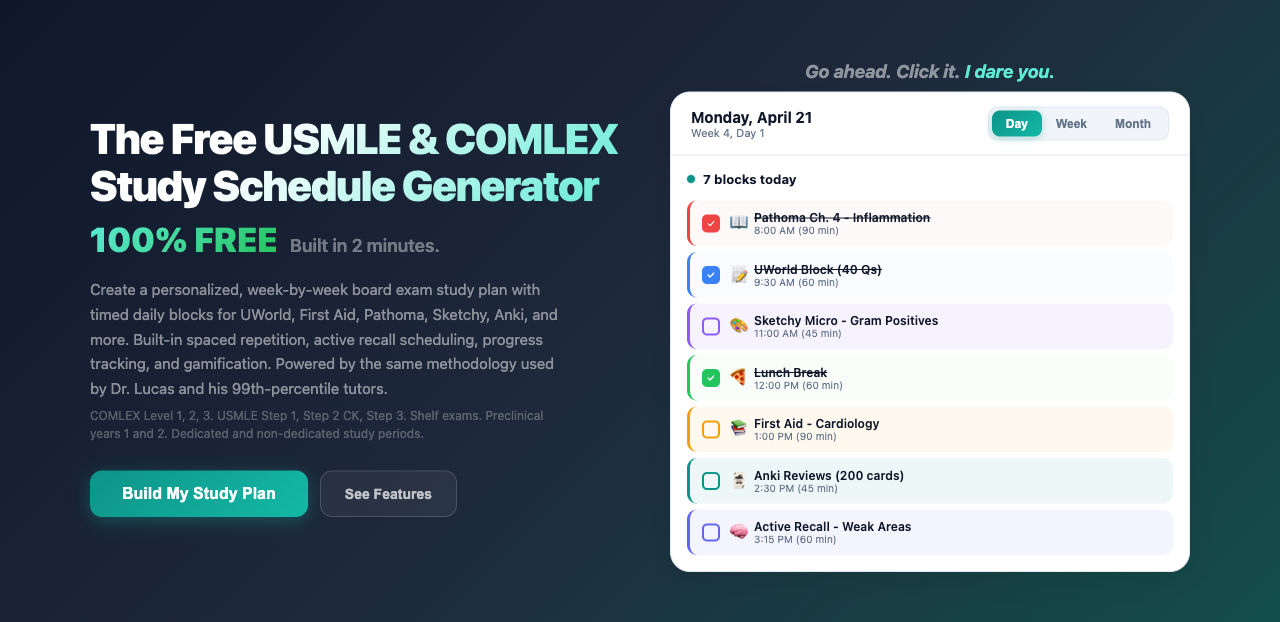
If mapping the focused blocks, practice-test dates, and content-review windows onto your actual exam date sounds like a weekend lost to a spreadsheet, our free Study Plan Builder generates the whole schedule from your test date, baseline, and weak areas.
Who should actually do content review first?
A minority of students, and the profile is specific. If you have historically been strong on standardized exams (a solid MCAT, consistent shelf performance, a track record of translating knowledge into points under time pressure), you probably don't need as much practice with test-day logic, so front-loading content costs you less. Students who have historically struggled on standardized exams need the opposite. They need the reps on applying information, starting immediately, because application is the skill that's actually broken.
There's a second version of this: the student with a real, structural gap in the foundation. A long leave of absence, a preclinical curriculum that never covered a system, a transfer with a genuinely missing block of material. Content first makes sense there, for that specific material.
Two guardrails if this is you. Cap it, because content-first should mean one to two weeks of front-loading, not half your dedicated. And attach active recall from day one, since content review with no self-quizzing is the exact combination that produces the "I watched everything and remember nothing" week five. Our piece on why effort alone does not raise board scores covers what that failure looks like from the inside.
What content review still earns a place in your day?
The evening window, aimed at a weakness the morning exposed. One to two hours of video on whichever section felt shakiest during your timed blocks, done at the point in the day when you're tired and need something lower-effort than active question work. Unsuspend up to 10 Anki cards per video, so the material has a retention mechanism attached instead of evaporating overnight.
What that window is not: a front-to-back pass through First Aid, a full rewatch of a video series, or a place to hide from questions because questions feel bad. Feeling bad during a block in week two is the system working. You're supposed to be missing things then. The score you care about is the one on test day, and the fastest route there is finding your holes early enough that you have time to fill them.
Frequently asked questions about content review and practice questions
Should I do practice questions on topics I have not studied yet?
Yes, with the expectation that you'll miss most of them. A missed question on unfamiliar material is a cheap, specific, high-retention introduction to that material, especially compared with a passive video. Your job is the review, not the score. Read the learning summary, understand the correct answer and the answer you chose, and make fewer than three Anki cards. What you should not do is treat an early low percentage as evidence you started too soon.
Is it bad to do practice questions before finishing First Aid?
No. First Aid is a reference and a rapid-review tool, not a prerequisite. Reading it cover to cover before your first block delays your weak-area data by weeks and gives you very little retention in exchange. Use it the other way around, as the thing you open during question review when an explanation needs more context. Reserve the front-to-back rapid pass for the final two weeks, when it works as consolidation rather than as first exposure.
Should questions be timed or in tutor mode while I am still learning the content?
Timed, every block, from the start. Tutor mode changes the task: you get feedback mid-block, you pace differently, and you build a rhythm that does not exist on test day. Timing is a learned skill, and the students who run out of time on the real exam are overwhelmingly the ones who practiced untimed. Do the learning in the review hours afterward, where it belongs, and keep the block itself an honest simulation.
How many practice questions a day should I do during dedicated?
Two blocks a day, which is 80 questions under the current COMLEX format. That's the minimum for most students and usually the practical maximum too, because each block needs about 2 hours of real review. Doing four blocks a day and reviewing none of them is a common way to feel productive while learning almost nothing. Close to test day you can scale up to 3 or 4 blocks for stamina, accepting that review time gets compressed.
What score should I expect on my first question blocks?
Lower than you want, and the number itself is not a useful signal that early. Your first blocks are a baseline measurement, not a verdict. What matters is the trend over the following weeks and your percentile on practice tests, not the raw percentage on block one. If you're still flat after 4 to 6 weeks of consistent effort, that's the signal worth acting on, and it usually points to a broken review method rather than a knowledge gap.
Does this change for USMLE Step 1 or Step 2?
The sequencing logic is the same, because the underlying problem is the same: you cannot target what you have not measured. Step content skews away from OMM and toward different weightings, so your focused-block priorities shift, but the question-first structure, the timed rule, and the review method carry over unchanged. Students preparing for both exams run one question-first plan and adjust the topic emphasis rather than running two separate strategies.
Build the schedule instead of guessing at it
The sequencing question gets a lot easier when the calendar is already built. Our free Study Plan Builder lays out your focused blocks, practice-test dates, Anki load, and the evening content-review window against your actual exam date and weak areas, using the same logic I use with 1-on-1 students.