
A 6-week COMLEX retake works when you stop adding volume and start fixing the system. The core moves are a Day 1 diagnostic practice test, a daily plan that pivots to your weakest areas based on what you missed yesterday, timed question blocks every single day, and hard accountability so you actually execute the plan instead of drifting. It is aggressive, and most schools that mandate a 6-week turnaround do so precisely because they want you back on track fast. It is also doable. I have walked DO students through it, and one of them went from a Day 1 practice test of 280 to a passing 440 in exactly six weeks.
This is the honest version of what those six weeks look like. Not a motivational pep talk, and not a generic "study harder" plan. A specific structure, a real case study with a real name and a public testimonial video, and the reasons most retakes fail when students try to wing it.
Can you really pass COMLEX in a 6-week retake?
Yes, a 6-week COMLEX retake is realistic if you have a dedicated study period during those six weeks and you change your method, not just your effort. Six weeks is enough time to rebuild a broken study system, drill your weak areas with timed blocks, and close a large score gap, but only if every day is structured and pointed at a specific weakness. The students who fail a retake are usually the ones who repeat the same plan louder.
Most schools that require a retake inside six weeks of releasing your failing score are doing it on purpose. The faster turnaround keeps you in study mode instead of letting the material decay over a long gap. The tradeoff is that you have almost no room for wasted days. A typical first-time dedicated period runs eight weeks or more, so a 6-week retake compresses the same work into less time. That compression is survivable, but it punishes a vague plan harder than a long timeline would.
If you have already failed once, the instinct is to assume you need more content. New books, a second question bank, longer hours. That instinct is almost always wrong, and I cover why in detail in why effort alone does not raise board scores.
Why do most COMLEX retakes fail?
Most COMLEX retakes fail because the student changes everything except the strategy. They pile on resources, grind more hours, and switch question banks, all while keeping the exact study method that produced the first failure. The fix is rarely more material. It is a structured plan that pivots daily to your weakest areas, timed practice that mirrors test conditions, and accountability that keeps you executing when motivation runs out.
I see three patterns in failed retakes. The first is the resource pileup, where a student runs three video resources and two question banks and never finishes any of them. The second is passive review, where questions get done but never truly analyzed, so the same mistakes repeat block after block. The third is the lone-wolf plan, where a smart student tries to self-direct a retake under enormous time pressure and quietly drifts off track without anyone catching it.
Justin, a real student of mine, is a clean example of the third pattern. His testimonial video is on the Doctor Lucas DO YouTube channel, and his contact info is in the description if you want to reach out and verify any of this yourself. He is a fourth-year at ATSU applying into family medicine. Before he came to us, he had already been working with another tutoring company, and in his words it "wasn't as specialized." The program had him doing a crap ton of UWorld questions and not much else. He failed COMLEX Level 2 on his first attempt with a score in the low 320s.
When I asked Justin what was actually holding him back, he didn't say content. He said this: "I was just kind of shooting off in the dark." No daily pivot to his weak areas, no structured plan that adapted to his practice results, and no one keeping him accountable. The knowledge gaps were real, but they were a symptom. The broken system was the disease.
What changed in Justin's 6-week retake
Justin's school required him to retake within six weeks of getting his failing score back. He had a dedicated period during that window, which is the single biggest factor that makes a fast retake possible. We did not respond by handing him more videos. We rebuilt his system around four things, and we started by measuring exactly where he stood.
The first thing we did was have him take a full practice test on Day 1. He scored a 280. I will be honest, when I saw that number I started regretting my life choices. A 280 is first percentile. He had just failed the real exam in the low 320s, and his fresh diagnostic came in even lower. That is the kind of baseline that makes a 6-week timeline look impossible on paper.
It was not impossible. It was a data point. Here is what the rebuild looked like:
- Focused question blocks targeting his weakest disciplines and systems, not random mixed blocks that let him coast on strengths.
- Everything timed, no tutor mode. Speed is a learned skill, and you only learn it by practicing under the clock the way you will execute on test day.
- A daily plan that pivoted based on what he missed the day before. Every practice test and every block fed the next day's priorities.
- A full physician team. He worked with Dr. Boesler, our OMM specialist, Dr. David, a neuro attending, Dr. Coghlin, our EM doc, and me. He got specialist-level explanations on the topics he couldn't crack alone.
Six weeks later, Justin sat for his second attempt and scored a 440. That is over 100 points above his failing first attempt, and roughly 160 points above his Day 1 practice baseline of 280. He passed, pulled seven to eight residency interviews, turned one down because he had so many, and he has already booked Level 3 with us. When I asked him for the single thing that pushed him over the edge, he didn't name a resource. He said responsiveness and accountability. "Just being able to have that guidance and support basically."
How does the daily-pivot plan actually work?
The daily-pivot plan works by treating every practice test and question block as a diagnostic that rewrites the next day's schedule. Instead of marching through a fixed syllabus, you do timed blocks, analyze every miss, identify the weakest area that surfaced, and aim the following day at that gap. The plan is never static. It chases your weaknesses in real time so you spend your limited days on the topics that actually move your score.
In practice the loop looks like this. You take a timed focused block in the morning, ideally 40-question blocks built around a specific discipline or system. You spend one to two hours reviewing it, and the review is the real work, not the question-answering. You focus on why the correct answer was correct and why the choice you picked was wrong. You unsuspend a small number of Anki cards tied directly to what you missed, then you drive that Anki queue to zero. The next morning, the plan has shifted toward whatever cracked under pressure the day before. For the mechanics of doing Anki the right way during a retake, see how to use Anki for COMLEX.
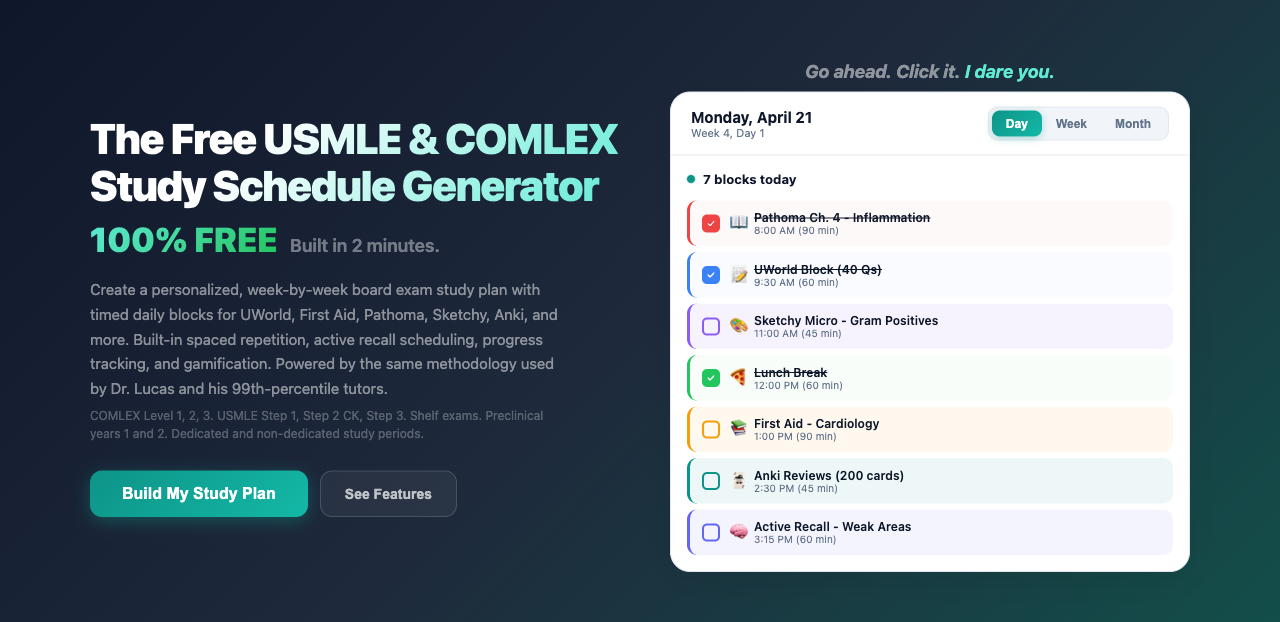
The reason this beats a fixed plan is simple. A fixed syllabus assumes you know your weak areas in advance, and after a failure you usually don't, at least not precisely. A pivot plan lets the data tell you. During a 6-week retake, that difference is the whole game, because you cannot afford to spend three days reviewing something you already know while a real gap sits untouched. If you want a structured starting template you can adapt yourself, the free Premeducated Study Plan Builder builds a daily plan around your test date, baseline, and weak areas.
What does "drill sergeant mode" actually mean?
Drill sergeant mode means you stop debating the plan and you execute it. Justin's phrase for it was "yes drill sergeant, do whatever you tell me." It is not about being yelled at. It is about removing decision fatigue during a high-pressure window, trusting a structured plan built by someone who has done this hundreds of times, and pouring your energy into the work instead of into second-guessing the work.
This matters more in a 6-week retake than in any other study scenario. After a failure, most students are flooded with doubt, and doubt is expensive. Every hour spent rebuilding your plan from scratch, googling new resources, or wondering whether you should switch question banks is an hour not spent learning. Justin described the relief of it well: "it was just easy not to think about it." He handed the strategy to a team he trusted and gave the execution everything he had.
There is a real limit here, and I want to be straight about it. Drill sergeant mode only works if the plan is actually good and the person directing it actually knows COMLEX. Blind obedience to a generic plan is how students fail the first time. The trust has to be earned, and it has to be paired with a method that pivots to your weaknesses. Effort poured into a broken plan is still wasted effort, which is the entire point of why effort alone does not raise board scores.
A realistic week-by-week 6-week retake structure
There is no single template that fits every student, because the pivot plan reshapes itself around your results. That said, the arc of a 6-week retake usually moves through recognizable phases. Use this as a mental model, not a rigid prescription.
- Week 1: diagnose and stabilize. Take a full practice test on Day 1 to get your true baseline. Start timed focused blocks in your weakest disciplines. The goal this week is honest data and a daily rhythm, not a score jump.
- Weeks 2 and 3: attack the biggest gaps. Now you know where you bleed points. Build the bulk of your focused blocks around those areas, keep everything timed, and keep your Anki tied to question review. Take a practice test at the end of week 2 to check the trend.
- Weeks 4 and 5: broaden and build stamina. Shift from narrow focused blocks toward mixed timed blocks that simulate the real exam. Scale up to multiple blocks per day so your stamina holds across a full test. Take another practice test to confirm the gap is closing.
- Week 6: simulate and taper. Do a final practice test early in the week under realistic conditions. Spend the last few days on rapid review of high-yield topics and on rest. The day before the exam, do not study. Sleep, hydrate, and protect your headspace.
Notice that practice tests anchor the whole structure. During dedicated, the standard cadence is a full practice test roughly every two weeks, with more frequent testing as you approach the exam. In a compressed retake, those tests do double duty: they measure progress and they expose the next round of weak areas to pivot toward. Plan on eight to ten hours of focused work per day during a retake dedicated period, with at least one genuine rest day so you don't burn out before test day. For the broader picture of how a dedicated period is supposed to function, see what is a dedicated study period for COMLEX and how long to study for COMLEX Level 1.
Frequently asked questions about a 6-week COMLEX retake
Is six weeks enough time to retake COMLEX?
Six weeks is enough if you have a dedicated study period during that window and you change your method rather than just your effort. Many schools mandate a retake inside six weeks of releasing a failing score specifically to keep you in study mode. The timeline is tight, so it punishes a vague plan, but it is very doable with a structured daily-pivot plan, timed practice every day, and real accountability. The students who struggle in six weeks are the ones repeating the same broken approach faster.
What should I do differently on a COMLEX retake?
Change the system, not the volume. The most common retake mistake is piling on more resources while keeping the study method that produced the failure. Instead, run one focused question bank, review every miss deeply, do all of your blocks timed, and let a daily-pivot plan aim each day at your weakest area. Tie your Anki directly to question review and drive the queue to zero daily. The diagnosis matters more than the hours, so figure out whether your real problem is strategy, timing, content gaps, or test anxiety before you build the plan.
How much should I study per day during a COMLEX retake?
Plan on roughly eight to ten hours of focused work per day during a dedicated retake period, structured into timed question blocks, deep review, and Anki. Take at least one real rest day per week, because a retake compresses a lot of work into a short window and burnout will sink you faster than a missed topic. Quality of review matters more than raw hours. Two well-analyzed blocks beat six blocks you rushed through and never truly learned from.
Will failing COMLEX once ruin my chances of matching?
A single COMLEX failure does not end your match chances, especially once you retake and pass. Justin pulled seven to eight residency interviews after a failed Level 2, turned one down because he had so many, and a program director he interviewed with had personally failed a board exam too. Programs often grant interviews before your retake score is even back, and you can send the updated passing score after the fact. What you do after the failure, the comeback and the work you put in, often reads as a strength rather than a liability.
Should I get a tutor for a 6-week COMLEX retake?
A tutor is most worth it on a fast retake when you cannot diagnose why you failed, when your score has been flat despite real effort, or when the compressed timeline leaves no room to figure it out on your own. The value is the daily-pivot structure, specialist-level explanations on your weak topics, and the accountability that keeps you executing under pressure. If your scores are already trending up and you have a clear plan, the free Study Plan Builder and community may be enough. For the honest version of who actually needs one, read who actually needs a COMLEX tutor.
What score do I need to pass COMLEX on a retake?
The passing score for COMLEX Level 1 and Level 2-CE is 400 on the 10 to 999 scale, where the mean is 500. On a retake, you want your recent practice tests trending at or above 450 before you sit, since that builds a safety margin above the pass line. Justin scored a 440 on his second attempt, comfortably above the 400 cutoff. Use your practice tests as the readiness signal, not your gut feeling, and aim to clear the line with room to spare rather than scraping it.
https://www.youtube.com/@drlucasdo
Get a real plan for your retake before the clock runs out
A 6-week retake leaves no room for a vague plan. On a free strategy call, we walk through your scores, your timeline, and your study history, and we build you a personalized plan using the same builder our 1-on-1 students use. Then we tell you honestly what you need to pass in the time you have, whether that is tutoring, the free community, or just the plan we built you. No pressure, no hard pitch.