
Before you hire a COMLEX tutor, ask five things: how they'll diagnose why your scores are stuck, who will actually tutor you on each topic, how they'll hold you accountable between sessions, what happens when the plan stops working, and whether they'd tell you that you don't need them. A good tutor answers every one of those with specifics. A tutor who quotes you a package before asking about your scores is selling hours, not a fix.
I run a tutoring company, so take this with that in mind. I'm also the person who tells about half of the students on our free strategy calls that they don't need to pay us. The questions below are the ones I'd want my own family to ask before spending thousands of dollars on board prep, including if they were asking me.
Should you be hiring a COMLEX tutor at all?
Start here, because the best question you can ask a tutor is whether you need one. Most DO students don't. If your two most recent COMSAEs are at or above 450, your trend over the last 4 to 6 weeks is moving up, and you've done well on the MCAT and your shelves, you can usually pass with a structured plan and a community to ask questions in.
There's a second group that shouldn't buy tutoring regardless of scores. If you aren't going to follow a plan, a tutor won't save you. Our 1-on-1 students put in 8 to 10 hours of focused work a day during dedicated. A tutor amplifies that effort. Nobody can replace it.
So the first question to ask on any consult call is: "Based on my scores, do you think I actually need you?" Then watch what happens. An honest tutor will walk through your practice history and tell you which group you're in. A sales-first company will tell you everyone needs tutoring, because that's how the business model works.
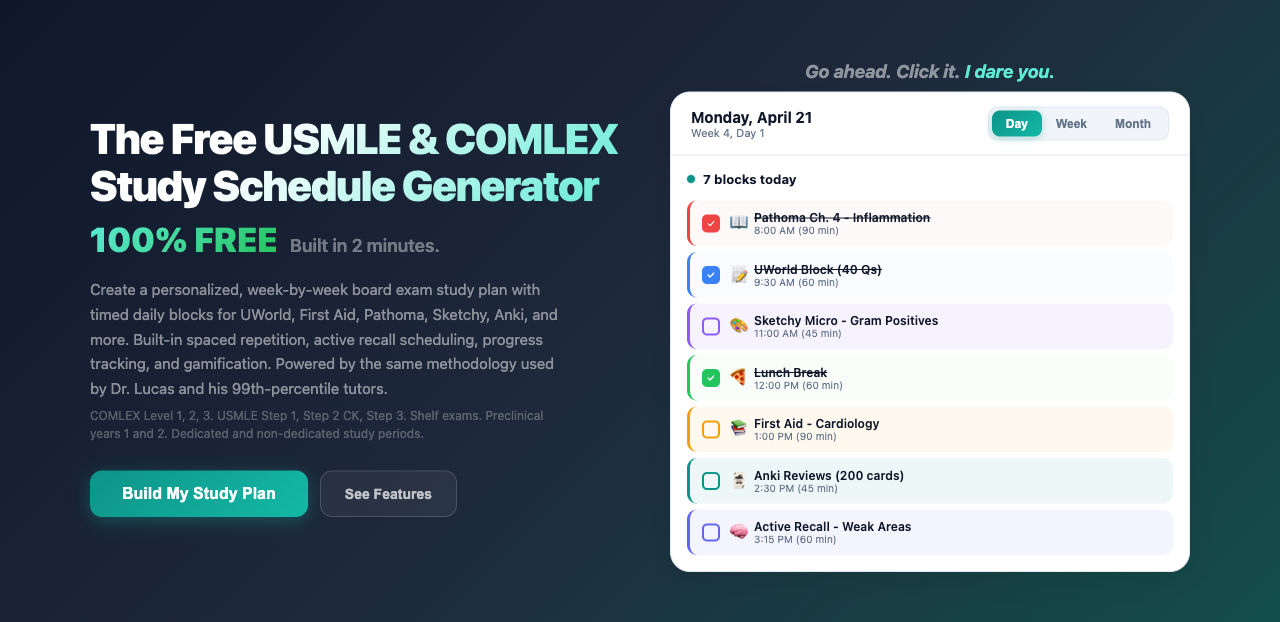
The students who usually do benefit fall into a few patterns: flat or falling scores for 4 or more weeks despite real effort, a previous failed attempt, real exam scores 50-plus points below practice scores, or running out of time on every block. If none of those describe you, the free Study Plan Builder and the free Skool community will likely carry you. The longer version of this sorting is in who actually needs a COMLEX tutor and who does not.
How will the tutor figure out why your scores are stuck?
Ask: "What do you do before the first content session?" The answer tells you whether you're hiring a diagnostician or a lecturer.
Most stuck students aren't stuck because of effort or intelligence. Justin, a real student with a testimonial on the Doctor Lucas DO channel, failed COMLEX Level 2 after studying full time for 1 to 2 months. He did questions every day and plenty of content review. The problem was his system: random question blocks, passive review, and no method for keeping information long term. More content would not have fixed any of that.
A good tutor starts with a full history of how you've been studying. At Premeducated that first evaluation covers your test date and how firm it is, any school COMSAE cutoff, the practice tests and question banks you've used, how you review missed questions, how you use Anki, and whether burnout or testing anxiety is in the picture. Then the plan gets built around what's actually broken. That process is laid out in what happens in the first week with a COMLEX tutor.
Follow-up questions worth asking:
- "Who runs the evaluation, and how long does it take?"
- "Will you look at my actual score reports and question bank data?"
- "What are the most common problems you find, and how does the fix differ for each one?"
That last one matters. Clayton, another student with a public testimonial, thought his problem was content. It wasn't. He knew the material, but OMM interpretation and question analysis kept turning that knowledge into wrong answers. A tutor who only re-teaches content would have spent weeks on the wrong problem.
Who will actually be tutoring you?
This is the question students forget to ask, and it's the one that separates programs the most. Ask: "Who is the person I'll meet with, what is their training, and will it be the same person each time?"
Some large prep companies staff their 1-on-1 hours with medical students. Others rotate whoever is available. Laura, a student who tried a big-name online course before coming to us, put it simply: her one-on-one sessions were "always with a different person," so "it wasn't consistent and they didn't know me." She was sitting at a 327 COMSAE with a 450 school cutoff.
For COMLEX specifically, ask how they handle OMM. OMM is a meaningful share of the exam, and USMLE-first programs often treat it as an add-on topic. A tutor who can't teach OMM fluently is a problem on a DO exam.
Here is how our model answers this question, so you have a benchmark. You get a team of physicians, and you switch tutors by topic. Clayton worked with me as his main tutor, a neurology attending for neuro, and OMM faculty who write COMLEX OMM questions. Justin met with our tutors in OMM, general surgery, OB/GYN, internal medicine, and emergency medicine. The person who plans your prep stays the same, and the specialists rotate in for the topics you can't crack alone.
How will they hold you accountable between sessions?
Most of the gains from tutoring come from what you do between sessions, not during them. Ask: "What am I supposed to do every day between our meetings, and how will you know if I did it?"
The right answer is a day-by-day plan: which question bank, how many questions, which focused blocks, how to review them, how many flashcards, and where your day off lands. You should never sit down to study and wonder what to do next.
Then ask how often you'll meet. Daily meetings sound impressive, and for almost everyone they're unnecessary. Shannon failed Level 1 on her first attempt and came to us juggling Sketchy Pharm, Sketchy Micro, Pathoma, multiple question banks, and Anki cards she looked at once. We cut her down to one question bank and a structured plan. Her tutoring was one hour on Monday, Wednesday, and Friday. That rhythm was enough to keep her honest and to adjust the plan when something stopped working.
Ask about the workload too. One big-name program our students came from prescribed four hours of lectures a day, an hour of tutoring with a medical student, and two question blocks with review, every day for 1 to 2 months. Laura's prior course gave her three hours of lecture plus 80 questions a day with no guidance on how to review them. She described it as being "met with a flood of information." If the daily plan a program describes sounds impossible to finish, it is.
What happens when the plan stops working?
Every plan stalls at some point. Ask: "How often does my plan change, and what triggers a change?"
Laura is the best example I have. Five weeks into working with us she went from a 327 to the 440s. Then she stalled at 440, 440, and 439 on three straight practice tests, still under her 450 gate. A static plan would have kept her grinding the same way. Instead, the sessions stayed focused on her thought process ("how did you get there?") rather than just the right answer, and her next score was a 510. She passed Level 1 on her first attempt, then Level 2 on her first attempt.
Sometimes the plan changes completely because the diagnosis changes. Priyanka scored as high as 900 on a COMSAE and still scored in the low 300s on two real Level 2 attempts. That gap is testing anxiety, not a knowledge problem. Her plan became structured exposure: timed, proctored mock exams away from home, twice a week for three months. She passed her third attempt with a 455. If you see a pattern like hers in your own history, read how to know if you have testing anxiety on board exams before you buy anything.
A good tutor should be able to explain what data they watch (practice test trends, block scores by system, timing, missed-question patterns) and what they'd change in response. A vague answer like "we'll keep working hard" means the plan probably won't change at all.
What does the guarantee actually cover?
If a company advertises a pass guarantee, ask for the terms in writing. Ask what happens if you fail with attempts left, what happens if you fail on a final attempt, and what you have to complete for the guarantee to apply.
Some of our packages include a pass guarantee. If you complete the program and fail with attempts remaining, you get additional tutoring hours at no charge. If you fail on your final allowed attempt, you get a partial refund. Use that as a reference point when you compare programs, and be wary of any guarantee nobody can explain in two sentences.
Also ask for a track record you can check. Our cohorts pass at 98%. Every student story in this article has a public testimonial video on the Doctor Lucas DO channel, and most include the student's contact information in the description so you can ask them yourself. If a program can't put you in touch with a single real student, that tells you something.
What is the full checklist to bring to a consult call?
Copy this into your notes before any call with any tutoring company, including ours:
- Based on my scores and history, do I actually need tutoring?
- What happens before the first content session, and who runs the evaluation?
- Who exactly will tutor me, what is their training, and is it the same person each time?
- How do you handle OMM, and who teaches it?
- What will I do every day between sessions, and how often will we meet?
- How often does my plan change, and what data drives the change?
- What does your guarantee cover, in writing?
- Can I talk to a real student you've worked with?
A few answers should end the conversation. A price quote before anyone asks about your scores is one. So is a tutor who can't name who you'll be working with, or a daily plan you could never actually finish. A good program will be glad you asked all eight.
If you want to run this checklist against us, book a free strategy call. It runs about 45 minutes, and you leave with a free personalized study plan whether or not you ever hire us.
Frequently asked questions about hiring a COMLEX tutor
What questions should I ask a COMLEX tutor before hiring them?
Ask whether you actually need tutoring based on your scores, how they diagnose why you're stuck, who will tutor you and whether it's the same person each time, how they handle OMM, what you'll do between sessions, how often the plan changes, what any guarantee covers in writing, and whether you can talk to a past student. A strong tutor answers each with specifics. Vague answers or a price quote before any questions about your scores are red flags.
How do I choose between COMLEX tutoring companies?
Compare who actually does the tutoring, how the first evaluation works, and how the plan adapts. Physician tutors matched by topic will usually explain OMM and clinical material better than rotating generalists or medical students. Look for a realistic daily workload, a written guarantee with clear terms, and real students you can contact. The cheapest hourly rate rarely wins if the plan between sessions is weak, because that's where most of the score gains happen.
Should my COMLEX tutor be a physician?
For COMLEX, a physician tutor has real advantages, especially for OMM and clinical reasoning. A physician who teaches or writes questions in a specific field can explain why an answer is right in a way a generalist can't. At Premeducated, students switch tutors by topic, so an OMM faculty member handles OMM and a neurology attending handles neuro. Whatever program you choose, ask directly who your tutor is and what their training is.
How often should I meet with a COMLEX tutor?
Most students don't need daily sessions. Two or three focused sessions a week is common, with a detailed daily plan carrying the work in between. Shannon passed her retake meeting one hour on Monday, Wednesday, and Friday. The right frequency depends on your timeline and how much accountability you need, so ask the tutor how they decide it and whether it changes as your scores move.
Is a free consultation call worth it if I'm not sure I want tutoring?
Yes, as long as the call is built around your data and not a pitch. On a Premeducated strategy call, the team walks through your scores, timeline, and study history, then builds you a free personalized plan with the Study Plan Builder. After that they tell you honestly what you need. About half of students who book don't need to pay for tutoring, and they're told so.
Run the checklist on us
Book a free 45-minute strategy call and ask us every question on this list. We'll walk through your scores, your timeline, and your study history, and you'll leave with a free personalized study plan either way. Then we'll tell you honestly whether you need tutoring at all.
Related guides and video resources
- Who actually needs a COMLEX tutor and who does not
- What happens in the first week with a COMLEX tutor
- How to know if you need a tutor or can self-study
- What it costs to fail COMLEX and why tutoring is cheaper
- How to know if you have testing anxiety on board exams
- Doctor Lucas DO on YouTube: COMLEX strategy videos, real student testimonial interviews, and question breakdowns