
You can self-study for COMLEX if four things are true: your two most recent practice scores are at or above 450, your trend over the last 4 to 6 weeks is moving up, you have a track record of performing on standardized exams, and you can follow a structured plan without daily check-ins. If all four hold, a free community and a structured plan will usually carry you to test day. If even one of them is clearly false, that's the signal a tutor would actually move your score. This article is the self-test, scored honestly, with no sales pitch buried in it.
I run a tutoring company, so the easy move would be to tell every DO student they need a tutor. I'm going to do the opposite. About half the students who get on a free strategy call with us don't need to hire anyone, and we tell them so. The point of this self-test is to let you reach that conclusion on your own, before you spend a dollar, and to flag the specific situations where paying for help is the rational call instead of a panic purchase.
What is the fastest self-test for whether you can self-study COMLEX?
Score yourself on four signals. Each is a yes or no, and you need a clean yes on all four to be a safe self-study candidate. The four are your recent score level, your score trend, your standardized-test history, and your ability to execute a plan alone. Three out of four is not a pass here. The one that's missing is usually the exact thing a tutor fixes, and it's usually the thing you can't fix by studying harder.
Here's the test in list form, because this is the part you'll come back to:
- Score level. Are your two most recent COMSAE or practice scores at or above 450?
- Trend. Over the last 4 to 6 weeks, are your scores moving up, even slowly?
- History. Do you have a track record of performing on standardized exams like the MCAT and your shelves?
- Execution. Can you follow a structured daily plan for 8 to 10 hours a day without someone holding you accountable?
Four clean yeses means self-study is a reasonable bet. You need structure and a place to ask questions, not a private tutor. Any clear no means read the section below on that specific signal, because that's where the honest answer lives.
Why does the 450 threshold matter so much?
450 is the number because the data behind it is real. NBOME outcome data presented in 2025 shows that a COMSAE scaled score around 450 corresponds to roughly a 99 percent probability of passing COMLEX, and a score around 400 corresponds to roughly a 94 percent probability. The passing line on Level 1 and Level 2 is 400. So a 450 isn't a vanity target. It's the buffer that absorbs a bad block, a rough morning, and the normal practice-to-real-exam slippage most students see.
If your two most recent practice scores are consistently at or above 450 and still climbing, you have margin. That margin is what makes self-study safe. You're not threading a needle on test day. For the full breakdown of what each score band actually predicts, the good COMSAE score guide walks through the bands in detail.
The trap is reading a single 450 as permission. One score is noise. Two recent scores at or above 450 with an upward trend is signal. A student who hit 455 once, then 410, then 430 is not a stable 450 student. That student has a consistency problem, and consistency problems are where outside help earns its money.
Why is the score trend more important than any single number?
A rising trend tells you your system works. That matters more than where you are today. A student sitting at 430 and climbing 15 points every two weeks is in a far better position than a student parked at 445 who hasn't moved in a month. The first student has a working engine and just needs more road. The second has a stalled engine, and more road won't help.
This is the single most useful question in the whole self-test. Pull up your practice score history right now and look at the slope, not the latest dot. Are you moving in the right direction over the last 4 to 6 weeks? If yes, your study system is converting effort into points, and self-study is working by definition. If your scores have been flat for a month despite full effort, the system is the problem, and no amount of additional volume fixes a broken system. That's the moment effort stops being the variable and strategy becomes the whole game.
I've watched this pattern more times than I can count. A student studies 10 and 12 hour days, does questions daily, runs Anki daily, and the scores don't budge. The diagnosis is almost never effort or intelligence. It's that the questions are being done randomly, reviewed passively, and never consolidated. Justin, a real student of mine whose interview is on the Doctor Lucas DO YouTube channel, came to us after failing Level 2 with a practice baseline of 280. We didn't add volume. We changed the system, targeted his weakest areas with timed focused blocks, and tied his spaced repetition to question review. Six weeks later he scored a 440 and passed. The effort was always there. The trend only turned when the system changed.
What does a strong standardized-test history actually tell you?
A solid MCAT, consistent shelf scores, and a history of performing under pressure are evidence that you've already built the test-taking muscle COMLEX rewards. Standardized exams test a specific skill that's separate from how much medicine you know. Students who have repeatedly performed well on timed, high-stakes, multiple-choice exams tend to carry that skill into COMLEX. If that's your history, you have a real asset, and it tilts you toward the self-study side of the ledger.
The reverse is also informative. If standardized exams have always been your weak spot, if your MCAT undersold what you knew, if your shelf scores ran lower than your clinical performance, that's a pattern worth respecting. It doesn't mean you can't self-study. It means the test-taking skill itself may need deliberate work, and a tutor who can diagnose where the points are leaking is more valuable for you than for the natural test-taker. The skill is trainable. It just may not train itself.
What if my real exam scores are lower than my practice scores?
A consistent gap between practice and real performance is the most underdiagnosed reason students fail, and it overrides everything else in the self-test. If you've been scoring well in practice and then dropping 50, 100, or more points on the actual exam, that's not bad luck and it's not a knowledge gap. That pattern is testing anxiety, a real form of performance anxiety, and more content review will not touch it.
Priyanka, another real student with an interview on the channel, scored as high as a 900 on a COMSAE and still came in around the low 300s on two real attempts at Level 2. She wasn't undertrained and she wasn't lazy. She was one of the brightest students I've worked with. The fix wasn't more Anki. It was structured exposure: timed, proctored mock exams in unfamiliar settings, twice a week for three months, until the stress response flattened. She passed on her third attempt and is a resident now.
If this is your pattern, no version of the four-signal test gives you a clean pass, because the failure isn't in your studying. The signal is a repeatable gap across multiple exams, not one bad day. If you're unsure whether what you feel is normal nerves or something more, the testing anxiety guide lays out how to tell the difference. This category is solvable, but it takes intentional, structured exposure work, and that's hard to build and enforce alone.
What if I run out of time on every question block?
Running out of time is a skill problem, not a knowledge problem, and it has its own fix. Speed on COMLEX is learned by practicing the way you'll execute on test day, which means timed mode on every block, every day. Students who live in tutor mode and assume speed will arrive once they understand the material better are waiting for something that never comes. Understanding and pace are two different muscles.
I worked with a student who couldn't finish 20 to 40 questions on every shelf and every COMLEX exam he'd ever taken, with no formal accommodations, just genuinely slow processing of question stems. We made finishing on time his single most important goal, restructured how he attacked each question, and did everything timed with no exceptions. After about two months he finished a full practice exam on time roughly a week before his real attempt, then finished COMLEX on time and passed. The point is that "go faster" is not a plan. Figuring out exactly why you're slow and building around it is a plan, and that diagnosis is genuinely hard to run on yourself.
If timing is your issue, you can attempt the fix solo by going fully timed and reviewing your pacing block by block. Many students get there. But it's the signal most likely to need a second set of eyes, because the reason you're slow is rarely the reason you think it is.
Can I pass COMLEX without a tutor if I follow a plan?
Yes, most students can, and the data supports it. If your scores are at or above 450 and trending up, you don't need a private tutor. You need three things: a structured plan tied to your test date and weak areas, a place to ask physician-level questions when you get stuck, and the discipline to execute 8 to 10 hours a day. The free Premeducated Study Plan Builder gives you the same daily structure I use with my 1-on-1 students, and the free Skool community gives you office hours with physician tutors, a 100-plus video library of question breakdowns, transcribed Anki cards, and direct DM access to me.
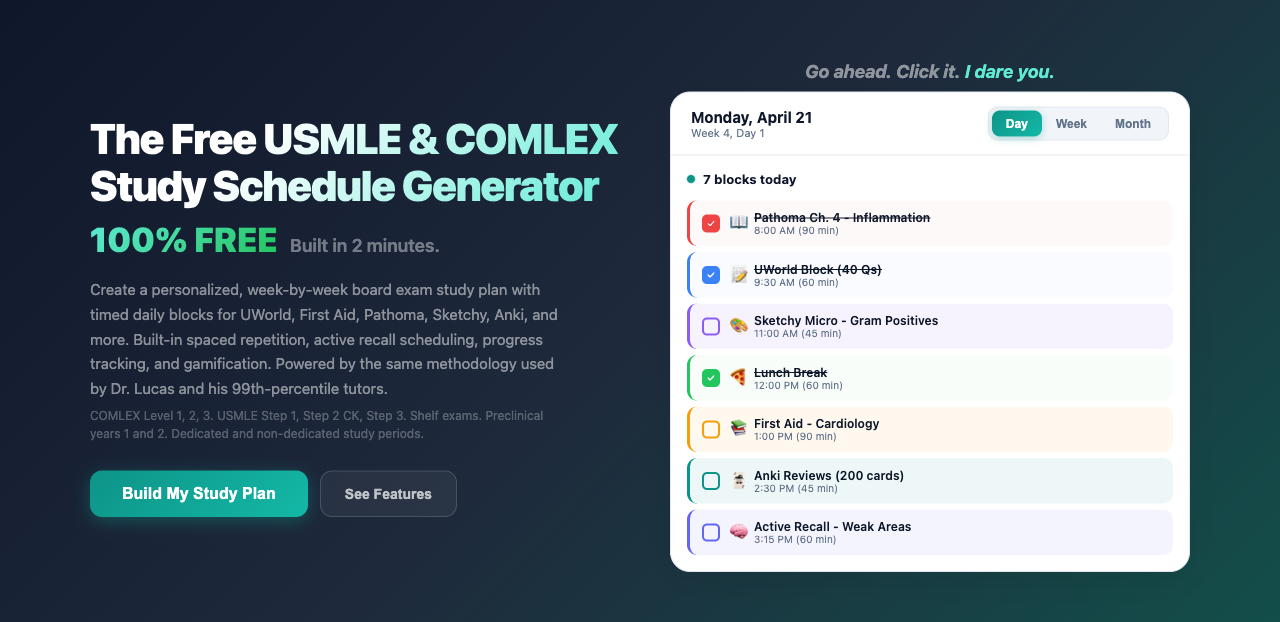
There's one disqualifier that ignores your scores entirely. If you aren't actually going to follow the plan, tutoring won't rescue you and neither will self-study. The work is real. Our 1-on-1 students put in 8 to 10 focused hours a day during dedicated, and that's the realistic floor, not a shortcut. A tutor amplifies good effort. Nothing replaces it. If you want the deeper version of this same framework, the companion article on who actually needs a COMLEX tutor breaks down the four patterns in full, and the Level 1 study timeline guide shows how long the plan realistically takes.
How do I score the self-test when I have mixed signals?
Most students don't get four clean yeses or four clean nos. The realistic outcome is two or three yeses and a real question mark on the rest. Here's how to read the gray zone honestly.
You're a safe self-study candidate when all of these are true:
- Your two most recent practice scores sit at or above 450
- Your trend over the last 4 to 6 weeks points up, even slightly
- Standardized exams have generally gone well for you
- You can execute a full study day without external accountability
A tutor genuinely earns its cost when any of these are true:
- Practice scores have been flat or sliding for 4 weeks or more despite full effort
- A previous failed attempt is behind you and a retake is ahead
- Real exam scores land 50-plus points under your practice scores
- You run out of time on practice blocks, including the most recent ones
- A school deadline forces a faster turnaround than your current trend will reach
The mixed case, some signals strong and one clearly weak, is exactly what an honest conversation sorts out. The weak signal is the diagnosis. A 460-and-climbing student who runs out of time on every block doesn't have a knowledge problem, they have a pacing problem, and that's a targeted fix rather than a full rebuild. Naming the one broken signal tells you whether you need a small adjustment you can make yourself or structured outside help.
What does a free strategy call actually look like?
It's a conversation, not a pitch. A consultant on our team gets on a roughly 45-minute video call, walks you through the free Study Plan Builder live, and builds you a personalized plan around your test date, baseline, and weak areas. You leave with that plan whether or not you ever pay us.
After the plan is built, we have a straight conversation about fit. If your self-test comes back clean, we tell you to use the free resources and we mean it. If one signal is clearly broken and your timeline is tight, we tell you why a tutor would help and what that would look like. If you're somewhere in the middle, we help you figure out which signal is the real problem. I would rather a student walk away knowing they don't need to pay us than take money and not move the needle. That honesty is why our cohorts run a 98 percent pass rate, because the call filters for fit before anyone commits.
Frequently asked questions about choosing between a COMLEX tutor and self-study
Should I get a COMLEX tutor or can I just self-study?
Self-study is the right call if your two most recent practice scores are at or above 450, your trend is moving up, you've historically done well on standardized exams, and you can follow a plan without daily accountability. With those four in place, a structured plan and a free community will usually carry you to test day. If any one of those is clearly false, especially a flat score trend or a practice-to-real-exam gap, that's the specific signal a tutor addresses. The decision is less about how you feel and more about what your score history shows.
What COMSAE score means I can pass COMLEX without a tutor?
A COMSAE around 450 corresponds to roughly a 99 percent pass probability per NBOME data presented in 2025, and a score around 400 corresponds to roughly a 94 percent probability, with the passing line at 400. Two recent scores at or above 450 with an upward trend give you the margin that makes self-study safe. A single 450 is not enough, because one score is noise. You want consistency across your two most recent attempts, not a one-time peak you can't reproduce.
Can I self-study after failing COMLEX once?
You can, but you have to change the system, not just study harder. The most common mistake after a failure is piling on more resources and more hours while keeping the same broken approach that led to the first result. That's how students end up on a third and final attempt. Before you commit to self-study on a retake, identify the actual diagnosis: strategy, timing, anxiety, or a real content gap. If you can name it and build a plan around it, self-study can work. If you can't figure out why you failed, that uncertainty is itself the reason to get outside eyes on it.
How do I know if my problem is testing anxiety and not knowledge?
Look for a consistent gap between practice and real performance across multiple exams, not a single bad day. If your COMSAEs sit comfortably above passing and your real COMLEX scores land 50 or more points lower, and you can see that same pattern on the MCAT or your shelves, that's testing anxiety rather than a knowledge gap. The fix is structured exposure work, timed and proctored in unfamiliar settings, plus mental health support when appropriate. More content review and more Anki will not close that gap, because the knowledge was never the missing piece.
Is it worth paying for a tutor if I am already scoring above 450?
Usually no. At 450 and climbing with a solid standardized-test history, you're in self-study territory and a free plan plus a community will typically get you across the line. The exceptions are narrow: you're gunning for a much higher score for a competitive specialty, you want insurance on a tight timeline, or you have a school-mandated cutoff to clear fast. For most 450-and-rising students, the honest answer is to save the money and trust the plan you can build for free.
What free resources can replace a COMLEX tutor for self-study?
A structured study plan and a community of physician tutors cover most of what 1-on-1 tutoring delivers, just at a slower pace. The free Study Plan Builder gives you a daily schedule tied to your test date and weak areas. The free Skool community gives you weekly office hours with physician tutors, a 100-plus video library of question breakdowns, transcribed Anki cards, and direct DM access. Together they provide the structure, accountability, and physician-level feedback that make self-study viable for a student who already has rising scores and a working system.
Take the self-test with us for free
Not sure how to score yourself? The Premeducated free strategy call is a 45-minute video conversation where we walk through your actual scores, your trend, and your history, then build you a free personalized study plan using the same builder our 1-on-1 students use. We tell you honestly which of the four signals are working and which one isn't. If self-study is your answer, we'll say so and point you to the free community. No pressure, no hard pitch.