
Recovering from a failed COMLEX attempt starts with the same six-part framework I use with every retaker: schedule a meeting with your school, evaluate for testing anxiety, build burnout recovery into the week, fix your spaced repetition, review questions the right way, and only then rebuild the study plan. Students don't fail COMLEX because they aren't smart enough. They fail because the system they studied with was broken, and a retake that changes the hours without changing the system tends to end the same way. This guide walks the framework step by step so your next attempt is the one that passes.
First, the part you already know but might need to hear from a physician: your career is not over. About 10 to 15 percent of practicing DO and MD family medicine physicians failed COMLEX or USMLE on a first or second attempt, and they are out there practicing medicine right now. A board failure is a setback, not a verdict on whether you'll be a good doctor. The work now is diagnosing why it happened and building a plan around the actual cause instead of the symptom.
What is the first thing to do after failing COMLEX?
Contact your school's administration and schedule a meeting before you touch a question bank. Your school holds the information that determines your entire timeline: when you're allowed to test again, whether you have to rotate while you study, whether a leave of absence is required, and whether you're mandated to pay for board prep or tutoring. You cannot build a retake plan without those constraints, so get them first.
A few realities worth naming so they don't blindside you. Some schools require you to take a leave of absence if you don't pass by a certain date, and an LOA can genuinely help your scores while also risking a delayed graduation and a pause on loan disbursements. Some programs will require you to pay for a tutor or a board prep course out of pocket, and the tuition you already paid usually doesn't cover it. None of this is fair, but knowing it up front lets you plan around it instead of getting surprised by an email two weeks in.
The stakes do shift by level. A failed Level 1 often means a postponed rotation schedule, possible mandatory tutoring, and the imposter syndrome of watching classmates move on. A failed Level 2 lands in the middle of audition rotations, ERAS, and interview season, which is heavier logistically. Level 3 is honestly the most recoverable of the three, because the passing score is lower and you're practicing the medicine you're studying every day on rotations. Whatever level you're on, the fix below is the same.
How do I know if testing anxiety caused my failure?
The signal for testing anxiety is a consistent gap between your practice scores and your real exam scores, especially across multiple standardized tests. If you've been scoring well on COMSAEs and then dropping 50 or more points on the actual COMLEX, that pattern points to anxiety, not a knowledge gap. More content review will not close it. This is the single most underdiagnosed reason retakers fail, and it's treatable.
When I evaluate a student for this, I pull their full score history and include their MCAT if they remember it. Someone who has underperformed their practice numbers on multiple national exams almost certainly has a degree of situational test anxiety. It is a real psychiatric condition, a form of performance anxiety, and it shows up as palpitations, sweating, brain fog, and outright panic attacks. That is not weakness, and it is not something you white-knuckle your way through with more UWorld.
Here is what I have every retaker with this pattern do:
- Get evaluated by a mental health professional, and start early, because therapy takes time to work.
- Consider prophylactic or acute medication with a psychiatrist, since scheduling can be slow and there are real options for the night before and the morning of.
- Have a therapist teach you stress, anxiety, and burnout management techniques you can actually deploy in the testing center.
- Drop the doomscrolling-as-coping habit, because procrastination only deepens the hole.
The fix that moves the needle most is structured exposure. Priyanka is a real student of mine whose testimonial interview is on the Doctor Lucas DO YouTube channel with her contact info in the description if you want to verify any of this. She failed COMLEX Level 2 twice and had the worst test anxiety I've seen, scoring as high as 900 on a COMSAE and then coming in around the low 300s on the real exam. She used to call me the morning of her practice tests because she was so anxious. So I built her plan around exposure therapy: timed, proctored mock exams, away from home, in unfamiliar environments, repeated for weeks until her nervous system adapted. The morning calls stopped. On her third and final attempt she scored a 455, a roughly 70-point jump, and she started her family medicine residency. If you want the deeper version of this diagnosis, I wrote a full guide on how to know if you have testing anxiety on board exams.
How do I recover from burnout while still studying for a retake?
You cannot out-study burnout, and trying to is how most retakers dig themselves deeper. Burnout accumulates slowly, it makes you slow and miserable, and the cruel part is that it feeds the exact anxiety that tanked your score in the first place. The recovery is not zero studying, because you still have a retake to prep for. It's structured studying with recovery built into the architecture of your week.
The trap is a feedback loop. You're anxious about passing, so you study hard for a long stretch. You get tired but push through anyway, and eventually you've pushed so long that you've lost interest in studying and maybe in medicine itself. Then you start taking unplanned breaks, which means you study less, which spikes your anxiety again. By test day you slept two hours, woke up with palpitations and clammy hands, couldn't eat breakfast, and couldn't recall half of what you knew. That is not a knowledge problem. That is a burnout-and-anxiety problem wearing a knowledge problem's clothes.
The single most effective fix I've found is scheduled time off, because when a break is planned you don't feel guilty taking it. Here's the structure I give students:
- Block your study day like the real exam: roughly two hours of focused work, then a 10 to 15 minute break, then repeat until you're done for the day.
- Reserve one to two hours every evening for yourself, fully off the books.
- Take one full day off each week. Keep doing Anki that day, but no practice questions, and spend most of it doing something you actually enjoy.
- Meet with a therapist weekly, because one hour is not going to wreck your score and an unbiased third party gives you real management tools.
Run SIG E CAPS on yourself honestly. If you're screening positive for depression, please get real psychiatric help. Too many bright students lose months, or worse, to untreated depression in med school. For the longer playbook, here's my full guide on managing burnout during board prep.
How should I fix spaced repetition on my retake?
Almost every retaker I've ever worked with was missing effective spaced recall, which means Anki used the right way. You read, you watch videos, you grind questions, but you re-see the information so rarely that your brain forgets the vast majority of it within a week. You might do a stroke question today and not touch another for a month. Anki's algorithm exists to show you a fact right before you'd forget it, and it quizzes you instead of letting your eyes glide passively over notes.
Anki only becomes overwhelming when people pull random cards or try to swallow the entire 30,000-plus Anking deck at once. Don't do that. Download the Anking deck, suspend every card, and then unsuspend only the cards tied to what you just studied. The workflow is one card on the correct answer choice, one card on the answer you actually picked, and an optional third for whatever else cements the main point. Not every question needs three cards, and keeping it under three per missed question is the rule that keeps the volume sane.
The math is friendlier than the reputation. A student late in prep on the high end might do around 500 cards a day. At 10 seconds a card, with real concentration, that's under 90 minutes. Even at 20 seconds a card you're under three hours, which is probably what you were already spending rereading notes, except now you'll retain far more of it. Comprehension comes first whenever possible: understand the concept, then make or unsuspend the card. Pure-memorization material like biochem, micro, pharm, and management algorithms is Anki's bread and butter, but your retention climbs even higher when you understood the topic before you committed it to a card. The full walkthrough lives in my guide on how to use Anki effectively for COMLEX.
How do I review practice questions the right way?
The sweet spot for reviewing a question block is one to two hours, usually closer to two. Students tend to land in one of two failure modes: they spend five hours dissecting a single block and learn too slowly to make progress, or they spend thirty minutes and learn nothing. Neither builds the pattern recognition a retake demands. The middle is where almost all of my students actually live.
When you review, the only two things that genuinely matter are why the correct answer is correct and why you chose what you chose. The other answer choices are mostly noise. If a distractor is high-yield, it will resurface as the correct answer or as your pick in a future question, and that is when you give it real attention. Chasing every wrong choice now is too slow and it crowds out the learning that counts.
Sort each missed question onto a continuum from rote memorization to logic and comprehension. Treat them differently:
- Rote questions (biochem, micro, pharm, algorithms) get reviewed through Anki, because the only job is consolidating the fact.
- Logic and comprehension questions (pathophysiology, physiology, next-best-step) get time spent making the concept genuinely click, plus a couple of Anki cards on the definitions and the reasoning you just worked out.
- If something refuses to make sense, ask for help instead of staring at it, since a quick explanation from a physician beats an hour of frustration.
This is the heart of why a retake that just adds hours rarely works. The retaker who changes everything except how they review questions is changing the volume, not the system. I broke this down in more depth in why effort alone does not raise board scores.
How do I rebuild my COMLEX study plan after a failure?
Once anxiety, burnout, spaced repetition, and question review are each handled, the retake study plan is just the assembly of those parts into a daily structure that fits your school's timeline. The plan that works treats the failure as a system diagnosis, not a willpower problem, and it builds in recovery instead of betting on raw hours. Stop trying to out-study your way out of fear, and strategize your way out instead.
Your retake plan should include:
- Exposure-based work for testing anxiety, if your score history shows that practice-versus-real gap.
- Recovery built into the week: structured breaks across the day, an evening off, and one full day off weekly.
- Daily Anki driven to zero, tied to your question review rather than pulled at random.
- Daily timed practice questions, because speed and stamina are learned skills you only build under the clock.
- A practice exam every one to two weeks to track the trend and surface anxiety patterns early.
- Realistic study hours and a timeline that aligns with your school's requirements and your retest date.
A note on how aggressive to be about the retest date. If your last COMSAE was about 50 points above your real COMLEX, aim to score at least 50 points higher than that on your final COMSAE the second time around to buy yourself buffer room. Track your two most recent practice scores, the overall trend, and your honest confidence. If you don't feel more confident than when you started, that's a strong signal to give yourself more runway, and meaningful progress tends to show up in roughly two-week intervals. If your scores are stuck and you genuinely can't see why, that's usually the point where outside eyes pay for themselves. I wrote an honest breakdown of who actually needs a COMLEX tutor and who doesn't so you can sort that out before spending a dollar.
If you want help assembling all six pieces into a plan built around your specific score history and timeline, that's exactly what a free strategy call is for. We review your history, outline the plan, and tell you honestly whether you need us or whether the free Skool community is enough.
Frequently asked questions about recovering from a failed COMLEX attempt
How many times can you retake COMLEX?
Under current NBOME policy, the number of attempts is capped, and a failed attempt counts against that cap, so a third attempt is typically your final allowable one. That's exactly why the structure of the retake matters more than the volume. The cost of getting a final attempt wrong is high, so the plan should be built around the actual diagnosis, whether that's anxiety, strategy, timing, or a content gap, rather than just studying harder with the same broken approach. Confirm your specific remaining attempts and any school-imposed limits directly with your administration.
How long should I study for a COMLEX retake?
Failure-recovery prep usually runs longer than a first-time dedicated period because there's rebuild work to do. Plan on something in the range of 8 to 16 weeks depending on your baseline, your history, and whether testing anxiety is in the picture. Students with a deep practice-versus-real gap, or those on a multi-repeat timeline, tend to need the upper end so the exposure work and the system rebuild both have time to take hold. Your school's required retest date may compress this, which is one more reason to meet with administration before you build the plan.
Does failing COMLEX ruin my chances of matching into residency?
No. A board failure is a hurdle, not a wall. Many students with a prior failure still earn plenty of interviews, and I've worked with retakers who matched while the rest of their application was strong. One of my students, Priyanka, even matched into family medicine before she had a passing Level 2 score, with a program that chose to wait for her. That outcome is rare, but it shows the failure itself doesn't end the story. You do eventually have to pass to start residency, so the priority is a retake plan that gets you there.
Why do smart students fail COMLEX even when they study hard?
Because effort and intelligence are usually not the problem. The common culprits are a broken study system, testing anxiety that drops the real score well below practice, and accumulated burnout that quietly erodes performance. A student grinding 12 hours a day with passive review and no effective spaced repetition can absolutely fail, and the fix isn't more hours. It's diagnosing which of those issues is driving the gap and rebuilding around it. That's why a retake that only adds volume tends to repeat the result.
Should I postpone my retake if I'm not scoring well?
If your practice scores are stuck and your confidence is low, postponing is often the right call, because so much of test day depends on your headspace. Aim for two recent practice scores above 450 where you can, and look for an upward trend over the prior weeks. Meaningful gains tend to show up in roughly two-week increments, so postponing 2 to 4 weeks at a time is reasonable. One hard rule: if you've had bad news recently, like a loved one falling ill, do not test. Protect the attempt.
Do I need a tutor to pass a COMLEX retake?
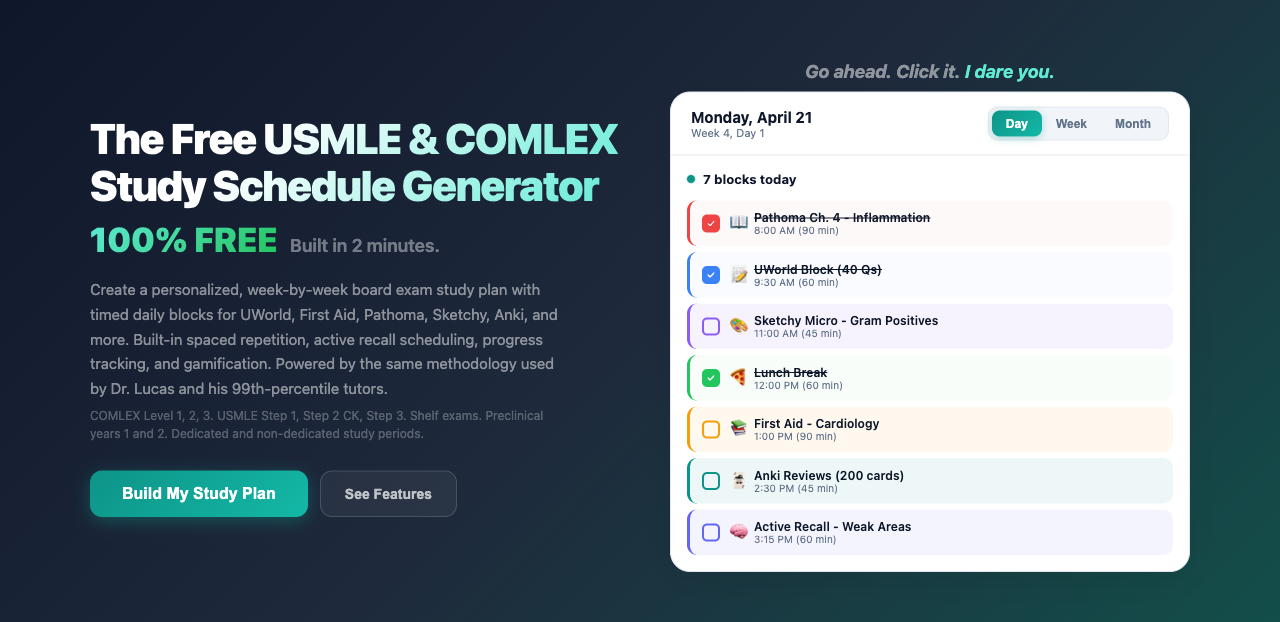
Not always. If you can honestly diagnose your own failure, fix the system, and your scores start trending up, the free Study Plan Builder and the free Skool community can carry many students across the line. A tutor earns its cost when your scores have been flat despite real effort, when testing anxiety needs structured exposure work, or when a final attempt and a tight school deadline raise the stakes. The honest way to decide is to look at whether your scores are actually moving, and a free strategy call exists to sort that out before you spend anything.
Build your retake plan with a free strategy call
If you just failed COMLEX and you're serious about passing the retake, get a second set of eyes on your score history before you rebuild. On a free 45-minute strategy call we review your attempts, your timeline, and your study history, build you a personalized plan, and tell you honestly whether you need 1-on-1 tutoring or whether the free community is enough. We've helped hundreds of DO students recover from a failed attempt, including final-attempt cases. No pressure, no hard pitch.