
A COMSAE plateau, defined as 30 to 45 days of flat or declining scores despite consistent effort, is almost always a strategy problem, not an effort problem. The fix is rarely "more hours." It usually comes from three specific resets: changing how you review questions, rebuilding your focused-block selection around current weak areas, and tying Anki directly to that question review instead of running it as a separate content-review crutch. Students stuck below 400 for more than 4 weeks should also evaluate timing, anxiety, and whether the current dedicated window is long enough to reach a passing score. Below is the exact diagnostic ladder we walk through with 1-on-1 students.
If you've taken three or four COMSAEs over the last month and your scores look like 380, 385, 390, 385, you already know the feeling. The hours are real. The Anki count is real. The video views are real. And the number on the score report won't move. That's the COMSAE plateau, and it's one of the most common things students bring to a free strategy call. The good news is that flat scores are diagnostic data, not a verdict. They tell you exactly where the leak is, if you know what to look for.
What counts as a real COMSAE score plateau?
A real plateau is three or more consecutive practice tests within roughly a 30 to 45 day window where your score has either moved less than 20 points or moved in the wrong direction. Single-test dips don't count, because COMSAE forms vary in difficulty and your day-to-day performance fluctuates with sleep and stress. The pattern matters more than any one number.
Two more thresholds shape how urgent the plateau is. First, the absolute level. A student plateauing at 470 has time and runway to polish toward 500 or higher. A student stuck at 380 with a test date 4 weeks out is in a much tighter spot, because the floor for a confident pass is 450, with the NBOME's 2021 poster reporting that COMSAE scores above 450 correspond to roughly a 99 percent pass rate. Their 2025 poster puts a 400 COMSAE at about a 94 percent pass rate. Second, the trend. A flat 420, 425, 420 is a different problem than 420, 405, 390, where scores are actively declining.
If you're not sure whether your trend qualifies, the cleanest test is to plot your last four practice scores against the dates. If you can draw a horizontal or downward line through them and your test date is within 30 to 60 days, you have a plateau worth diagnosing right now.
Why your COMSAE scores stopped improving
There are five common reasons a COMSAE score stalls. Most plateaued students are running two or three of them at the same time.
1. Question review is being treated as the wrong activity. The biggest single mistake we see during a plateau is treating the question block as the learning. The block tells you what to study. The review is where you actually study. A thorough review of a 40-question block takes most students about 2 hours. If you're spending 20 minutes after a block and moving on, you're not actually consolidating the material. You're collecting verdicts.
2. Focused blocks aren't being updated. When students first build a study plan, they choose 4 to 6 focused question blocks per discipline and 3 to 6 per system, weighted toward the weakest topics from their score report. Two weeks in, the weak topics have shifted, but the focused-block list often hasn't. The same areas keep getting hammered while new gaps open underneath, and the next COMSAE picks them up. A static focused-block list almost guarantees a flat score curve.
3. Anki is being used as a content-review tool, not a memory tool. The Anki philosophy that works on boards is premade Anking, suspend all cards by default, then unsuspend in response to question review. Specifically, fewer than 3 cards per missed question. When students instead unsuspend by topic, run 2,000-plus cards a day from a buffet of decks, and never tie the cards back to questions they actually got wrong, Anki becomes a content-review crutch that eats hours without moving scores. Clayton, a real student whose testimonial video is on the Doctor Lucas DO YouTube channel, was doing exactly that before we worked with him. He was running 2,000 cards a day in Anki and stuck at a 425. The fix wasn't more Anki. It was less, tied directly to question review, with the rest of the time redirected to active question work.
4. Timed mode is being avoided. Speed and stamina are learned skills, and they only get learned by living them every day in timed mode. Students who do most of their questions in tutor mode see their score plateau in part because they've never actually built test-day timing into their muscle memory. The real exam doesn't slow down when you get tired. If your practice doesn't either, the COMSAE will reflect it.
5. Burnout is masking real progress. Six straight weeks of 12-hour days with no real day off doesn't make a student smarter. It makes them slower and less accurate. A plateau that coincides with skipped weekly days off and broken sleep is often a burnout plateau, not a content plateau. The fix isn't another video. It's an enforced day off and protected sleep for 7 to 10 days.
A plateau diagnosis usually involves more than one of these. The next section is how to find which ones are yours.
How do I diagnose where my COMSAE plateau is coming from?
The diagnostic order matters. Start with the cheapest, fastest checks and work downward toward the heavier rebuilds. Here is the order we walk through with 1-on-1 students in week one of a plateau breakthrough.
Step 1: Open your most recent COMSAE score report
Look at the discipline and system breakdown. On a typical COMSAE Level 1 score report, MSK runs around 13 percent of the test, Community Health around 12 percent, and OMM around 10 to 12 percent. These shares matter because a 5-percentage-point gap in MSK costs more raw points than a 5-percentage-point gap in a smaller topic. Note the three weakest disciplines and the three weakest systems. These are your new focused-block priorities, regardless of what you chose 2 weeks ago.
Step 2: Time your last question review
Pick any block you've reviewed in the last week. Look at the timestamp from when you opened the review to when you stopped working on it. If that gap is less than 90 minutes for a 40-question block, your review is too thin to drive a score change. The fix is to spend 1 to 2 hours per block, focused on the right answer plus the option you actually picked, with fewer than 3 Anki cards generated per missed question. Detailed question review methodology is the single highest-leverage change most plateaued students make.
Step 3: Audit your Anki settings and behavior
Open Anki and check the deck stats for the last 7 days. If you're running more than 200 to 300 reviews per day and the deck isn't tied to specific question-review unsuspends, you're using Anki as content review. The reset is to suspend everything, then only unsuspend cards you generated in direct response to a missed question. Cap unsuspends at fewer than 3 per missed question. Drive new, learning, and review counts to zero every day. Detailed setup is in our guide on how to use Anki effectively for COMLEX.
Step 4: Check your tutor-mode versus timed-mode ratio
Pull up the bank you've used most recently and look at the split. If more than 20 percent of your questions over the last 2 weeks have been in tutor mode, switch fully to timed mode for the next 10 days. Speed gains and stamina gains often show up on the very next COMSAE.
Step 5: Look at your sleep and your day-off discipline
Honest question: have you taken a full day off in the last 14 days? Are you averaging 7 hours of sleep? If either answer is no, your plateau may be a burnout plateau, and the fix is rest before it is study.
If you've worked through all five and your COMSAE is still flat 2 weeks later, the diagnosis moves to anxiety or to outside support. We'll cover that lower in the article.
The three resets that actually break a COMSAE plateau
Once you've diagnosed the cause, the rebuild is structured. These three resets are what we use with our 1-on-1 students who walk in mid-plateau. Run them together. Doing one alone tends to produce a smaller bump than doing all three for 2 to 3 weeks.
Reset 1: Spaced repetition tied to question review
The structural rule is simple. Premade Anking deck, every card suspended by default. The only cards you unsuspend are ones that come directly from a missed question in your daily review, capped at fewer than 3 cards per question. Suggested settings: 1m and 1d learning steps, 10m relearning interval, FSRS off if you want to keep things simple, auto-advance on. The goal is to drive the deck to zero every day, including reviews, so that nothing carries over.
What this fixes: it stops Anki from being a passive content-review activity that eats time without moving scores. The cards that stay in your deck are the cards that map to actual gaps you've already shown the bank you have.
Reset 2: A focused-block reset based on your current score report
Take the three weakest disciplines and the three weakest systems from your most recent COMSAE. Build 4 to 6 focused blocks per discipline and 3 to 6 per system, all in timed mode, all 40-question blocks, no tutor mode. Run them over the next 7 to 10 days while doing thorough 1-to-2-hour reviews of each block.
What this fixes: it kills the "I built my focused-block list 3 weeks ago and never updated it" pattern that produces flat scores even when daily volume looks fine. Your weak topics aren't where they were a month ago. Your blocks shouldn't be either.
Reset 3: Pure timed mode with full-block discipline
For the next 10 days, every question you do is in timed mode, in a full 40-question block. No partial blocks, no question-by-question review pauses, no tutor mode. After each block, do the 1-to-2-hour structured review. Then move on.
What this fixes: it rebuilds the speed-and-stamina muscle that tutor-mode habits erode, and it makes question fatigue management an explicit skill rather than something you hope shows up on test day.
After 2 to 3 weeks running all three resets in parallel, take a fresh COMSAE. Most plateaued students see a 30 to 70 point jump on that first test. Some see more. Either way, the trend should be visibly back to climbing, which is the actual goal.
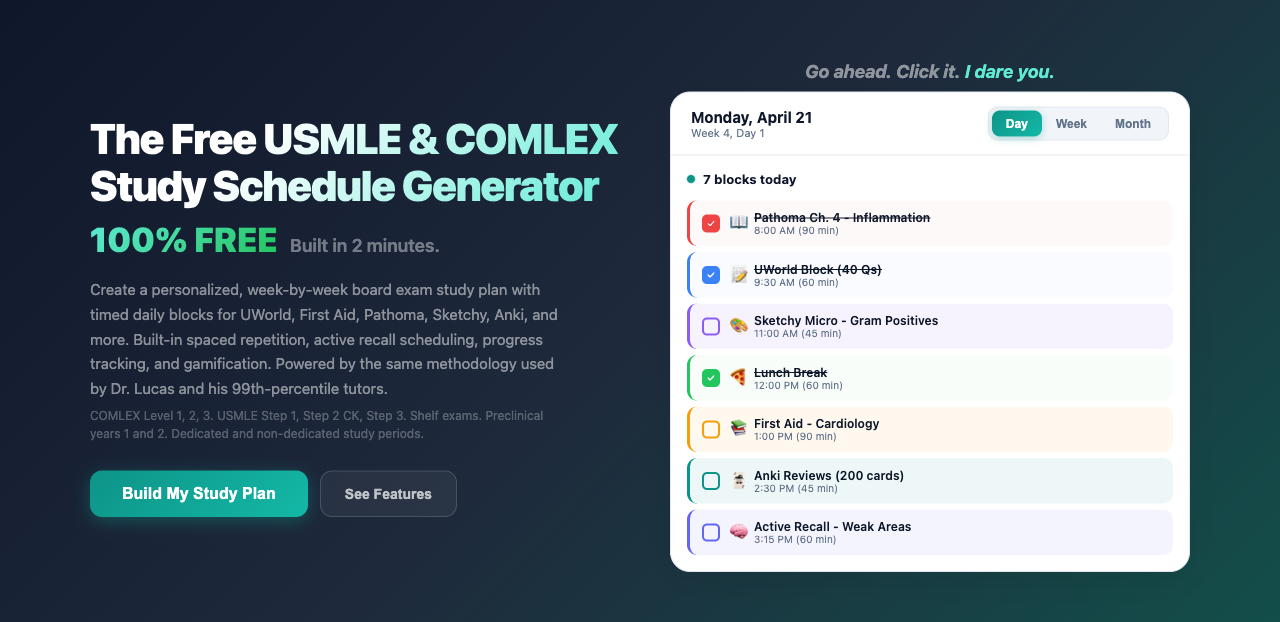
If you'd rather not assemble all of this manually, the free Premeducated Study Plan Builder builds the post-plateau plan automatically based on your current scores, weak areas, and test date. It uses the same logic Dr. Lucas uses with 1-on-1 students.
Should I postpone my COMLEX if my COMSAE is plateaued?
Maybe. The postpone decision is based on six inputs, not on the plateau alone. We walk through the same six with students on free strategy calls: the most recent two COMSAE scores, the overall trend over the last 4 to 6 weeks, the question-bank percentile on whichever bank you've used most recently, the recency of your question-bank work, any rotation or LOA constraints, and your honest headspace going into the test (the combined anxiety-and-confidence read).
Concretely, the postpone conversation gets serious when:
- Scores have been flat under 400 for more than 4 weeks despite consistent effort.
- Your last two COMSAEs both came in below the 5th to 9th percentile floor that maps to a passing test-day score.
- You're a previous test taker who dropped 50 or more points from COMSAE to actual exam, which is a strong testing-anxiety pattern that needs an exposure-based fix rather than a content fix.
- A school deadline with a real LOA option would let you genuinely reset rather than rushed-restart.
Most postponements that work are 2 to 4 weeks. Longer than that and burnout starts to outweigh the extra prep time. If you're trying to decide whether to push the date, our free Postpone Calculator walks you through these inputs and gives you a structured recommendation.
When a tutor is the right move during a COMSAE plateau
For most plateaued students, the three resets above plus a refreshed plan are enough. There's a specific subset where outside support compresses the timeline meaningfully. The signal that a tutor pays for itself fast is when your COMSAE has been flat for 4 or more weeks despite consistent effort and you genuinely can't figure out why. That diagnostic block is where 1-on-1 work is worth the money, because someone outside the loop can spot the leak you've stopped seeing.
Justin, whose testimonial video is on the Doctor Lucas DO YouTube channel, came to us after a failed Level 2 attempt with a first practice score around the first percentile on his retake prep. We didn't add more volume. We changed the system: timed focused blocks, structured review, Anki tied directly to question review, and a daily plan that pivoted based on what he missed the day before. Six weeks later he scored a 440 and matched into family medicine. The pattern that worked for him is the same pattern that works for a plateaued student, just with different starting scores. The guide on who actually needs a COMLEX tutor has the full breakdown of when 1-on-1 tutoring is and is not the right call.
Frequently asked questions about breaking a COMSAE score plateau
Why is my COMSAE score not improving even though I'm studying every day?
Effort alone does not raise board scores. The most common reasons a COMSAE plateaus despite consistent daily work are thin question review (less than 90 minutes per 40-question block), focused-block lists that haven't been updated based on recent score reports, Anki used as content review rather than tied to missed questions, and too much tutor-mode practice with not enough timed full blocks. Burnout from skipped weekly days off can also flatten scores without you noticing. The fix is structural, not volume-based. Daily hours often need to come down or stay flat, not go up.
I'm stuck at 400 on COMSAE. What should I do?
A 400 COMSAE corresponds to roughly a 94 percent pass rate based on the NBOME's 2025 poster, so you are inside the passing band but without much margin. If your test date is 4 or more weeks out, prioritize the three resets above (Anki tied to question review, focused-block reset based on the most recent score report, and pure timed-mode practice). Most students see a 30 to 70 point jump on the next COMSAE if all three are running in parallel. If your test date is closer than 4 weeks and your trend is flat, evaluate a 2 to 4 week postponement using the Postpone Calculator. The goal is two recent scores above 450 in the final 2 weeks before test day, not one heroic effort to clear 400.
How many COMSAEs in a row count as a plateau?
Three or more consecutive practice tests over a 30 to 45 day window where your score either moves less than 20 points or trends downward. Single-test dips don't count. COMSAE forms vary in difficulty and your performance fluctuates with sleep, recent qbank work, and stress. The pattern matters more than any single score. Plot the last four scores against their dates. If you can draw a horizontal or downward line through them, that's a plateau worth treating now.
Can a COMSAE plateau mean I have testing anxiety?
It can, especially if you've also seen a 50 or more point drop between practice scores and an actual COMLEX attempt. The signal that anxiety is in play is a consistent gap between practice and real-test performance, not occasional bad days. The fix is structured exposure work (timed proctored mock exams in unfamiliar environments) plus, when appropriate, support from a therapist or psychiatrist. The SIG E CAPS screen for depression and a similar anxiety check should be on the table when scores plateau and motivation drops together. Content review alone won't fix an anxiety plateau.
Is it bad to retake a COMSAE form I've already taken?
For an early data point during a plateau, no. A reused COMSAE will overestimate your score by some amount because you've seen the questions, so don't treat it as a real readiness signal. Save unused COMSAEs for the final 2 weeks before test day, where you need clean data above 450 across two consecutive scores. Mid-prep, a reused form can be useful as practice cadence and stamina work even when it isn't useful as a diagnostic score.
How long should I run the resets before I expect to see my COMSAE improve?
Plan on 2 to 3 weeks of running all three resets in parallel before taking a fresh COMSAE. One week usually isn't enough for the question-review changes to compound and for the new focused-block list to cover the actual weak topics. After 2 to 3 weeks, most students see a 30 to 70 point jump on the next COMSAE if the resets have been run cleanly. If you've genuinely done all three for 3 weeks and the next COMSAE is still flat, that's the cue to bring in outside support and to use the postpone framework to decide whether to push the test date.
Build a personalized post-plateau study plan in a few minutes
The right plateau-breakthrough plan depends on your current scores, your test date, and your specific weak areas. The free Premeducated Study Plan Builder uses the same logic Dr. Lucas uses with 1-on-1 students to assemble a personalized plan that tightens question review, refreshes your focused-block list, and ties Anki directly to missed questions. Free, no upgrade required.