
Use First Aid during COMLEX dedicated as a reference you open while reviewing practice questions, and as a rapid-review fact list in the final two weeks. Don't use it as a textbook you read cover to cover. Questions and Anki do the heavy lifting in dedicated, and First Aid is where you look things up when a question exposes a hole. First Aid alone isn't enough for COMLEX, because it's written for the USMLE and skips OMM.
That's the short version. The longer version matters because First Aid is the book almost every student already owns, and it's very easy to spend dedicated reading it instead of studying from it. Reading feels productive. It fills the hours, it feels like progress, and it moves your score far less than the same hours spent on timed questions and their review. Here is how to put the book in its proper place.
Is First Aid enough for COMLEX?
No. First Aid for the USMLE Step 1 is a condensed outline of the Step 1 content, and COMLEX Level 1 tests a lot of that same content. But the book is built for a different exam, and it leaves out the things that make COMLEX COMLEX. There's no OMM chapter. The osteopathic principles, the Chapman's points, the counterstrain tender points, and the viscerosomatic reflexes you'll see across your COMLEX sections aren't in it.
The bigger issue isn't what's missing from the book. It's what the book is. First Aid is a list of facts. COMLEX is a test of whether you can recognize those facts inside a long clinical vignette, under time, with two answer choices that both look right. Knowing that TTP presents with the FAT RN pentad is a fact. Picking TTP over HUS in a stem where the only separating clue is the patient's age and the absence of bloody diarrhea is a skill. Only questions build the skill.
So the honest answer to "is First Aid enough for COMLEX" is that no single book is enough. You need a question bank (TrueLearn is the gold standard for COMLEX, with UWorld as a strong adjunct), a spaced-repetition system (Anki is the gold standard by far), and content resources for the gaps. First Aid can be one of those content resources. It shouldn't be the backbone.
How should First Aid fit into a dedicated study day?
First Aid fits into the parts of the day that are already built around learning from your mistakes: question review and the optional content-review window at night. It doesn't get its own block. The core dedicated day we give most of our 1-on-1 students is 8 hours: 2 hours of timed questions, 4 hours reviewing those questions, and 2 hours of Anki. There's no slot labeled "read First Aid" in that schedule, and that's on purpose.
Here's where the book actually shows up:
- During question review (4 hours). When you miss or guess a question, you open First Aid to the topic and read the relevant section. That's a few minutes per question, not a chapter.
- During the optional content-review window (5 PM to 6 or 7 PM). If a whole topic felt shaky in the morning blocks, you can spend part of this window on it. Most students get more out of a content video here (Pathoma for path, Sketchy for micro, Osmosis for physio), but a focused First Aid section is fine too.
- During the final two weeks. The Rapid Review section becomes a cram list for high-yield facts. More on that below.
The rule underneath all three is that a question decides which page you open. You don't pick the next First Aid chapter because it's next in the book. You open the page because a question just told you that you don't know what's on it.
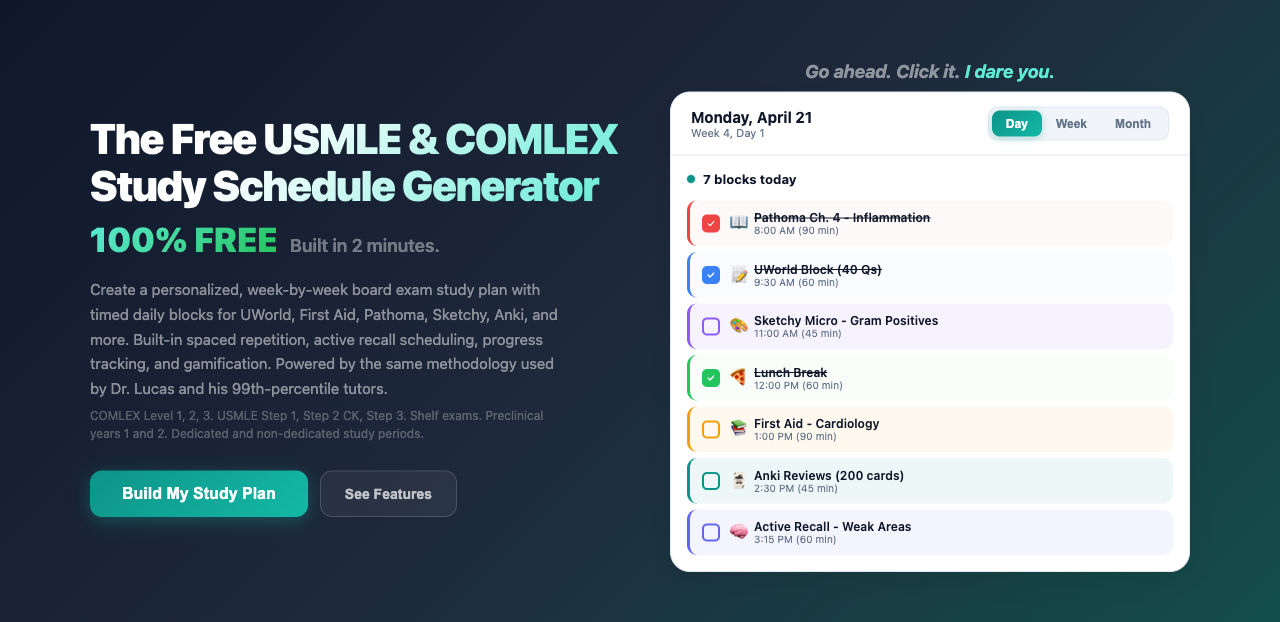
If mapping this onto your own calendar feels like a lot, the free Study Plan Builder generates this schedule around your test date and weak areas.
How do I use First Aid during question review?
Use it to confirm and expand the main point of each question you missed or guessed on. The main point is the learning summary, meaning the correct answer and why it's correct. You also want to understand the answer you actually picked, because that's the trap you'll fall for again. The other answer choices matter less. If they're important, they'll come up as the main point of a different question.
A clean review loop with First Aid looks like this:
- Read the explanation first. The question bank explanation is written for that exact stem. Start there.
- Open First Aid to the topic. Look at where the fact sits. The book's value is context: the table that puts the right answer next to its neighbors, the chart that shows why the distractor you picked belongs to a different category.
- Decide what kind of miss it was. A rote memorization miss (a drug side effect, an enzyme deficiency, a bug's virulence factor) goes into Anki. A logic or comprehension miss (you knew the facts but couldn't reason through the physiology) needs a few minutes of understanding before you move on, plus Anki on the definitions that tripped you.
- Unsuspend or make fewer than three Anki cards. Keep it under three cards per missed or guessed question. If you got it right for the right reasons, move on without adding cards.
That third step is where First Aid earns its keep. The book's tables and flow charts are great for seeing a fact next to the things it gets confused with. That's exactly what you need when you've just picked the wrong neighbor.
Some First Aid content is best learned as a group rather than one card at a time. The bacteria flow chart is the classic example. If you keep forgetting the gram-positive, catalase-negative organisms, make a card that says "draw out the gram-positive, catalase-negative bacteria" and take 20 to 60 seconds to draw the whole branch from memory. The same trick works for all the generic drug names in a class and for management or diagnostic algorithms. One drawing card replaces ten single-fact cards, and it forces you to rebuild the relationships the book lays out.
For the full review method, see our guide on how to review practice questions efficiently.
Why doesn't reading First Aid cover to cover work?
Reading First Aid cover to cover doesn't work because reading is passive review, and COMLEX tests retrieval. Recognizing a fact on the page ("oh right, I know that") feels like knowing it. It isn't the same as pulling that fact out of your head, unprompted, in the middle of a 40-question section with a clock running. The test rewards the second skill. Rereading only trains the first.
This is one of the most common ways strong students lose dedicated time. Passive review worked in undergrad, so they default to it. Highlighting First Aid, rereading it, rewriting it into color-coded notes. All of it feels productive, and none of it builds the retrieval that boards reward. We wrote more about that pattern in why smart med students fail board exams.
There's also a math problem. The book is dense, and a full pass takes weeks of a dedicated period that might only be six or eight weeks long. Those are weeks where you aren't doing two timed blocks a day, aren't reviewing them, and aren't building the stamina you need for eight 1-hour sections on test day. And by the time you finish the last chapter, the first one has already started to fade, because nothing was spacing it.
If you're going to spend time on content, make it active. Read a section, close the book, and quiz yourself on it. Cover your notes with your hand and recall them. Turn what you missed into Anki cards. The rule we give students is simple: no passive reading.
Should you finish content review before starting questions at all? For most students, no. Content review should come mostly from question review, with a small slice of pure content at the end of the day. Our breakdown of whether to finish content review before starting practice questions covers the exceptions.
What does First Aid miss for COMLEX?
First Aid misses the osteopathic content and underweights the parts of COMLEX that aren't classic Step 1 basic science. For a DO student, that gap is big enough that you need other resources to cover it. Plan for it on purpose instead of discovering it on your score report.
The main gaps and what we recommend filling them with:
- OMM. First Aid has no OMM chapter. Use COMQUEST for your OMM and MSK focused blocks (it's what we use for those two areas even when the rest of the focused blocks run in UWorld), and consider supplementing with the Dirty Medicine OMM series.
- Ethics and jurisprudence. First Aid covers the basics, but COMLEX leans on it. Run 1 to 2 ethics and jurisprudence blocks near the end and pair them with Dirty Medicine's ethics and law videos. High-yield topics include emancipated minors, EMTALA, HIPAA, Stark law, anti-kickback law, and the need for an official translator.
- Biostatistics. First Aid's biostats section is a solid summary, but it's a list of formulas, not practice. Do 1 to 2 biostats blocks (44 to 88 questions) and use Dr. Randy Neil on YouTube for review. You want sensitivity, specificity, relative risk, absolute risk reduction, NNT and NNH, odds ratio, type I and type II errors, study design, and biases cold.
- Question style. No book prepares you for COMLEX-style stems. That's what TrueLearn, COMQUEST, and the NBOME's own welCOM question packs are for.
Community health, which includes ethics, biostats, USPSTF guidelines, milestones, and vaccine schedules, shows up on your COMLEX score report as its own category. First Aid treats most of it as a single chapter, so budget question blocks for it instead of assuming the book has it covered.
How should I use First Aid rapid review in the final two weeks?
In the final two weeks, use First Aid's Rapid Review section as a list of high-yield facts to skim, and pull only the ones that keep tripping you up into Anki. It's the one point in dedicated where reading a section of First Aid straight through makes sense. You aren't building knowledge anymore. You're consolidating it, and a dense fact list is the right tool for that.
Think of the final two weeks as the good version of the undergrad night-before cram, stretched over fourteen days. Any memorization topics you've been putting off get done now. The Rapid Review section fits that goal because it's pure memorization material, the kind that fades fast and rewards one more look right before test day.
Three rules keep it from turning into another passive read:
- Don't Anki every fact. Read through it and flag the facts you've seen come up in questions and still miss. Many of those may already be in the AnKing deck, so check before you make new cards.
- Keep your questions going. Rapid Review supplements your mixed question blocks, it doesn't replace them. Once your final focused blocks are done, run mixed blocks all the way to test day.
- Keep Anki at daily zero. New cards should drop off in the last stretch. Maintenance of what you already know matters more than adding volume now.
This sits alongside the other final-stretch priorities: ideally one full-length practice test two weeks out and another one week out, with two scores above 450 as the readiness signal, plus the biostats and ethics blocks above. Our full plan for the final two weeks before COMLEX lays out the day-by-day version.
Get a dedicated schedule that puts First Aid in the right place
The free Premeducated Study Plan Builder generates the same 8-hour dedicated schedule we give our 1-on-1 students, built around your test date, your baseline, and your weak areas. Timed blocks, review time, Anki, and content review all land in the right slots, so you stop guessing how much time First Aid deserves.
Frequently asked questions about using First Aid for COMLEX
Should I read First Aid cover to cover during dedicated?
No. Reading First Aid cover to cover is passive review, and it eats weeks you need for timed questions and their review. COMLEX tests retrieval under time, and rereading trains recognition instead. Open First Aid when a missed or guessed question sends you to a topic, read that section, and turn the facts you missed into fewer than three Anki cards. The one exception is the Rapid Review section in the final two weeks, which works well as a fast consolidation list.
Is First Aid enough to pass COMLEX Level 1?
No single book is enough, and First Aid has a specific gap for DO students: it has no OMM chapter. It's written for the USMLE Step 1, so it also underweights community health topics like ethics, jurisprudence, and biostatistics that COMLEX reports as a major category. Pair it with a COMLEX question bank like TrueLearn or COMQUEST, daily Anki, and targeted resources for OMM such as Dirty Medicine. Questions should be the backbone of dedicated, with First Aid as the reference.
Should I annotate First Aid while I do questions?
You can, but annotation is only useful if it feeds active recall. A margin note you never quiz yourself on is just more passive reading later. If you like annotating, keep it brief and make sure the fact also ends up in Anki, where spaced repetition will actually bring it back. For most students, the time is better spent making or unsuspending one to two good cards per missed question than building a heavily annotated book.
Do I need First Aid if I use the AnKing deck?
Not necessarily. The AnKing deck is very comprehensive, with over 30,000 premade cards, and it covers a lot of the same facts. First Aid still helps during question review because its tables and flow charts show a fact next to the things it gets confused with. If you already have another reference you like, such as Pathoma for path or Sketchy for micro, you can use that instead. The resource matters less than the loop: question, review, card.
When should I use First Aid Rapid Review?
Use it in the final two weeks of dedicated. Skim the section, flag facts that keep showing up in your questions and that you still miss, and add only those to Anki if they aren't already in your deck. Keep running mixed question blocks every day while you do it. Rapid Review works late in dedicated because the goal has shifted from building knowledge to consolidating memorization-heavy facts that fade quickly.
Is First Aid useful for COMLEX Level 2?
Much less. First Aid for the USMLE Step 1 is a basic-science resource, and Level 2 is a clinical exam. For Level 2, OnlineMedEd is considered the gold standard content resource, and Emma Holliday's review videos are a strong option for high-yield internal medicine, surgery, pediatrics, and psychiatry. The same principle applies either way: questions lead, and content resources fill the gaps the questions expose.
Related guides
- What to do in the final two weeks before COMLEX
- How to use Anki effectively for COMLEX
- How to review practice questions efficiently
- Should I finish content review before starting practice questions?
- Doctor Lucas DO on YouTube: question breakdowns and dedicated-period walkthroughs