
Yes, and you should take one every week. One full day off per week is part of the schedule I give my 1-on-1 students, not a reward for finishing it. On that day you do your Anki reviews and nothing else: no question blocks, no content videos, no new material. The next morning you run a normal study day without trying to make up the hours you didn't study.
Most students don't actually ask me whether a day off is allowed. They ask whether they can afford one. That's a different question, and the answer comes from how dedicated burns people out, which is faster and more isolated than anything else in medical school. The day off is how you keep showing up at 8 AM in week 6 with a brain that still works.
Why should I take a day off during COMLEX dedicated?
Because scheduled time off is the most effective burnout management I've found, and burnout during dedicated doesn't slow down on its own. You've been accumulating burnout through all of medical school. Dedicated accelerates it, because you're locked in a room for weeks without class, without friends, and without anything fun. A weekly day off resets the week so the grind doesn't become one unbroken stretch of 40 or 50 days.
The word that matters is scheduled. When you plan the break in advance, you don't feel guilty taking it. When you take it spontaneously because you hit a wall on a Wednesday, you spend the whole day feeling like you're falling behind, which means you rest badly and come back feeling worse.
The day off also protects the hours that actually move your score. Those are the two timed question blocks at the start of each day and the review that follows. They only work if you arrive rested. A student who studies 7 days a week for 8 weeks isn't getting 56 good days. A growing share of those days turn into rereading stems three times and retaining nothing.
Here's the pattern I see over and over. Almost every student I meet who is failing practice tests is already studying 12 to 14 hours a day. Effort is almost never the problem. The typical advice when scores are flat is "work harder," and that advice assumes the student is going home to play video games. They aren't. Adding a seventh study day to a week with no shape is just a slower way to burn out.
What should a real day off look like?
A real day off is Anki reviews in the morning, then the vast majority of the day spent doing whatever you actually want to do. Make plans. See people. Get outside. The goal is a full disengagement from board prep, and the day should look nothing like your study days.
The one exception: Anki reviews
Anki survives the day off for one reason. Missed reviews compound. The spacing algorithm punishes lapses, so skipping a day of reviews means the next day's review count balloons, and now your two afternoon Anki blocks can't reach zero. New cards can wait. Reviews can't.
Do the reviews early, ideally in the morning, so they're done and out of your head. Don't unsuspend new cards, and don't open your question bank to "just check" anything. If the reviews take you an hour, the day off still has 15 waking hours left in it.
What doesn't count as a day off
"Light studying" isn't a day off. Watching a Pathoma chapter on the couch isn't a day off. Doing one untimed block "just to stay sharp" isn't a day off either. Each of those keeps the career part of your brain switched on, which is exactly the part that needs the break.
Reading COMLEX threads on Reddit for three hours also doesn't count. Neither does comparing your TrueLearn percentile to the group chat. If the activity is about the exam, it's work, even if you're doing it in sweatpants.
Active recovery beats passive recovery
The best day off includes something physical: the gym, a long walk, a hike, a pickup game. Active recovery stacks physical rest on top of mental disengagement. Passive recovery is still fine. A day of Netflix and sleeping in is better than a day of half-studying. The point is the disengagement, not how productive your fun looks.
Water a different plant
My own therapist gave me an analogy I use with students constantly. Life has several plants you can water: a career plant, a relationship plant, a hobbies plant, a friendships plant, and more. You only have so much water. Med students tend to pour all of it into the career plant, and when that plant wilts after a bad COMSAE, they're crushed because nothing else is growing.
The day off is when you water the other plants. Call your family. Go on the date. Play the guitar you haven't touched since M1. A psychiatrist I spoke with put it this way: burnout in med students hits so hard because being a good medical student is often the only thing they have going for them. One day a week of having something else going for you changes how a bad practice score feels.
Can I afford a day off if I'm behind or my test is soon?
Yes. A student who is behind needs the day off more, not less, because being behind is usually a strategy problem and a tired brain makes worse decisions about strategy. Dropping the day off to buy back time trades a reliable 8-hour study day for a low-quality seventh day and a worse week after it.
Before you cancel a day off because you feel behind, check whether you actually are. "Behind" only means something against three things: your own study plan, your test date, and the passing threshold. Your classmates aren't on that list. I wrote a full breakdown of what to count in is it normal to feel behind during board prep.
If your scores are flat after 4 to 6 weeks of consistent 8-hour days, a seventh study day won't fix it. Flat scores point to the shape of the day: too much tutor mode, review that re-explains every answer choice, or Anki used as a content crutch. Fix the input, keep the day off.
What about the final stretch before the exam?
The weekly day off stays in place through the last two weeks. The only thing that changes near test day is the day before the exam, which becomes a full day off on top of the weekly one. At most, do your Anki reviews that morning. No new questions, because a bad block the day before can psych you out. Would you run a marathon the day before a marathon? The full checklist is in what to do the day before COMLEX.
How do I get back to studying after a day off without trying to catch up?
Run a normal study day. Two timed question blocks starting at your exam start time, two blocks of review, two blocks of Anki, a hard stop, and at least 1 to 2 hours for yourself that evening. Don't add a third question block. Don't stay up until midnight. The day off was already in the plan, so there is nothing to repay.
This is the step most students get wrong. They take Sunday off, feel guilty about it Sunday night, and try to cram 10 or 12 hours into Monday to make up for it. Now Monday is the low-quality day, Tuesday starts tired, and the day off produced net negative recovery. The guilt cancelled out the rest.
Why you can't just add a third question block
Two timed blocks a day is the minimum for most students, and it's usually the maximum as well. The reason is review. One 40-question block takes most students about 2 hours to review properly, and review is where the learning happens. A third block added to make up for a day off almost always means one of the three blocks gets a 20-minute skim instead of a real review. You've collected data and changed nothing.
The only time I move students from 2 blocks to 3 or 4 is near test day, for students with a genuine timing or stamina problem. That's a deliberate change to the plan with a known cost to review. It isn't a make-up mechanism.
Your Anki is already caught up
Because you did your reviews on the day off, your Monday afternoon Anki blocks look like any other day. That's the whole reason Anki survives the day off. If you skipped the reviews too, do the reviews first on the day you come back and hold off on new cards until the review count hits zero. Set new cards to show after reviews so you're protecting the facts you already learned.
Let the plan absorb it
A good study plan has the weekly day off built in before day one. When it does, your total question count, your practice test dates, and your test date already account for it. You don't owe the calendar anything. If your plan doesn't have a day off built in, the plan is the problem, and you should rebuild it rather than run it at 7 days a week.
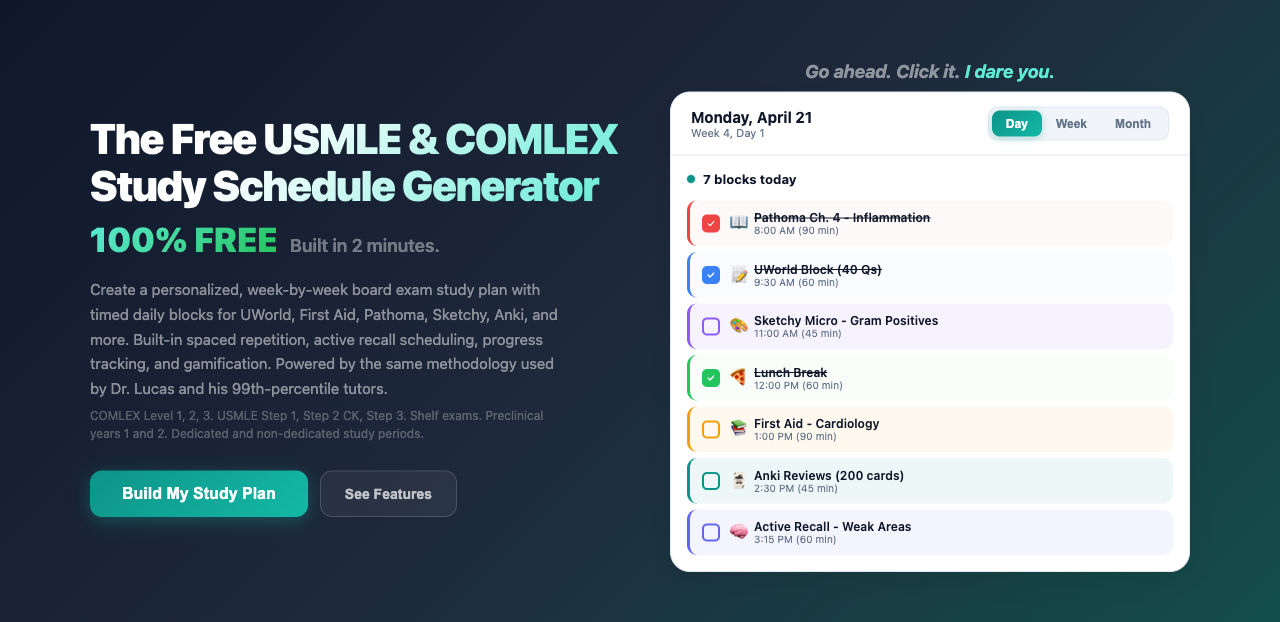
Students who want the day off placed into a real calendar, with practice tests and the day before the exam already mapped, can use the free Study Plan Builder. It builds the week-by-week schedule around your test date and baseline in a few minutes.
What if I miss a study day I didn't plan to miss?
Treat it the same way. You got sick, a family thing came up, or you woke up and genuinely could not sit at a desk. Do your Anki reviews if you can, then come back the next day and run a normal day. One unplanned day off doesn't sink a dedicated period. Trying to make up for it with three 12-hour days might.
On a busy or rough day, the floor is your Anki reviews. Get the reviews done and call it a day. That's fine as long as it isn't every day.
If unplanned days start stacking up, pay attention. Repeatedly being unable to start studying is often burnout or depression, not laziness. Run SIG E CAPS on yourself. If it comes back positive, see a psychiatrist or another psych prescriber. I also recommend that everyone in dedicated see a therapist once a week, or at least every other week. One hour a week won't hurt your score, and it gives you real tools for the stress that builds up anyway. Too many bright minds are lost to depression in medical school.
How does the day off fit into the rest of the week?
The day off is one of three layers that work together. Each study day ends at a fixed time with at least 1 to 2 hours to yourself. Each study block has short breaks between hours, so you're never grinding 12 hours straight. Each week has one full day off. Skip any one layer and the other two carry more load than they can handle.
I learned this the hard way. Through preclinical I studied 16-hour days, cut out the gym and my friends, and lost 20 pounds because I'd convinced myself I didn't have time to cook. I still scored in the 99th percentile on Level 1. The burnout was entrenched enough by then that I never fully recovered from it, and the score didn't fix that. Eight focused hours, a real stopping point, and a day off every week would have gotten me the same score without the damage. The longer version is in how to manage burnout during board prep.
Practice test days are their own thing. A full COMSAE is an 8-hour effort and it replaces your question blocks that day. It doesn't replace your day off. Aim for one practice test every 1 to 2 weeks, and keep the weekly day off on a separate day. For the full daily structure, read how many hours a day you should study during COMLEX dedicated.
Frequently asked questions about taking a day off during COMLEX dedicated
How many days off should I take during COMLEX dedicated?
One full day off every week, plus the day before the exam. In a 6-week dedicated, that's 6 weekly days off and the day before test day. The weekly day off is the floor, not a suggestion. On each one, do your Anki reviews and nothing else. Students who skip the weekly day off rarely see higher scores for the trouble, and they often hit a wall by week 5 or 6 when burnout catches up.
Should I do Anki on my day off?
Yes, reviews only. Missed reviews compound, so skipping a day means the next day's review count balloons and your afternoon Anki blocks can't reach zero. Do the reviews in the morning so they're out of your head, and skip new cards. The rest of the day is for actual rest. No question blocks and no content videos on the day off.
Is it OK to take a day off right before my COMLEX exam?
Yes. The day before the exam should be a full day off. At most, do your Anki reviews in the morning. Don't do new questions, because a bad block the day before can psych you out. Make plans to stay busy, skip caffeine in the afternoon, avoid working out within two hours of bed, and go to bed early. One extra day of studying won't change your outcome. One restful day might.
Will taking a day off a week make me fall behind?
No, if the day off is built into your plan from the start. Your question totals, practice test dates, and test date already account for it, so there is nothing to make up. Students fall behind when they skip the day off, burn out, and lose more than one day of quality studying later. If your scores are flat after 4 to 6 weeks, the fix is the shape of the study day, not a seventh study day.
What should I do the day after a day off?
Run a normal study day. Two timed question blocks at your exam start time, two blocks of review, two blocks of Anki, and a hard stop with at least 1 to 2 hours for yourself. Don't add a third question block to catch up, because two blocks is the practical maximum for real review. Don't extend the day into the night. The day off was planned, so there are no hours to repay.
Can I split my day off into two half days?
The guidance I give students is one full day, not two half days. A half day still keeps board prep switched on, and most students spend the free half thinking about the half they studied. The point of the day off is full disengagement from the exam, with Anki reviews as the only exception. If your week genuinely can't fit a full day, that's a sign the plan needs rebuilding.
Build the day off into your plan before you start
A day off only works if it's scheduled. When it's already on the calendar, alongside your practice tests and the day before your exam, there's nothing to feel guilty about and nothing to make up. Our free Study Plan Builder lays out your whole dedicated around your test date and baseline, with the weekly day off built in, in a few minutes.