
Your COMLEX score report has two halves that matter: the pass/fail decision (or the three-digit scaled score on Level 2-CE) and the performance profile that breaks your result into disciplines, competency domains, and clinical presentation systems. Read the profile from highest-weighted topic to lowest-weighted, because that ranking is exactly how you should pick your next focused blocks. The single most useful fact buried in that report is that MSK and Community Health together make up at least a quarter of the questions. Most students stare at the profile, feel vaguely judged, and learn nothing actionable from it. This guide fixes that.
The reason this matters is that the same report drives two different decisions. If you already passed, the profile tells you where to aim your Level 2-CE prep so you don't repeat the same weak-topic pattern. If you're staring at a COMSAE report during dedicated, the profile tells you which focused blocks to build this week. Either way, the trick is knowing which sections of the report carry real signal and which are statistical noise.
What does a COMLEX score report actually tell you?
A COMLEX score report gives you an overall outcome plus a performance profile. COMLEX Level 1 went pass/fail on May 10, 2022, so a Level 1 report shows you a pass or fail decision rather than a number, while Level 2-CE still reports a three-digit scaled score. Underneath that headline, both reports include a performance profile that splits your result into three views of the same questions: by discipline, by competency domain, and by clinical presentation (system).
Each area in the profile is plotted against a reference group, with a band showing whether you performed below, at, or above the comparison standard, and a confidence interval around that band. The profile is not a second score. It's a diagnostic map. The whole point is to tell you where your knowledge was thin relative to the blueprint, so the order you read it in actually matters. Go highest-weighted topic to lowest-weighted, not top-to-bottom on the page.
One caveat before you over-interpret anything: the NBOME does not publish how heavily it weights each discipline, and it tells you almost everything else. So discipline-level data is the fuzziest part of the report, and the system-level data is the most actionable.
How do you read the discipline breakdown?
The discipline breakdown sorts your performance by subject area (internal medicine, surgery, psychiatry, OMM, and so on). The most important thing to read here isn't the band itself. It's the width of the confidence interval next to it.
A wide confidence interval means there were few questions in that area, so the estimate is noisy and you shouldn't overreact to it. Look at how large the interval is for psychiatry and surgery compared to family medicine. Family medicine is a much higher-yield discipline than either of them, and its tighter interval reflects that there were simply more questions feeding the estimate. A "below average" flag on a topic with only a handful of questions can swing on two unlucky guesses, so treat narrow intervals as real signal and wide intervals as a rumor.
This is also why internal medicine is the discipline most worth your attention. IM encompasses essentially all of adult medicine, which makes it both heavily represented and hard to study directly. You don't beat IM by doing an "IM block." You beat it by doing focused blocks across the individual systems that make up internal medicine, which is the next view of the report.
What do the competency domains mean on a COMLEX report?
The competency domain section is the part of the report most students misread, because most of it is statistical filler. Here's what each row is really telling you:
- The top row is your OMM score, which represents roughly 10% to 12% of the exam. OMM is specific, learnable, and reliably tested, so a weak OMM band is one of the few competency-domain flags worth acting on directly.
- The interpersonal and communication rows describe your ethics, jurisprudence, and communication questions, which together account for about 6% of the exam.
- Everything else in this section is regurgitated overlap from other areas. It's made-up fairy dust, the same questions re-sorted into a different bucket, and it carries no new study signal.
So read the competency domains for exactly two things: your OMM band and your ethics/communication band. If you scored poorly on OMM, that's a genuine, fixable gap. If the report flags some abstract "patient care" or "medical knowledge" competency, ignore it. It isn't pointing at a body of content you can go study. The competency domains exist for accreditation framing, not for your study plan.
Which clinical presentation systems are weighted highest?
The clinical presentation (systems) view is the most actionable section of the entire report, because the NBOME effectively tells you the weighting here. Two systems dominate, and most students underweight both.
| Clinical presentation system | Approximate share of the exam | Why it matters |
|---|---|---|
| Musculoskeletal (MSK) | 13% | The single largest system. Overlaps with OMM, so studying one props up the other. |
| Community Health | 12% | Ethics/jurisprudence, biostats, USPSTF guidelines, milestones, vaccine schedules, the stuff students avoid. |
| Neuro | ~10% | High-yield, learnable patterns. |
| Circulatory/Hematologic (cardio + heme/onc) | ~10% | Combine with related systems for efficient blocks. |
| Respiratory | ~10% | Pairs naturally with circ/heme for mixed blocks. |
| Gastrointestinal | ~10% | Steady, predictable yield. |
| Everything else | ~5% each | Real, but lower priority than the systems above. |
MSK at 13% and Community Health at 12% together make up at least one in four questions on test day. That's the headline almost everyone misses. Community Health in particular is the bucket of material students hate the most: biostatistics, USPSTF screening guidelines, developmental milestones, vaccine schedules, ethics, and jurisprudence. It's boring, it's memorization-heavy, and it's worth more points than any individual organ system you're stressing about.
MSK is the other quiet giant, and it has a hidden bonus. Because MSK overlaps heavily with OMM, time you spend on one tends to lift the other. If your report flags both MSK and OMM, you've found your single highest-leverage study target on the whole exam.
After those two, the 10%-ish systems (neuro, circulatory/hematologic, respiratory, and GI) are where you spend the bulk of your remaining focused-block time. Everything else sits around 5% and gets cleaned up with mixed blocks, not dedicated focused blocks.
How do you turn a score report into a study plan?
You translate the report into a ranked list of focused blocks, weakest high-weight topics first. The profile told you where you're thin. Your job is to attack those gaps in priority order, weighting by how much of the exam each topic represents rather than by how bad the band looked.
Here's the framework I use with 1-on-1 students, straight off a real score report:
- Lead with OMM/OPP. It's a large, specific, and easy-to-study slice of the exam. Do 4 to 6 focused blocks of about 44 questions in TrueLearn or COMQUEST. (OMM and MSK questions tend to be better in COMQUEST than UWorld.)
- Hit MSK and Neuro together. Combined, they're roughly 23% of the test. Run 4 to 6 combined focused blocks so you don't reflexively pick the "MSK answer" just because you know it's an MSK block.
- Combine Circ/Heme and Respiratory. Around 20% of the test together. Do 4 to 6 mixed blocks rather than isolating each system.
- Add GI and Reproductive. Roughly 15% combined. 3 to 5 focused blocks here.
Notice that you combine similar systems on purpose. If you only ever do single-system blocks, you start pattern-matching to the block topic instead of actually reading the stem, and that habit falls apart on a mixed test day. For disciplines, plan 4 to 6 blocks of 44 questions in total (not per day); for systems, 3 to 6. Start at the low end of each range and add more only if you're scoring well below average on those blocks.
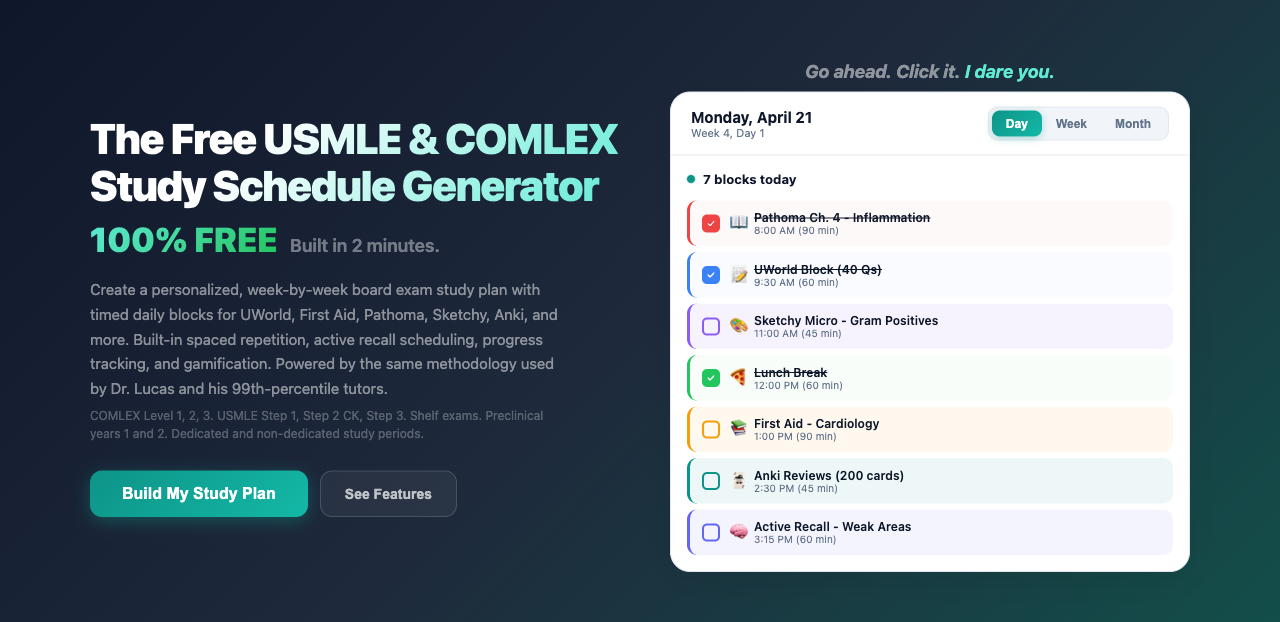
If you'd rather not do the count-back math and block selection by hand, the free Premeducated Study Plan Builder turns your weak topics, test date, and baseline into this exact focused-block plan in a few minutes. As you work each block, tie your Anki review to the questions you just missed rather than shuffling random cards.
How is COMLEX scored, and when do you get your report?
Each COMLEX level is scored on a 10 to 999 scale, with a mean around 500 and a standard deviation of about 85. Passing is 400 for Level 1 and Level 2-CE, and 350 for Level 3. Because Level 1 is now pass/fail, that 400 threshold still exists under the hood even though your report just shows a pass or fail. A score near 530 is roughly average, and scores above about 600 land in the top quartile on the levels that still report a number.
The scale is normed against everyone who took your exam form, so there's no fixed number of correct answers required to pass. You just have to clear the bottom 5% to 9% of test takers (the exact cutoff varies by form). There's no penalty for guessing, so answer every single question. That last point sounds obvious until you're watching the clock bleed out in block 8.
Score release timing is the other thing students obsess over. COMLEX score releases land anywhere from 1.5 to 12 weeks after you test, with Level 1 and Level 2-CE usually closer to 2 to 4 weeks and Level 3 on the long end. Releases are scattered through the day but tend to post around noon. You can check the posted release schedule on the NBOME website. If you're waiting on a COMAT or shelf instead, no news is usually good news: schools tend to notify failures within a couple of days, while a passing score can take up to a week to surface.
If your most recent report came from a COMSAE during dedicated rather than the real thing, the same reading rules apply, and the number itself tells you whether you're on track. A good COMSAE score is its own conversation, but the performance profile underneath it gets interpreted exactly the way described above.
Frequently asked questions about COMLEX score reports
Does the COMLEX Level 1 score report show a number?
No. COMLEX Level 1 has been pass/fail since May 10, 2022, so the report shows a pass or fail outcome rather than a three-digit score. The underlying scaled passing standard is still 400, but you won't see your number. You will still get a performance profile breaking your result into disciplines, competency domains, and clinical presentation systems, and that profile is the part worth studying. If you want a number to track your progress, that comes from your COMSAEs during dedicated, not from the Level 1 report itself.
What is the most heavily weighted topic on COMLEX?
Musculoskeletal (MSK) is the single most heavily weighted clinical presentation system at about 13% of the exam, followed closely by Community Health at about 12%. Together those two account for at least a quarter of the questions on test day. MSK also overlaps with OMM, which is another 10% to 12% of the exam, so the MSK/OMM cluster is the highest-leverage content area on the entire test. Most students underweight all three.
What do the confidence intervals on a COMLEX score report mean?
The confidence interval shows how reliable each band is. A wide interval means there were few questions in that area, so the estimate is noisy and shouldn't drive big study decisions. A narrow interval (you'll see this on high-volume disciplines like family medicine) means more questions fed the estimate, so it's more trustworthy. Compare the wide intervals on psychiatry and surgery to the tight one on family medicine. React to the narrow bands and treat the wide ones as rumors.
Why do most of the competency domains not matter?
Most competency domain rows are statistical filler, not separate content areas. The only two rows that carry real study signal are your OMM band (roughly 10% to 12% of the exam) and your combined ethics, jurisprudence, and communication band (about 6%). The remaining domains are the same questions re-sorted into accreditation buckets, so a flag there doesn't point at any body of content you can go study. Read the competency section for OMM and ethics, then move on.
How do I use my score report to build a study plan?
Rank your weak areas by how much of the exam they represent, then attack them with focused question blocks in that order. Start with OMM/OPP, then combined MSK/Neuro, then Circ/Heme/Resp, then GI/Repro, combining similar systems so you don't pattern-match to the block topic. Plan 4 to 6 blocks of about 44 questions for disciplines and 3 to 6 for systems, starting at the low end and adding more only where you're well below average. The Study Plan Builder automates this from your test date and weak topics.
How long does it take to get a COMLEX score report?
COMLEX scores are released between 1.5 and 12 weeks after the exam. Level 1 and Level 2-CE usually post closer to 2 to 4 weeks, while Level 3 tends to take the longest, sometimes up to three months if you test in a slow season. Releases happen throughout the day but typically post around noon, and the current schedule is published on the NBOME website. COMAT and shelf results move faster: schools often flag a failure within a couple of days, while a passing score can take up to a week to appear.
Turn your score report into a focused-block plan in minutes
The most useful thing your score report gives you is a ranked list of weak, high-weight topics. The free Premeducated Study Plan Builder takes that list, your test date, and your baseline and builds the exact focused-block schedule Dr. Lucas uses with 1-on-1 students. Free, no upgrade required.
Related guides and video resources
- What is a good COMSAE score for COMLEX Level 1?
- How does pass/fail Level 1 affect Level 2 strategy?
- How long should I study for COMLEX Level 1?
- How to use Anki effectively for COMLEX
- Doctor Lucas DO on YouTube: score report walkthroughs, focused-block selection, and COMSAE interpretation videos