
After a low COMSAE, don't rebuild your whole plan. Turn the score report into three or four focused-block groups ranked by exam weight, run 4 to 6 timed blocks per group, and schedule your next practice test about two weeks out as a checkpoint. Your test date decision waits until that checkpoint, and it should rest on your two most recent practice scores, your question-bank percentile trend, and your headspace. A score below 400 is a signal to change what you study, not to study more hours.
The panic move after a bad COMSAE is to buy a new resource, start a content review course from page one, and push study days to 12 or 13 hours. That plan spreads your time evenly across the whole exam, which is exactly the wrong shape. The low score already told you where the points are leaking. The plan's job is to put most of your question time there, then measure whether it worked.
What counts as a low COMSAE score?
For COMLEX Level 1, a COMSAE under 400 is low, because 400 is the passing score on the real exam. The 2025 NBOME poster found that a COMSAE above 400 corresponds to a 94% chance of passing. The target I give students is 450 or higher, and ideally 500 or higher, since that cushion absorbs a bad form or a bad morning on test day.
Scores between 400 and 450 sit in a gray zone. You're likely on track, but one score in that range is not enough evidence to walk into the exam with confidence. Treat it the same way you would treat a score below 400 for planning purposes: find the weak, high-weight areas and target them.
Two cautions before you trust the number. First, purchasable COMSAEs (107, 110, and 111 for Level 1) are notoriously variable against real COMLEX results, so one form can come in low for reasons that have nothing to do with your knowledge. Second, a score from a COMSAE you'd already taken is inflated by familiarity. If your earlier "good" score came from a repeated form, the new low score may simply be your true baseline.
Also check whether you finished on time. Unanswered questions get scored as wrong, and on the score report they look like content gaps. If you ran out of time on two or more sections, part of your plan has to be timed question blocks, not just content.
Why shouldn't you rebuild your whole plan after one low score?
One practice test is a single data point with a wide error bar. Rebuilding everything around it throws away the parts of your routine that are working and replaces them with untested changes, all with a test date approaching.
What the score report gives you is more useful than the headline number. It shows which disciplines and systems are dragging you down, and the NBOME tells you roughly how much each system is worth. That combination lets you change the 20% to 30% of your plan that matters and leave the rest alone.
Your daily structure (timed blocks in the morning, thorough review, daily Anki, one day off a week) should survive a low score. What changes is which questions go into those morning blocks.
How do I read my COMSAE score report to build the plan?
Read the report from highest-weighted area to lowest-weighted area, and ignore the sections that don't point at studyable content. The goal is a short list of three or four weak areas that are also worth a lot of points on test day.
Start with the clinical presentation systems
This is the most actionable part of the report because the weights are public. MSK is about 13% of the exam and Community Health is about 12%. Together those two make up at least one in four questions on test day. Community Health is the bucket students avoid: biostatistics, ethics and jurisprudence, USPSTF screening guidelines, developmental milestones, and vaccine schedules.
Next come the roughly 10% systems: neuro, circulatory and hematologic (cardio plus heme/onc), respiratory, and GI. Everything else sits around 5% each. A weak MSK band is worth far more of your time than a weak endocrine band.
Then check two rows in the competency domains
The top row is your OMM score, which is about 10% to 12% of the exam. The interpersonal and communication rows describe ethics, jurisprudence, and communication questions, about 6% combined. The rest of the competency domains are overlap re-sorted from other areas, and they don't point at anything you can study.
Read the disciplines with the confidence intervals in mind
A wide confidence interval means few questions fed that estimate. Psychiatry and surgery usually carry wide intervals compared with family medicine, which is much higher yield. A "below average" flag on a wide interval can swing on two guesses, so trust the narrow ones.
Internal medicine deserves a note. It covers essentially all of adult medicine, which makes it heavily tested and hard to target directly. You don't fix IM with "IM blocks." You fix it with focused blocks on the systems that make up IM.
For a full walkthrough of each section, see how to interpret your COMLEX score report.
How many focused blocks should the plan include?
Pick three or four weak areas that are also high weight, then assign each one a fixed number of timed blocks. Use 4 to 6 blocks total per weak discipline and 3 to 6 blocks total per weak system, starting at the low end and adding more only if you're still well below average on those blocks.
That cap is the point. Focused blocks are a limited tool with a finish line, not a new permanent way of studying. Once you've worked through them, you switch to mixed blocks, because the real exam is mixed.
Combine similar systems into one block
Don't run a pure cardio block if you can avoid it. When you know every question is cardio, you pick the cardio answer by default, and the block overestimates what you know. If circulatory/heme and respiratory both came back low, build combined circ/heme/resp blocks instead.
Here is the shape of a focused-block list built from a real student's score report in my curriculum:
- OPP: 4 to 6 blocks in TrueLearn or COMQUEST
- MSK and neuro: about 23% of the exam, 4 to 6 blocks in any bank
- Circ/heme and respiratory: worth about 20% of the exam, 4 to 6 blocks in any bank
- GI and reproductive: 3 to 5 blocks (about 15% of the exam)
Notice there's only one discipline on that list. OPP is specific and easy to study for, so it earns its own blocks. Internal medicine gets handled through the system blocks.
The arithmetic keeps this plan short. Four groups at 4 to 6 blocks each comes to 16 to 24 blocks. At two timed blocks per day, that's roughly 8 to 12 study days of focused work before you move to mixed blocks. The full method lives in how to pick focused question blocks based on weak areas.
Which bank should the focused blocks come from?
Run focused blocks in UWorld, except OMM and MSK, which go in COMQUEST. TrueLearn is still the closest thing we have to COMLEX style, and if you've already finished TrueLearn and you're scoring above average consistently, move to a different bank rather than repeating questions you remember.
What does a study day look like after a low COMSAE?
The day stays the same eight 1-hour blocks that mirror the post-May-2026 COMLEX format (eight 1-hour sections of 40 questions). Only the content of the morning blocks changes.
- 8:00 to 9:00 AM: Timed block 1, 40 questions, focused block from your list
- 9:05 to 10:05 AM: Timed block 2, 40 questions, back to back with the first
- 10:10 AM to 12:15 PM: Review of block 1, in two 1-hour blocks with a 5-minute break
- 12:15 to 12:45 PM: 30-minute lunch
- 12:45 to 2:50 PM: Review of block 2, in two 1-hour blocks with a 5-minute break
- 2:55 to 5:00 PM: Anki until new, learning, and review cards all hit zero
- Optional 5:00 to 6 or 7 PM: 1 to 2 hours of content video on whatever felt shakiest that morning, unsuspending up to 10 related Anki cards per video
That's 2 hours of timed questions, 4 hours of review, and 2 hours of Anki. Review takes the biggest share because a thorough review of one 40-question block takes most students about 2 hours. Take one day off per week, with Anki reviews only and no questions.
Every block runs timed. Tutor mode feels productive after a low score because you get more right, but test day isn't in tutor mode, and students who train untimed run into timing problems on the real exam.
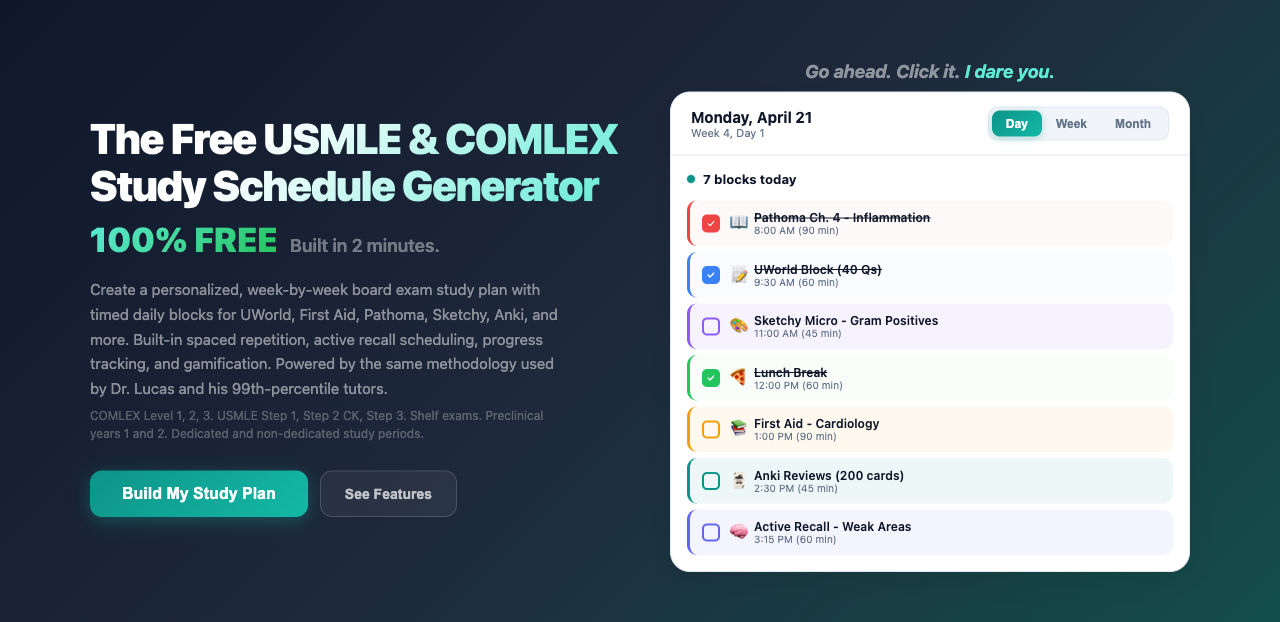
Mapping all of this to your exact test date and weak areas by hand takes a while, so the free Study Plan Builder generates the schedule and the focused-block order from your baseline.
When should I take the next practice test?
Take the next practice test about two weeks after the low one. In my experience, two-week intervals are where students see meaningful movement, so a retest after three days mostly measures noise. The general rule is one practice test every two weeks at minimum, plus two tests in the final two weeks before your exam.
Protect your unused COMSAEs for the end
Count how many practice tests you have left and how many weeks remain. If you're short, repeat a COMSAE you've already used early in the plan and save the unused forms for the last two weeks, since those are the scores your date decision depends on.
When unused COMSAEs are scarce, a workable order is the retail TrueLearn self-assessment and the two COMQUEST self-assessments first, then used COMSAEs, then unused COMSAEs. Try to keep two tests in reserve for the very end.
Read the other practice tests correctly
On the TrueLearn self-assessment, ignore the three-digit score and the "chance of passing" estimate, which almost always lands between 45% and 55%. Look only at the percentile. Above the 40th percentile is a strong result, and passing the real exam takes roughly the 5th to 9th percentile depending on the form. The COMQUEST self-assessments tend to overpredict, so don't let a high CQSA alone settle anything.
Between practice tests, watch your bank percentile too. TrueLearn shows your percentile over your last 100 questions. A useful check is 100 mixed questions, record the percentile, repeat two or three times, and average the results. For more on spacing, see how many practice tests should I take before COMLEX.
How do I decide whether to keep my COMLEX date?
Decide at the checkpoint, not the night of the low score. The clearest green light is two practice scores above 450 in the last two weeks before your exam. Consistency above 400 with high confidence is a reasonable minimum, but it carries more risk.
I weigh six inputs before telling a student to keep or move a date:
- Practice test trend: are your scores rising over time, or stuck on a plateau?
- Your two most recent scores: are both above 400, and ideally above 450?
- Bank performance over time: is your question-bank score or percentile moving up and to the right?
- Recent bank performance: what does your last 100 to 300 mixed questions say?
- Rotation schedule or leave of absence: studying around a rotation slows progress, while an LOA may delay graduation and pause loan disbursements.
- Headspace: do you feel more confident than when you started, and do you have a history of underperforming your practice tests on standardized exams?
The sixth input can override the other five. If you've had bad news recently, such as a loved one falling ill or dying, don't test. Too many students have failed shortly after news like that.
If you have to move the date, postpone 2 to 4 weeks at a time and keep the same focused-block plan running. Students retaking after a failed attempt should also build in a buffer. If your last COMSAE was about 50 points above your real COMLEX score, aim to score at least 50 points higher on your final COMSAE this time. The full framework is in should I postpone my COMLEX exam.
Frequently asked questions about a low COMSAE study plan
What should I do the first day after a low COMSAE?
Read the score report before you change anything. Confirm the form was unused and that you finished every section on time. Then rank the weak areas by exam weight, starting with MSK (about 13%), Community Health (about 12%), and OMM (about 10% to 12%). Pick three or four high-weight weak areas and assign each 4 to 6 timed focused blocks. Keep your daily structure, your Anki, and your day off exactly as they were.
Is a COMSAE under 400 a reason to postpone right away?
Not by itself. A single score is one data point, and purchasable COMSAE forms vary a lot against the real exam. Run your focused blocks for about two weeks and take the next practice test as a checkpoint. If your two most recent scores still sit below 400 and your bank percentile isn't climbing, postponing 2 to 4 weeks becomes the safer choice. Bad news in your personal life is the exception: in that case, don't test.
How many focused blocks should I do after a low COMSAE?
Use 4 to 6 blocks total per weak discipline and 3 to 6 blocks total per weak system, not per day. Start at the low end and add blocks only if you're still well below average on them. Combine related systems, such as circ/heme with respiratory, so you can't guess the topic from the block label. Four weak areas at that rate comes to about 16 to 24 blocks, or 8 to 12 days at two blocks per day.
Should I go back to content review after a bad COMSAE?
Usually not as your main activity. For most students, the bulk of content learning should come from thorough review of timed question blocks, with 1 to 2 hours of content video saved for the end of the day on whatever felt weakest that morning. A content-review-first approach helps a minority of students, but switching to it after one low score takes question time away from the areas the report flagged.
How long until my COMSAE score goes up?
Meaningful progress usually shows up in two-week intervals, which is why the next practice test belongs about two weeks after the low one. Progress can also look like compound interest. Not much seems to change at first, then scores move more noticeably toward the end. Track your bank percentile between tests so you can see movement before the next COMSAE confirms it.
Turn your COMSAE score report into a schedule
The free Premeducated Study Plan Builder takes your test date, your baseline score, and your weak disciplines and systems, then lays out the focused blocks, the daily schedule, and the practice-test checkpoints for you. It uses the same logic Dr. Lucas uses with 1-on-1 students, and it's free with no upgrade required.