
COMLEX is rolling out a major format refresh between May 2026 and January 2027. Level 1 and Level 2-CE drop from 352 to 320 questions in eight 1-hour blocks of 40, with total seated time held at about eight hours and roughly 90 seconds per question. Level 3 collapses from a two-day exam to a one-day exam, targeted for January 2027. The COMLEX-USA Blueprint isn't changing, which means content and topic mix stay the same. The shift is structural: fewer questions, more time per question, and one less day at the testing center for Level 3 candidates.
If you're a DO student or resident who hasn't finished all three levels, these changes affect you. This guide breaks down what NBOME actually announced, when each format flips, what it means for your block timing and your TrueLearn practice, and how to think about whether to push your test date.
What is changing about COMLEX in 2026 and 2027?
On December 13, 2024, the NBOME Board of Directors approved a set of structural updates to all three COMLEX levels. The headline change is fewer questions per exam, with proportional adjustments to block size and per-question time. The COMLEX-USA Blueprint, which governs content distribution across competency domains and clinical presentations, is unchanged. What you study does not change. How long you sit and how many questions you answer does.
Here is the short version:
- Level 1: 352 questions becomes 320 questions, in eight 1-hour blocks of 40 questions each. Total seated time stays at about 8 hours. Target rollout: May 2026.
- Level 2-CE: same drop from 352 to 320 questions, same eight blocks of 40, same total seated time. Target rollout: June 2026.
- Level 3: two-day exam collapses to a one-day exam. Question count and CDM case count have not been fully detailed by NBOME beyond a "similar proportion" of multiple-choice to clinical-decision-making cases. Target rollout: January 2027.
Per-question time math: at 320 questions across roughly 480 minutes of seated test time (8 hours), each question gets about 90 seconds instead of the previous 82 seconds. That's an extra 8 seconds per question, or roughly 44 extra minutes of buffer time spread across the full exam. The breaks logic stays familiar: short breaks scheduled between every block and a longer break for lunch in the middle, totaling about 60 minutes of optional break time across the day.
When does each new format roll out?
The rollout is staggered across three target dates. Use these to plan around your test window.
| Level | Old format | New format | Target rollout |
|---|---|---|---|
| Level 1 | 352 questions, 8 blocks of 44 | 320 questions, 8 blocks of 40 | Already Completed |
| Level 2-CE | 352 questions, 8 blocks of 44 | 320 questions, 8 blocks of 40 | First Test Date In June 2026 |
| Level 3 | Two-day exam, ~420 MCQs + 26 CDM cases | One-day exam, similar MCQ-to-CDM proportions | January 2027 |
NBOME has called these "enhancements" and aligned them with the existing COMLEX-USA Blueprint. As of mid-2026, Level 1 candidates are testing under the new format, Level 2-CE candidates are right at the rollout window, and Level 3 candidates have an additional six to eight months before the one-day change goes live.
What changes for COMLEX Level 1 and Level 2-CE?
The structural changes for Level 1 and Level 2-CE are mechanically identical. Both exams drop from 352 to 320 questions and reorganize from eight 44-question blocks into eight 40-question blocks. Total seated time stays at about 8 hours. The content blueprint stays untouched.
What that gets you on test day is more breathing room. With 32 fewer questions and the same seated time, the per-question budget rises from about 82 to about 90 seconds. Less mental fatigue across the back half of the exam matters more than the math probably suggests on paper. Mental stamina is the resource that runs out fastest in dedicated, and giving you one fewer block-equivalent of stamina drain is a real edge.
A subtle tradeoff is hiding inside the change. Fewer questions also means each question carries a slightly higher share of your final scaled score. If your historical pattern has been "I rely on getting lucky on the last 10 to 15 questions per exam," that statistical buffer just got a little tighter. If you're actually prepared and reading stems carefully, this is a structural win.
What changes for COMLEX Level 3?
Level 3 is the biggest structural change of the three. The current format is a two-day exam: Day 1 is four blocks of 70 multiple-choice questions, Day 2 is two clinical-decision-making (CDM) blocks (26 cases total) plus two more 70-question multiple-choice blocks. Total: roughly 420 multiple-choice questions and 26 CDM cases across two days, with three-and-a-half-hour blocks and limited rest in between.
Starting January 2027, that condenses into a single day. NBOME has confirmed the change but has been light on specifics about the exact question count and CDM case count in the new format. Their language is that the new exam will preserve a "similar proportion" of multiple-choice questions to CDM cases. The widely circulated expectation, not yet officially confirmed, is that something close to 210 multiple-choice questions and 13 CDM cases lands in one day. NBOME has not published a final blueprint as of the rollout target, so treat the specific count as an estimate and not a guarantee.
A few real-world implications:
- One day at the testing center instead of two. For residents who have to travel to a regional testing center, this is a meaningful logistical win.
- Single test-day routine to prepare for, instead of two consecutive test-day routines with hotel logistics in between.
- A condensed scoring pool. With fewer questions per candidate, expect more score volatility in the first one to two test cycles after the change, until NBOME's scoring model calibrates to the new format.
If you're scheduled for Level 3 in late 2026 under the two-day format and you have flexibility, the calculus might favor pushing to early 2027. If you're already locked into a Q4 2026 date or your residency timeline is tight, just get it done under the format you're prepared for.
How do the new block size and timing affect your study plan?
The new block size and per-question time should change how you practice. Three concrete adjustments matter.
1. Practice in 40-question blocks if your exam is after the rollout. This is the single most underrated change. UWorld and TrueLearn default to 44-question blocks for COMLEX practice. After the format flip, the real exam is 40 questions per block. Match the practice to the test. A 40-question block trained at 90 seconds per question is what your stamina and pacing need to be calibrated for.
2. Use 90 seconds per question as your pacing benchmark. The new per-question time is roughly 90 seconds (1.5 minutes), so a 40-question block runs about 60 minutes. Train your timing on that exact pace. If you finish a 40-question block in under 50 minutes, you're probably rushing; if you blow through 60 minutes and have stems unread, you're losing points to pacing rather than to content.
3. Plan your in-exam breaks for the same total budget. NBOME's break logic across Level 1 and Level 2-CE still allows for short optional breaks between blocks, with a longer lunch break in the middle of the exam, totaling roughly 60 minutes of break time across the day. Use the structured break logic during your full-length practice tests too. Standing up, eating, hydrating, and resetting between blocks is a learned skill, and you have to rehearse it before test day so it doesn't burn brain capacity in the moment.
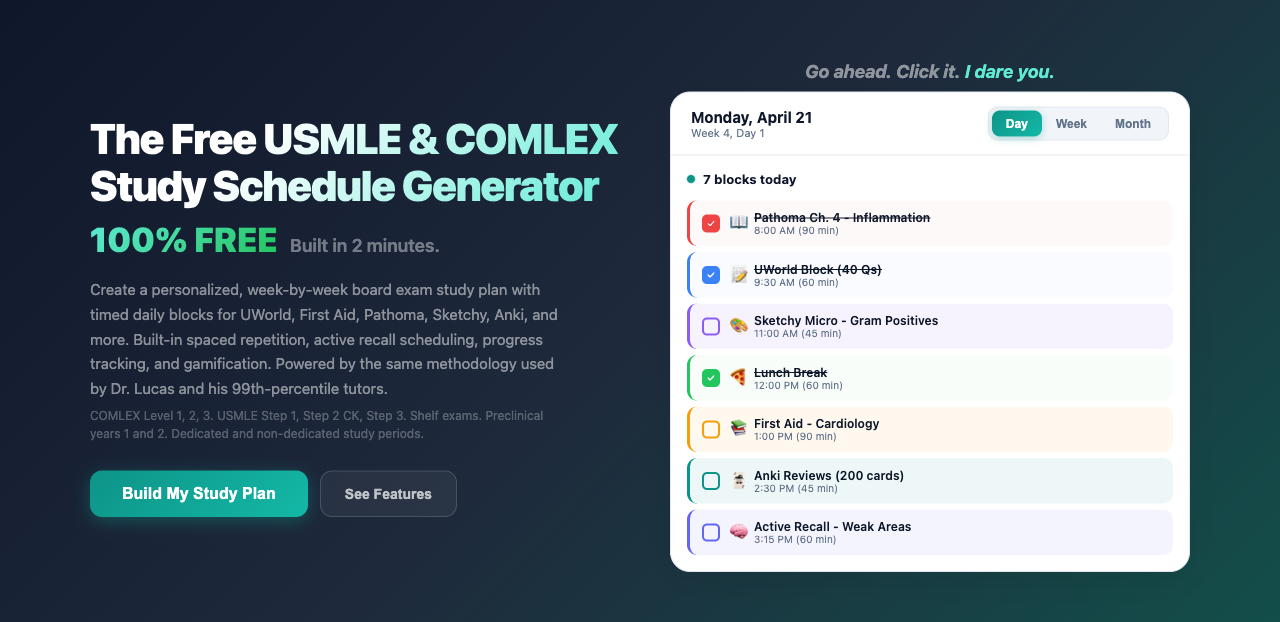
If you'd rather not stitch all of this into your own calendar by hand, the free Premeducated Study Plan Builder generates a personalized schedule that already accounts for the new block size, the new per-question time, and the test-day break pattern.
What does the TrueLearn timing mismatch mean for current students?
There's a real trap for students who are sitting for COMLEX in the awkward transition window. TrueLearn switched its default timer to 90 seconds per question several months ahead of the actual exam format change. If your test date is before the rollout for your level, the TrueLearn timer is giving you more time per question than the real exam will.
Here is the math: a 44-question TrueLearn block at 90 seconds per question is 66 minutes. A 44-question block on the old COMLEX format was about 60 minutes. So if you're practicing on TrueLearn and finishing right at the timer, you would be roughly six minutes short on the real (old-format) exam. That's a recipe for unfinished blocks and unforced losses.
The fix if you're testing before your level's rollout:
- Set your own block timer to 60 minutes for a 44-question block, regardless of what TrueLearn shows.
- Or use the TrueLearn timer as a soft reference but make a hard rule: finish 44 questions by the 60-minute mark.
- Confirm which format you'll actually sit for. Your test date relative to the rollout dictates which format you're in, and NBOME publishes your scheduled exam form details in your candidate confirmation.
If you're testing after the rollout for your level, the TrueLearn 90-second timer matches the real exam. You just need to switch your practice blocks from 44 to 40 questions to match the new block size.
Should you delay your exam to get the new format?
This is the most common question I'm getting from students right now, and the honest answer depends on which level we're talking about.
For Level 1 and Level 2-CE. The new format is objectively easier from a timing and fatigue perspective. More time per question, fewer questions per block, less cumulative mental drain. None of those changes are going to be the single thing that defines whether you pass for most students. If your study plan is solid and your practice scores are tracking toward a pass, the format flip is a small bonus, not a reason to delay. I wouldn't postpone a planned test date by more than about a month just to catch the new format. Studying for an extra month tends to accumulate more burnout than score gain.
For Level 3. The calculus is different. Going from two days at a regional testing center to one day is a meaningful quality-of-life improvement, especially for residents balancing on-service weeks. If your original Level 3 timeline lands within a couple months of the January 2027 rollout, waiting can make sense. If you're already prepared and scheduled under the two-day format, the safer move is usually to take the format you've trained for. The first one to two cycles under the new one-day Level 3 will probably have unusual scoring behavior while NBOME's psychometricians recalibrate to the smaller per-candidate sample size.
In general, students who fail board exams don't fail because of format. They fail because of study-system gaps. If you're trying to figure out whether you should postpone, the most useful tool is the Premeducated Postpone Calculator, which weighs your last two practice scores, your trend, your question-bank percentile, and several other inputs to give you a real recommendation instead of a vibe.
Frequently asked questions about the COMLEX 2026 format changes
Does the content blueprint for COMLEX change in 2026?
No. NBOME has been explicit that the new formats are aligned with the existing COMLEX-USA Blueprint. The content distribution across competency domains, clinical presentations, and disciplines does not change. Same topics, same OMM weighting, same emphasis on osteopathic principles. If you've built a study plan around the existing blueprint, it still works. The structural changes are about block size, per-question time, and Level 3's collapse to one day, not about what you need to know.
Does the COMLEX passing score change with the new format?
NBOME has not announced a change to the passing score (still 400 for Level 1 and Level 2-CE, 350 for Level 3). The scaled-score system absorbs format changes by recalibrating difficulty curves to maintain historical pass-rate benchmarks. Expect roughly stable pass rates across the transition, with the caveat that the first one to two cycles under the new formats may show slightly more score variability while psychometric models adjust to the smaller per-candidate sample size.
Will the COMLEX 2026 changes make the exam easier?
Not in any meaningful way. More time per question and fewer total questions reduce fatigue and pacing pressure, which helps students who were losing points to time management. Actual content difficulty isn't changing. Students who pass the new format will pass for the same reasons students have always passed: a reliable question approach, real understanding of high-yield content, and stamina trained through full-length practice tests. The format flip is not a substitute for a working study system.
Should I take COMLEX before or after the format change?
Take it when you're ready, not based on the format. For Level 1 and Level 2-CE, the new format is slightly friendlier on timing, but the difference isn't large enough to justify postponing a test date you're prepared for. With Level 3, the one-day format is a meaningful logistical improvement, and if your timeline naturally lands in 2027 anyway, waiting for the one-day exam is reasonable. Postponing more than a month or two to chase the format usually costs more in burnout than it gains in score.
How does the new COMLEX block timing compare to USMLE?
USMLE Step 1 currently runs seven 1-hour blocks of 40 questions each (280 total), with about 90 seconds per question. The new COMLEX Level 1 format runs eight 1-hour blocks of 40 questions (320 total) at the same 90-second-per-question pace. The two exams are now much closer structurally. For DO students sitting both COMLEX and USMLE, this means block-level practice timing translates more cleanly between the two exams than it used to. You still have one extra block on COMLEX and the OMM content layer, but the in-block pacing is now nearly identical.
Has NBOME published the exact Level 3 one-day question count yet?
As of the rollout target, NBOME has confirmed the move to a single day and stated that the new exam will preserve a "similar proportion" of multiple-choice questions to clinical-decision-making (CDM) cases. They have not officially published the exact MCQ and CDM counts under the new format. The widely circulated estimate (around 210 MCQs and 13 CDM cases in one day) is plausible based on the proportional language but should be treated as an estimate rather than a confirmed number until NBOME publishes the updated bulletin.
Related guides
- How long should I study for COMLEX Level 1?
- When should I start studying for COMLEX Level 1?
- What is a good COMSAE score for COMLEX Level 1?
- What is the difference between COMLEX and USMLE?
- How to study for boards while still in classes
## Get clear answers on the new COMLEX format in the free Skool community The Premeducated free Skool community is where DO students get current, no-paywall guidance on the COMLEX format changes, weekly live office hours with physician tutors, and a full library of practice question breakdowns. If you have format questions, study plan questions, or just want to talk to other students sitting under the same rollout, this is the place. Free to join, no upgrade required. [**Join the free Skool community**](https://skool.com/premeducated?utm\_source=blog&utm\_medium=article&utm\_campaign=comlex-2026-format-changes-what-students-need-to-know)