
No. On test day, reviewing your flagged questions at the end of a COMLEX block is mostly second-guessing without a legitimate reason to change anything. The only time to go back is when a later question gave you information that answers an earlier one. Keep flagging anyway, because that flag is how you find the earlier question fast when that rare cross-reference shows up.
Why does reviewing flagged questions usually cost points?
End-of-block review should really be called "second guessing myself without any legitimate reason to change the answer." That's the honest description of what happens for most students.
Think about what's actually different when you circle back. The stem hasn't changed. The answer choices haven't changed. Your knowledge of the medicine hasn't changed in the last 40 minutes. The only variable that moved is you, and you're more tired and more anxious than the version of you who answered the question the first time.
That's a bad trade. The first pass had your full attention, a fresh read of the objective findings, and a clear diagnosis in mind. The second pass has a ticking clock, a list of questions you already feel shaky about, and a brain that's looking for a reason to worry.
A few specific things go wrong on that second pass:
- Uncertainty gets mistaken for evidence. You flagged the question because you weren't sure. Rereading it doesn't make you more sure, so the doubt feels like a sign the answer is wrong.
- The familiar choice pulls harder. Under pressure, you drift toward the answer you've seen most often in your question bank and then reread the stem to justify it.
- One shiny detail hijacks the picture. A needlestick injury, a travel history, or a family history jumps out on the reread and suddenly outweighs the five clues you already used.
None of that is new reasoning. It's the same question read by a more stressed person, and stress is a terrible tiebreaker. I go deeper into the psychology in how do I stop changing answers on board exams.
When does going back to a flagged question actually help?
Go back only when a later question in the same block handed you the fact you were missing on an earlier one. That's the one situation where returning makes you more accurate, because you're working with information you genuinely didn't have the first time. It's pretty rare, but it does happen.
Here's what a real cross-reference looks like.
Say question 6 describes a patient on an antiepileptic who has developed gingival overgrowth and asks for the drug's mechanism. You couldn't place which antiepileptic causes gingival hyperplasia, so you guessed between two mechanisms and flagged it. Then question 29 is a different patient entirely, but the stem says she takes phenytoin and has gingival hyperplasia on exam. That's your missing link. Phenytoin blocks voltage-gated sodium channels, and now you can fix question 6 with a reason.
Another version: question 12 is a young adult with bilateral hilar lymphadenopathy and noncaseating granulomas, and it asks what lab abnormality you'd expect. You flag it because you can't remember whether sarcoidosis goes with high or low calcium. Question 34 later explains a sarcoidosis patient's hypercalcemia as increased 1-alpha-hydroxylase activity in activated macrophages. That's a direct answer to your earlier gap, so going back is justified.
Notice the pattern in both. The later question didn't just remind you of the topic. It supplied a specific fact that closes the exact gap that made you flag the earlier one.
The test before you change anything
Before you click back, finish this sentence: "Question 29 told me ___, and that answers question 6." If you can fill in the blank with a concrete fact, go back and fix it. If the blank fills with "it made me think about seizure drugs again" or "I just feel less sure now," stay where you are.
A later question on the same organ system doesn't count. A later question that makes you remember you've been guessing a lot doesn't count either. The new information has to change what the earlier question's best answer is, not just how you feel about it.
What about a question you misread?
Catch misreads while you're still on the question, not at the end of the block. The question part (the last sentence) decides what's being asked, and single words flip the right answer. "What's the best initial step?" and "What's the most definitive step?" are completely different questions. OMM items love to hide "activating versus inhibiting" and "sympathetic versus parasympathetic" in that last line.
That's why I read the question part slowly, if not twice, before I commit. My sequence is to read the objective findings (vitals, physical exam, labs, imaging) down through the question part, form a diagnosis or a short differential, try the answer choices, and only reread the stem from the top if I'm still uncertain. That second read is planned, it happens in the moment, and it gives you two passes at the most important information.
Doing it this way means the end-of-block sweep for misreads becomes unnecessary. You already did the careful reread when your head was still inside the question. The full reading method is in what is the best way to study for long COMLEX question stems.
How should you use flags on test day versus practice blocks?
Flagging does two different jobs depending on where you are. On test day it's a bookmark for the rare cross-reference. On practice blocks and practice tests it's a review tool, and it's critical.
On test day
Flag any question you're uncertain about. You won't review them all, and that's the point. The flag exists so that if question 31 gives you the answer to question 8, you can jump back to question 8 in a few seconds instead of scrolling through the block trying to remember which one it was.
Don't treat the flag count as a scoreboard. Flagging a lot of questions in one section feels awful, but it's not evidence that you're failing. It just means the section had a lot of material you weren't certain about, which is true for almost everyone on almost every block.
On practice blocks and practice tests
Flagged questions are your guessed questions: right answer, wrong math. They tell you where to spend review time, because a correct guess is a knowledge gap that happened to land on the right letter.
My review rules treat them exactly like misses:
- If you were correct for the right reasoning, move on.
- If you guessed and were correct, or you were incorrect, focus on the main point.
- Make sure you understand the correct answer and the one you picked. The other choices matter less, and if they're important they'll show up as the main point of a future question.
- Keep it to fewer than 3 Anki cards per incorrect or guessed question, and ideally no new cards for questions you got right for the right reasons.
Without flags, you'd review a correct guess the same way you'd review a question you nailed, which means skipping it. That's how gaps survive all the way to test day. My full workflow is in how to review practice questions efficiently.
What should you do with extra time at the end of a COMLEX section?
Under the current COMLEX format, each section is 40 questions in 1 hour, about 1.5 minutes per question. If you read efficiently, you'll often finish with minutes to spare, and that leftover time is exactly when the urge to reopen every flag hits hardest.
Use it differently:
- Make sure every question has an answer marked. A blank can't earn a point, and a guess can.
- Check whether any flagged question has a real cross-reference. Run the "Question X told me ___" test from above. If nothing qualifies, you're done with the content.
- Reset your headspace for the next section. Slow deep breathing (in for four seconds, hold for two, out for four) or a physiologic sigh (a maximal inhale, a second quick sharp inhale, then a slow exhale) works well between sections.
Then end the section and take your break. Get up, walk, stretch, drink some water, and eat a snack. The minutes you would've spent talking yourself out of right answers are worth more as recovery for the next 40 questions.
Should you look up flagged questions on your break?
That one's personal. Looking up questions on a break might help you on a later section, and it might also spike your anxiety. I chose not to look anything up on my breaks so I wouldn't psych myself out. Some students report it helped them get later questions right. If you know that one wrong answer on your phone will follow you into the next block, leave it alone. Test day logistics and break timing are covered in test day strategy and what to bring to COMLEX.
How do you make fewer flags in the first place?
Commit with a reason the first time. Most flags come from being stuck between two answers, and most unjustified changes come from reopening those same two-answer questions later. Solve the tie in the moment and there's less to second-guess.
The point system is how I break those ties. List your highlighted clues (or pick 2 to 3 key clues plus age, acuity, timeline, laterality, unusual findings, and labs or imaging) and give each one a point. Then score each remaining choice: 1 point if it explains the clue, 0.5 for a maybe, and 0 for a no. The higher total is the one you should feel more comfortable picking. It takes 10 to 20 seconds, so eliminate everything you can first and save it for the final two.
Here's the example I use. A 24-year-old medical student just finished finals, has been skipping meals and sleep, had a needlestick injury, and has high unconjugated bilirubin with normal AST and ALT. Gilbert syndrome scores 4.5 out of 5. Viral hepatitis scores 3 out of 5, because the bilirubin is usually conjugated and the transaminases would typically be in the hundreds to thousands. Gilbert wins.
Now picture that question at the end of the block. The needlestick is exactly the detail that jumps out on a nervous reread and pulls you toward hepatitis. If you already did the tally, you have a written reason for Gilbert, and a reason is the best protection against switching. It still requires knowing the medicine. The full walkthrough is in how do I choose between two answers on COMLEX.
How do you practice the no-review rule before test day?
Build it in timed blocks, the same way you build speed. Test day is the worst place to try a new decision habit for the first time, and tutor mode can't train it because there's no end of block to resist. If timing is a problem for you, timed versus tutor mode explains why timed mode should be your default.
Run every timed block with the same routine:
- Answer each question, using the point system when you're down to two.
- Flag it if you're uncertain.
- At the end of the block, return only to questions where a later item gave you the missing fact.
- Submit.
After a few weeks, the routine stops feeling like a restriction. Your flags become a clean list of guessed questions for review, and your end-of-block minutes turn into a reset instead of a spiral.
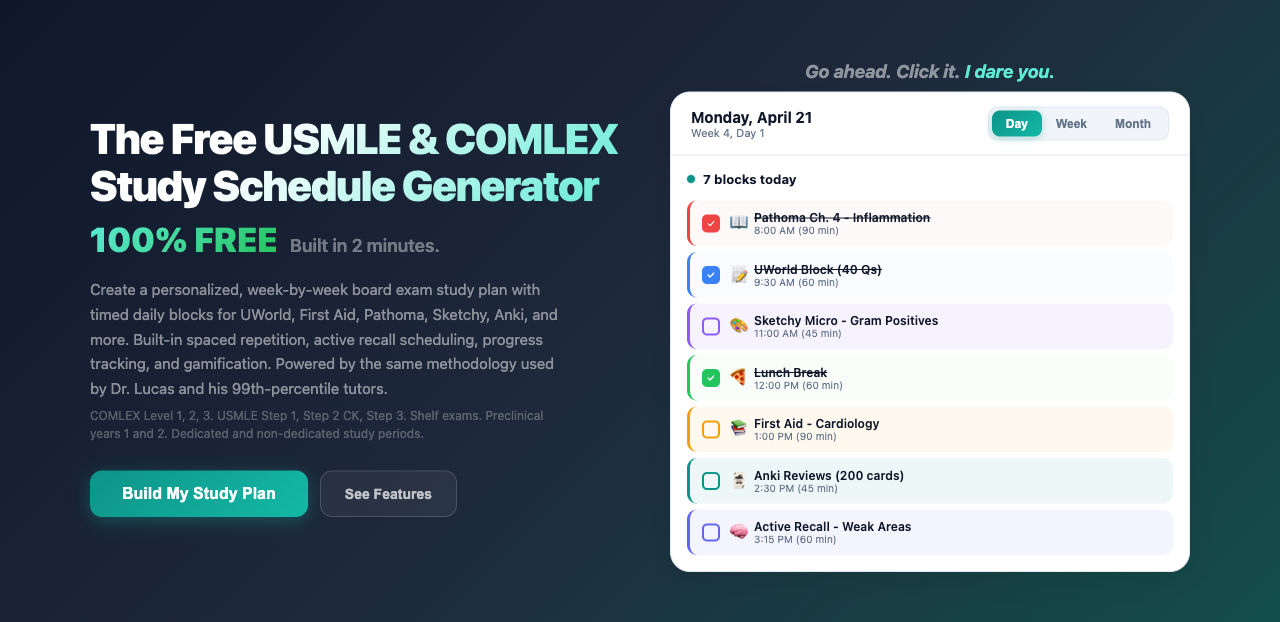
The rule also only sticks with daily reps, which means your question blocks need a fixed place in your schedule. If you don't have that yet, the free Study Plan Builder lays out your dedicated period day by day, including timed question blocks and practice-test checkpoints.
Frequently asked questions about reviewing flagged questions on COMLEX
Should I go back and review flagged questions on COMLEX?
No, not as a routine. Reviewing flagged questions at the end of a block is mostly second-guessing without new information. You're rereading the same stem with a more tired, more anxious brain. The one exception is when a later question in the same block gives you a specific fact that answers an earlier flagged question. Then go back and fix it. Otherwise, leave your answers alone and use the extra time to reset before the next section.
Is flagging questions on COMLEX pointless if I'm not reviewing them?
No. On test day, the flag lets you find an earlier question quickly if a later one supplies the missing fact, which is the one legitimate reason to return. On practice blocks and practice tests, flagging is critical. Flagged questions are your guessed questions, right answer with the wrong math, and they deserve the same review time as the questions you missed.
What counts as new information from a later question?
A specific fact that changes the best answer to the earlier question. If question 29 mentions a patient on phenytoin with gingival hyperplasia, and question 6 asked the mechanism of the antiepileptic causing gingival overgrowth, that's new information. A later question on the same organ system, or one that simply makes you feel less confident, is not. Test it by finishing the sentence "Question X told me ___, and that answers question Y."
What should I do if I finish a COMLEX section early?
Confirm every question has an answer marked, check whether any flagged question has a genuine cross-reference from a later item, and then stop. Use the leftover minutes to reset with slow breathing or a physiologic sigh before your break. Those minutes do more for you as recovery for the next 40 questions than they would as a second pass through questions you already worked.
Should I review flagged questions on practice tests like COMSAE?
During the timed test itself, follow the same rule you'll use on test day, so the habit is already automatic by the real exam. After the practice test, review the flagged questions thoroughly. They mark your guesses, and a correct guess is still a knowledge gap. Focus on the main point, understand both the correct answer and the one you picked, and keep it under 3 Anki cards per guessed or missed question.
Put the flagging rule on a real schedule
The no-review rule only becomes automatic with timed blocks every day. The free Premeducated Study Plan Builder maps your dedicated period into daily question blocks, practice-test checkpoints, and review sessions, so the reps actually happen. It's free and takes a few minutes to set up.